
There is no homeowner version of wiring a three-phase EV charger, and this article does not give one: it explains what a compliant three-phase installation involves, as a professional process, because the wiring itself is licensed electrical work. In outline, a licensed electrician confirms that a three-phase supply reaches the property, designs a dedicated circuit around the charger’s stated input, installs and tests it, and leaves the sign-off paperwork your local rules require. One route needs no wiring at all — a three-phase portable charger that plugs into an existing CEE socket.
Key Takeaways
- Wiring a three-phase charger is a licensed electrician’s process — survey, design, install, test, sign-off — not a DIY procedure.
- Confirm the three-phase supply first; on a single-phase supply a 22 kW charger can never reach its rating.
- A three-phase portable on an existing CEE socket is the one route with no new wiring.
- Cable and breaker figures are calculated for your building and your local rules; they belong to the installer, not a web page.
Start With the Supply, Not the Charger
A three-phase charger can only deliver its rating if three-phase power actually reaches the building. Many homes have a single-phase supply, and no charger changes that. Your network operator or an electrician can confirm which supply your address has; our single-phase vs three-phase explainer sets out the signs. If the supply is single-phase, the honest options are an upgrade arranged through the network operator — their project, quoted and scheduled by them — or a charger sized for the supply you have.
Two Routes: Hardwired or Plug-In
| Route | What “wiring” it needs | Who does the electrical work | It fits when |
|---|---|---|---|
| Hardwired wallbox | A new dedicated three-phase circuit, permanently connected | A licensed electrician, start to finish | The charger stays in one place and charges at full power daily |
| Plug-in portable | None, if a suitable CEE socket already exists; fitting a new socket is still electrical work | An electrician for any new socket; you plug the unit in | A three-phase socket is already on site, or the charger moves between sites |

What the Electrician Works From
The design starts from the charger’s stated input requirements, printed on its listing and in its manual. The EV-ACT3204PE, for example, is specified at 22 kW on a three-phase supply — 32 A per phase at 380–400 V. The electrician combines that fixed load with what varies by building: your supply’s capacity, the run’s length and route, and your local wiring rules. That is why no honest guide can print your cable size or breaker rating — both are calculated for your property, and getting them wrong is a safety issue. The wider sequence sits inside our wallbox installation guide. At process level, the job runs like this:
- Survey and supply confirmation. The electrician checks the supply, the consumer unit and the intended position.
- Circuit design. Cable, protection and earthing are specified for the stated load and the actual run.
- Permission and notification. Whatever permit or network-operator notification your local rules require is handled before work starts.
- Installation. The circuit is run and the charger fixed and connected — the licensed part, done by the electrician.
- Testing and commissioning. The installation is tested, the charger set up, and access features such as RFID or the app configured with you.
- Sign-off. You receive the test and certification records your local rules require.
EVDANCE Three-Phase Options
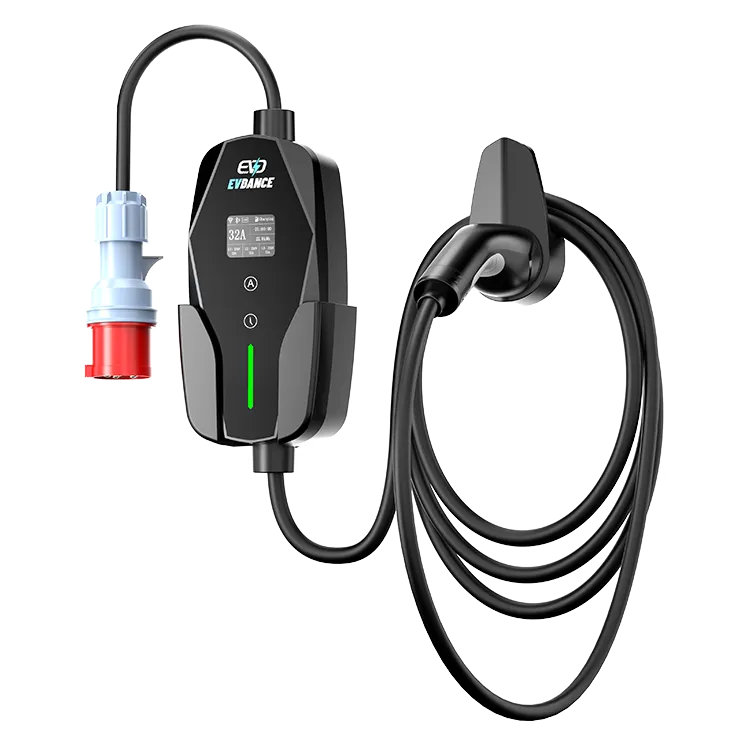
Three stated-fact options cover the two routes. The EV-ACT3204PE is the hardwired wallbox: 22 kW three-phase, tethered Type 2 cable, RFID and app control, IP66, CE. The EV-ACS3205PE is a 22 kW three-phase portable with a CEE 32A five-pin plug, Type 2, IP66 — it needs a suitable socket, not a wiring job. The ACS1605PE is the 11 kW three-phase portable on a CEE 16A plug, 7.6 m cable, IP66. Either way, fixed wiring belongs to a licensed electrician working to your local rules.
Frequently Asked Questions
Can I wire a three-phase charger myself?
No. A hardwired three-phase charger is fixed electrical work: it needs a licensed electrician for the design, the installation and the certification your local rules require. This article deliberately contains no wiring steps, terminal details or cable sizes.
Does a three-phase portable charger need any wiring?
Not if a suitable CEE socket already exists — you plug it in. Installing a new socket is electrical work for an electrician, and its circuit must suit the load.
What if my property turns out to be single-phase?
Then a 22 kW three-phase charger cannot deliver its rating. Either arrange a supply upgrade through your network operator, or choose a single-phase charger for the supply you have — an electrician can price both after a survey.
Related Reading
- Single-Phase vs Three-Phase EV Charging: 7kW, 11kW and 22kW Explained
- CEE Plugs Explained: Choosing 16A or 32A for a Three-Phase Portable EV Charger
- Wallbox Home Charger Installation Guide 2026: Costs, Amperage, and What Determines Charging Speed
- Portable EV Charger Types Explained: 10A, 16A, 32A and Three-Phase Models

