
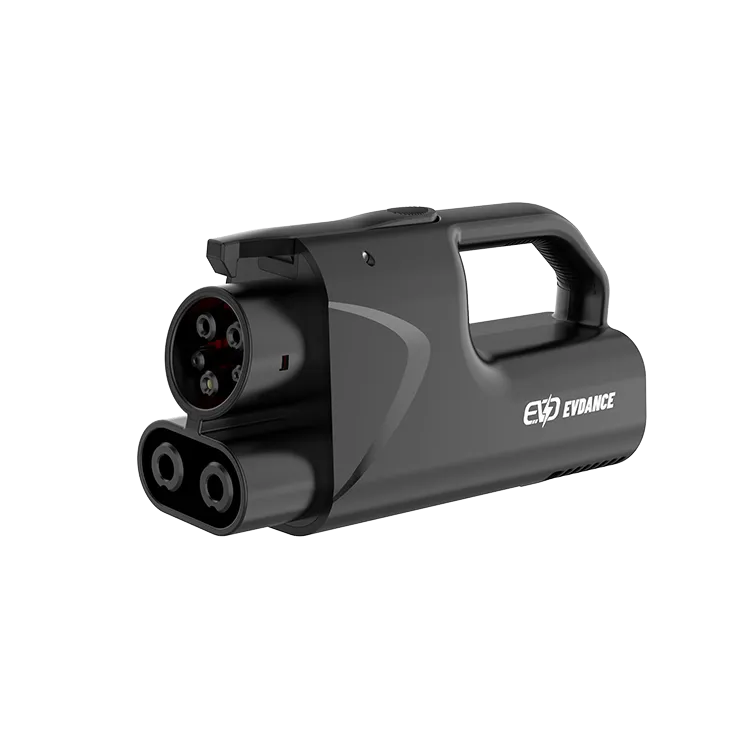
Stocking the JT08 and JT09 is a two-model decision about one job: both are NACS-to-CCS1 DC adapters in the 250 kW class, rated up to 500 A, sealed to IP66, and the JT09 adds a handle. The questions that decide a good order are which form your customers reach for, what you confirm in writing first, and what your counter staff may never promise.
Key Takeaways
- One job, two forms: the JT08 and JT09 split on the handle, not on ratings, power or permission.
- Confirm in writing what the listing does not state — the JT09’s voltage line and any certification documents — before it reaches shelf copy.
- Counter staff never certify a customer’s car: maker approval and an open station are the buyer’s checks, printed on your guidance card.
- Prices, pack quantities and lead times belong to the written quote, not to memory or marketing.
The Shelf Decision: Who Buys Which
Because the two models share a ratings family, the split on the shelf is a handling split. In the pattern retailers see with parts like these, the handled JT09 is the one frequent DC users reach for: drivers who charge on the road weekly, or who work a heavy station connector with gloves on — the handle is grip and seating control at every stop. The handleless JT08 is the occasional-use form: bought for the trips that need it, stored flat in a pouch the rest of the year. Neither pattern is a sales figure; it sets the opening ratio — depth on the handled form for a driving-heavy catchment, a balanced pair where DC trips are seasonal.
The split is never about permission or power: both models pass the same session through and carry the same two conditions of use — which follow the product onto your shelf.
Confirm in Writing Before the Order
| Line | What the listing states | Action for the stockist |
|---|---|---|
| Ratings | 250 kW class, up to 500 A, IP66 for both models | Quote them exactly as stated, no more |
| Voltage | JT08: up to 1000 V. JT09: not stated separately | Do not assume the pair is symmetrical — written confirmation for the JT09 line |
| Certifications | None named in the listing | Request the documents before any certification appears in shelf copy |
| Branding and private label | A separate programme, not a listing line | Confirm separately through the OEM programme before planning own-brand stock |
| Pack quantities, prices, lead times | Not stated in the listing | Set them in the written quote — never quote from memory |

The Counter Conversation Is Part of the Product
A DC adapter can be sold responsibly only with its condition attached — and the condition is not fine print, it is the product’s terms of use: either adapter may be used only where the buyer’s vehicle maker approves third-party DC adapter use for their car, from the maker’s current documents, and only at stations open to that car. Your staff’s duty follows:
- Never certify a customer’s car. “Works with your car” is a sentence the counter cannot say. The maker’s document decides; staff point the buyer to it before the sale.
- Print the two conditions on your own guidance card. One card in the box or at the till — maker approval and an open station — saves the returns conversation later.
- Read returns correctly. A buyer whose maker does not approve adapters, or whose network has not opened to their car, does not have a defective adapter. That case is handled by the card, not the refund till.
Ordering the Pair
The EVDANCE JT08 and the EVDANCE JT09 are stocked through the trade channel on our resellers and distributors page; own-brand supply runs through the OEM and private-label programme, which starts from 100 units. Keep the confirmations with the order file: the ratings you may quote, the documents you requested and the guidance card are the three pieces of paper a good adapter shelf runs on.
Frequently Asked Questions
Can we advertise the adapters as compatible with specific car brands?
No. Compatibility is decided per car by two documents your shop does not control: the maker’s approval of third-party DC adapters, and the network’s opening of its stations. Shelf copy states the ratings and the two conditions — never a car named as approved.
Do we need to stock both models?
In most catchments, yes: the pair splits on handling, so a one-model shelf refuses half the counter conversations. The ratio is your local call, set by how your customers charge.
A customer’s session would not start. Is that a warranty return?
Not on that evidence. A session that never starts is usually a conditions case — maker approval or station access — or a seating case, none of which a shelf can diagnose. Visible damage or heat marks are the manufacturer’s conversation; start there.
Related Reading
- Are EV Charging Adapters Safe?
- EV Charging News: NACS Overtakes CCS1 in U.S. DC Fast Charging Connectors
- Is the Tesla Charger NACS? NACS, J3400 and Adapters Explained
- Does J1772 Work With CCS? CCS Connectors Explained

