
A local repair centre makes sense for an importer when the arithmetic of distance turns against shipping every faulty unit back — and the evidence for that is yours, not the industry’s. Your returns log shows the volume, freight quotes price the legs the centre would remove, and the maker agrees in writing to parts access and repair authorisation. Without all three, a centre is a workshop that cannot fix what arrives. No threshold volume is published anywhere; the decision is computed from your records and your maker’s terms.
Key Takeaways
- Three evidences decide: your coded returns volume, freight quotes for the legs removed, and the maker’s written authorisation.
- Authorisation scope and parts supply are agreed before the first repair — never retrofitted after it.
- The centre decision follows the remedy-model decision; the centre is where a model is executed, not the model itself.
- EVDANCE publishes no repair-centre network or parts catalogue; a local arrangement is settled per market, in writing.
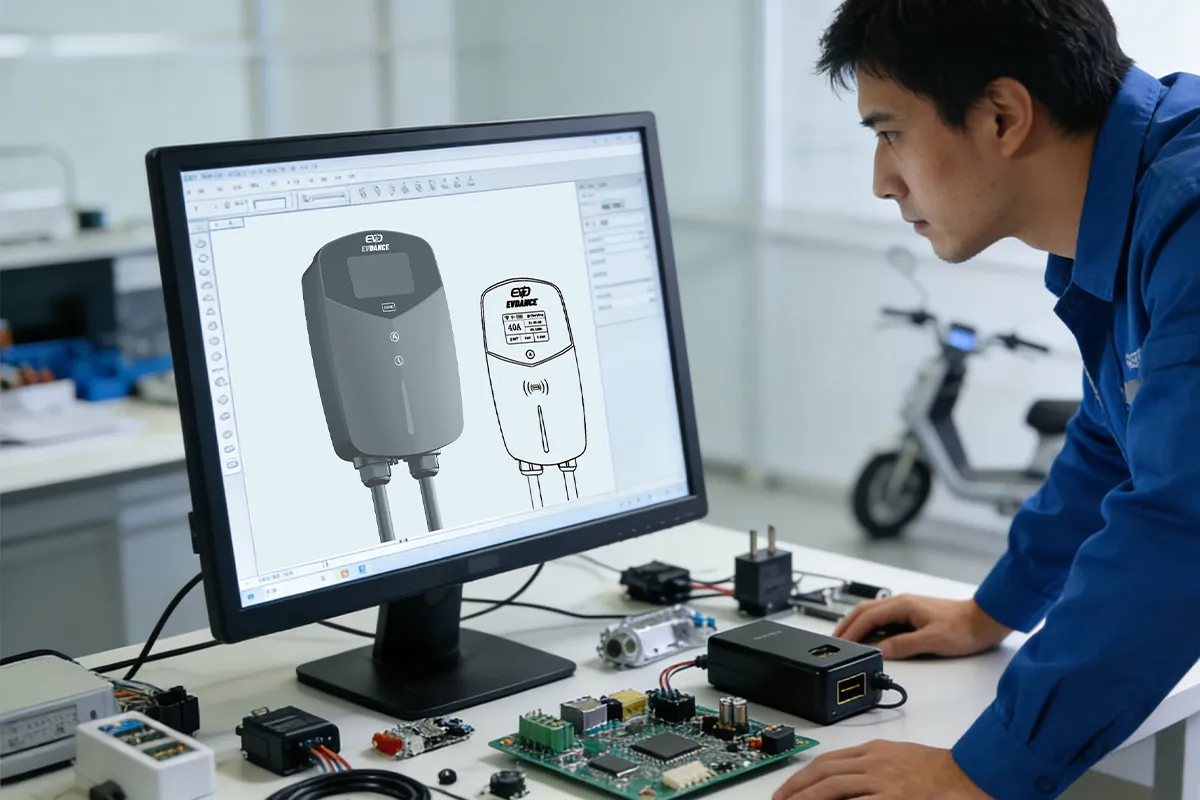
The Factor Table
| Factor | Evidence from your own records | The written term it needs |
|---|---|---|
| Return volume per model | The coded returns log, per period: which models come back, and how often | None — this is your trigger to open the conversation |
| Freight legs removed | Carrier quotes for the return route, against local handling and courier costs | Who carries which leg, in the warranty and agreement documents |
| Downtime per claim | Days open in the claim records — the wait your customers currently absorb | The service expectation your own customer terms have already sold |
| Parts access | The part classes your log shows failing — connectors, readers, displays, internals | The maker’s written parts supply: what the centre may hold and fit |
| Fault classes it can close | Your log again: which classes dominate, and which need the maker’s bench | An authorisation scope limited to those classes; the rest still travels |
| Warranty integrity | The claims disputed or paid so far, and on what grounds | The maker’s written confirmation that centre repairs keep cover intact |
Three Shapes a Centre Takes
- Your own bench. A corner of your warehouse, your trained technicians, your parts shelf. Full control; the whole fixed cost is yours, and it is justified only by your log’s volume.
- A contracted local service firm. Their bench and staff, your authorisation and parts pipeline. The agreement with the firm mirrors the one with the maker: scope, records, and who answers for the work.
- A repair-first agreement without a centre. Sometimes the honest answer: no dedicated facility, but written terms that let your own team close the common fault classes and route the rest — the model choice behind any centre.
What a single repair should cost to price, once a route exists, is a separate unit-economics question. And a centre serves whichever remedy model your agreement runs — it is the place advance replacement ships from, or the bench a repair-first claim is executed on — so the centre decision follows the model decision, never precedes it.

The Position for Imported EVDANCE Units
The freight logic bites by class. A portable like the EV-ACS3210T (32 A NACS, about 7.7 kW, IP66) travels cheaply in a courier box; an installed station like the EV-AC03201T (dual-connector, up to 43 kW shared, IP54, floor-standing) or the EV-RHDC30K-L DC charger (22 kW DC, OCPP 1.6J, IP54) costs real money to move and leaves a site dark while it travels. Stated plainly: EVDANCE publishes no authorised repair-centre network, no parts catalogue and no repair terms, so a local arrangement for its units is a written-confirmation item in the distributor discussion — raise it through the reseller and distributor programme or contact us, with your returns log as the evidence.
Frequently Asked Questions
What return volume justifies a local repair centre?
None that anyone publishes. Compute it from your own file: the freight and downtime your log prices today, against the centre’s fixed cost from real quotes. If the two lines do not cross on your numbers, the centre is a hope, not a plan.
Can we start repairing units and settle authorisation later?
No. Repair by hands the maker never authorised is the classic disputed claim: the work may be perfect and the cover still contested. The authorisation scope is written first, the first spanner turns second.
Does a local centre replace the maker’s RMA process?
No. It executes part of it, locally, under the maker’s terms. Claims, records and reporting still run through the agreed route — the spare parts and RMA process is the pipeline the centre plugs into, not one it abolishes.
Related Reading
- EV Charger Spare Parts and RMA Process for Distributors
- Common EV Charger Faults and How Suppliers Should Handle Them
- EV Charger Warranty and After-Sales Terms: A Distributor’s Checklist
- How Distributors Can Build a Profitable EV Charger Product Line

