
Once a school’s chargers are installed, staff charging runs on four arrangements: bays inside the staff car park rather than the visitor area, card or app access limited to a staff list, a simple roster for oversubscribed days, and the school’s normal site rules. The safeguarding boundary around the staff car park does most of the work — charging inherits it.
Key Takeaways
- Staff charging is an operations question: boundary, access list, roster, written arrangement.
- Bays inside the staff car park inherit the school’s existing safeguarding rules.
- School-day dwell makes rotation a weekly question, not an hourly one.
- Benefit or cost recovery is the school’s decision — check funding terms first.
Keep Staff Charging Inside the Staff Boundary
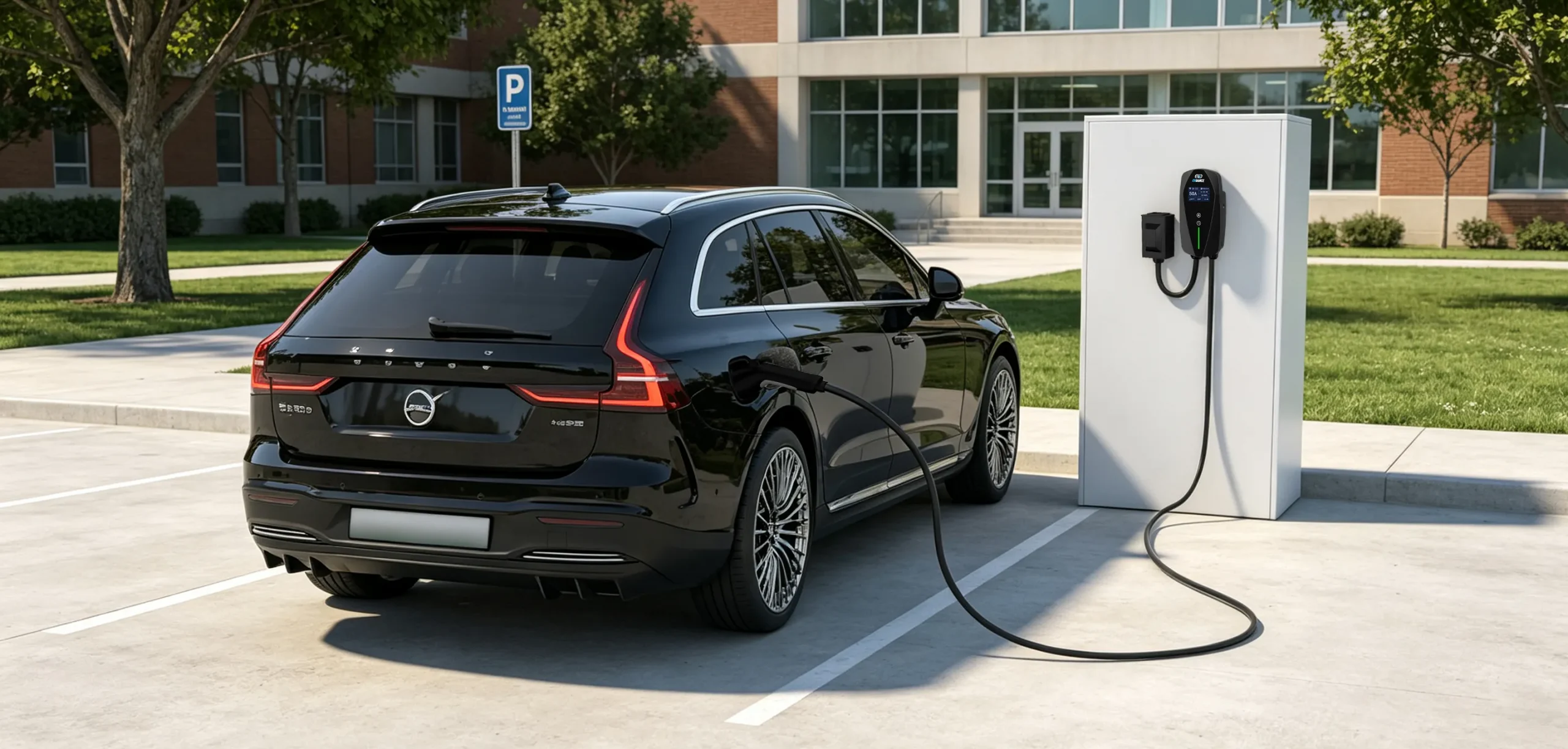
A school site is already divided by its safeguarding rules: pupils through pupil areas, parents through reception and visitor parking, staff through a staff car park that is usually gated. Staff chargers belong on the staff side of that line. Then the rules a school already enforces — who may enter the staff area, when gates are locked — answer most charging questions in advance, and parked-all-day cars stay out of the drop-off flow. Evening use follows the same boundary: a parents’ evening does not by itself open the staff chargers — that is a separate decision, in the same site rules.
Access Runs on the Staff List
Staff-only charging works because access is a list, and the school already keeps one. Each staff member gets an RFID card or app account; the charger starts only for someone on the list. Joiners are added when they start, leavers removed when they leave, supply teachers added temporarily or not at all. The planning logic is the same as planning a workplace EV charging program, with the school boundary on top. Networked chargers also log who charged and how much each session took.
The Roster: One Bay, One Car, One School Day
Staff dwell time does the roster’s heavy lifting. A car parked from morning registration to the end of the day needs one bay for the day, not a fast turnaround — Level 2 adds roughly 10–20 miles of range per hour (U.S. DOT), so a school day covers most commutes. Rotation matters only on oversubscribed days, when EV-driving staff outnumber bays:
| Roster pattern | How it works | Fits when |
|---|---|---|
| Fixed bay per driver | Each regular EV driver keeps an assigned bay | Bays match or exceed regular drivers |
| Weekly rotation | Drivers take turns across the week on a published rota | More drivers than bays, predictable schedules |
| Book-ahead list | Staff reserve a bay by day through the office or an app | Irregular patterns — part-time staff |
What schools avoid is the midday swap: moving a car between lessons costs more goodwill than the extra charge is worth. A fair written rota, reviewed each term, survives a real timetable.
Hardware That Fits a Staff-Only Setup
For a staff-only park, the EV-ACT3204PE 22 kW wallbox (tethered Type 2 cable, RFID and app control, IP66, CE) issues access per staff member — exactly the staff-list model above. A larger park can use the EV-AC03201T dual-connector AC station — two Type 2 connectors sharing up to 43 kW (22 kW per connector), OCPP 1.6J and RFID — serving two cars a day from one installation. Both sit in our commercial charging range. Who pays for the electricity is the school’s written decision, below.

Write the Staff Arrangement Down
A one-page staff charging note should settle these fields before the first term:
- Who pays. Free as a staff benefit, or cost recovery from per-user records. The school’s choice; if funding supported the installation, check its terms first — programmes listed by DSIRE sometimes attach conditions.
- Hours. School hours only, or evenings and event nights too.
- The roster. Which pattern from the table above, and who administers it.
- Care of the kit. Cables coiled away; faults reported to the office the same day.
- Leavers. Access removed with the staff list, like keys and badges.
Frequently Asked Questions
Can parents use the staff chargers while they wait?
Not under a staff-only setup — parents are not on the access list, and the bays sit inside the staff boundary. Visitor charging is a separate decision, with bays near reception, if offered at all.
Do staff have to move their cars at lunchtime?
Usually not. The school day is long enough for Level 2 charging to cover a commute, so one car keeps its bay all day. Rosters handle oversubscribed days, not hourly swaps.
Who pays for the electricity staff use?
The school decides: free charging is a staff benefit; cost recovery from per-user records is the alternative. Check any grant or incentive terms first — they can attach conditions.
Related Reading
- How to Plan a Workplace EV Charging Program
- How Do Commercial EV Charging Stations Work?
- Hotel EV Charging: How to Plan Guest Charging That Pays Off
- How to Open an EV Charging Station: Step by Step

