
Neither is better in general — they trade reach for tidiness. A straight cable gives you its full stated length and lies where you put it; a coiled cable parks itself in a short bundle but its working reach is less than the number on the box, and it pulls gently the whole time it is plugged in. The right choice is decided by your parking layout, not by the cable.
Key Takeaways
- Straight cables trade tidiness for full usable reach; coiled cables trade reach for self-tidying storage.
- Choose by your layout: long or changing runs favour straight, short fixed runs favour coiled.
- Connector type, rating class and correctly measured length matter more than the shape.
- Neither form changes charging speed or power.
The Five Differences That Decide It
| Factor | Straight cable | Coiled cable |
|---|---|---|
| Usable reach | The full stated length, end to end | Less than the stated (stretched) length in comfortable use |
| During a session | Lies where you lay it, including across the floor | Pulls back toward the charger; tends to lift clear of the ground |
| Handling | Long lengths are a heavy armful to loop up by hand | A compact bundle that carries and stows easily |
| Storage footprint | Needs a hook or holster with room for the loops | Parks itself in a fraction of its stretched length |
| Replacing it | Match the stated length like for like | Match the stretched length, and check the working reach still covers your run |
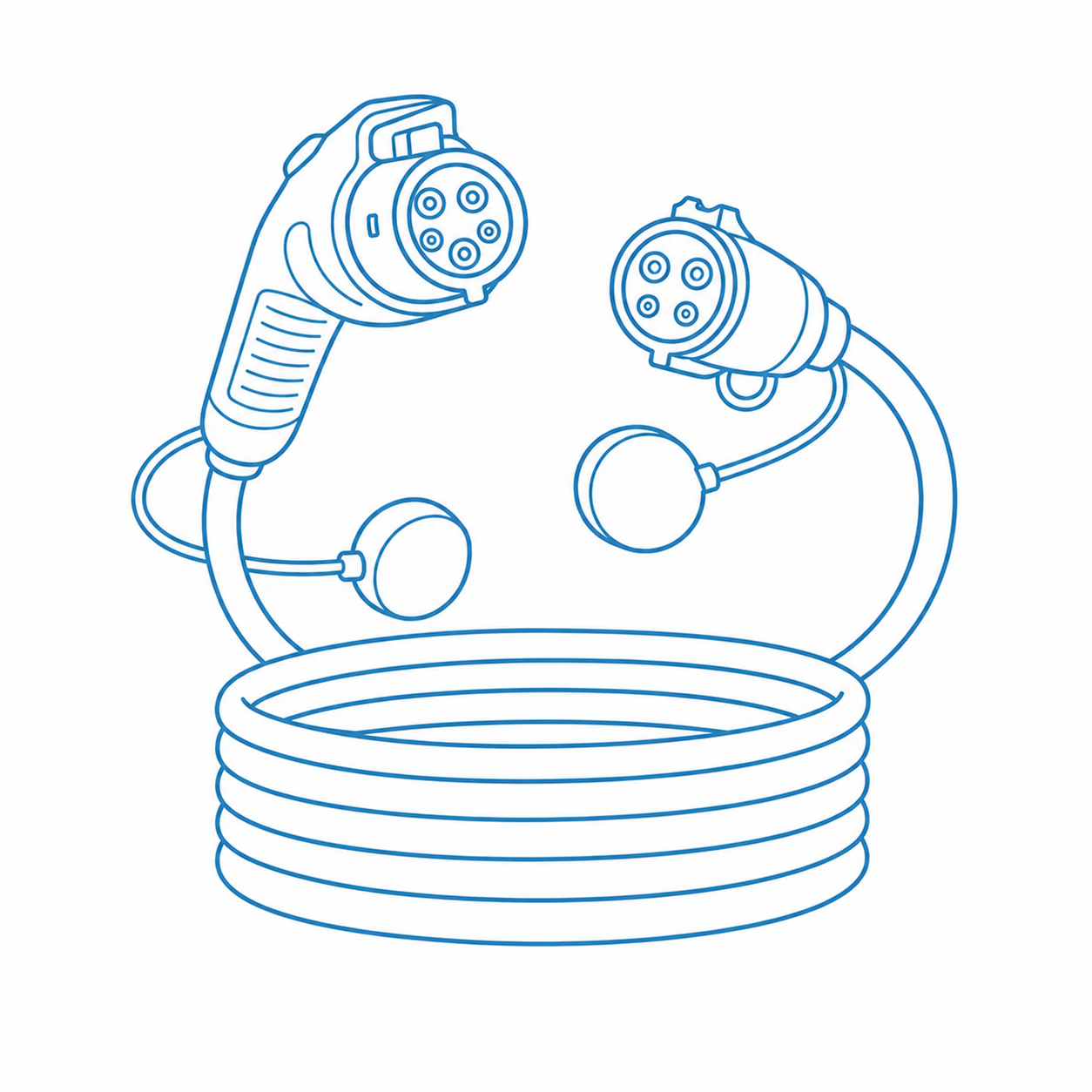
When Straight Is the Better Buy
- The run is long or varies. Two cars, changing parking positions, or a charge port far from the charger all eat length. A straight cable spends its whole stated length on the run; a coiled cable spends part of its on the stretch.
- The cable crosses the floor. A straight lead lies flat where it is laid. A coiled lead under tension can pull itself into the walkway or drag against the car.
- You want the simplest replacement later. Straight leads are the standard form supplied with chargers, so a like-for-like swap is straightforward.
When Coiled Earns Its Place
- One car, one spot, a short run. If the charger sits close to where the car always parks, the reach penalty never bites and the self-tidying spring works every day.
- Tidiness is the real problem. Where loose loops are a trip hazard or the cable would otherwise live on a wet floor, a cable that lifts and parks itself solves the actual complaint.
- Nothing to mount. The spring is the storage, so there is no hook or reel to fit — useful where you cannot fix hardware to the wall.
The Checks That Matter More Than the Shape
Shape is the last thing to decide, not the first. The connector type has to match your car and charger, the cable’s rating class has to cover the charger’s output, and the length — measured the way that form states it — has to cover your run with something to spare. Get those three wrong and no shape saves the purchase; our explainer on whether all EV charging cables are the same works through the differences that actually affect a session.

What EVDANCE Supplies
EVDANCE chargers come with straight cables, and the stated lengths are full working lengths: the EV-ACS3210E Type 2 portable charger carries a 7.5 m cable, and the EV-ACS4005T NACS portable charger comes with a 25 or 28 ft cable. If you are weighing one against a coiled lead, compare the coiled cable’s stretched figure against the same measured run — our cable length guide shows how to measure it.
Frequently Asked Questions
Does a coiled cable charge more slowly?
No. The form does not set the power. Charging speed is decided by the charger, the car’s onboard charger and the cable’s rating class — the lowest of the three — whichever shape the cable takes.
Can I wind my straight cable up so it behaves like a coiled one?
No. Hand-wound loops are just storage; they have no spring in them and have to be laid out again before use. Charging with any cable still bunched up is a heat question, covered in our explainer on whether EV charging cables get hot.
Is a coiled cable harder to use in winter?
A little. Cold makes any cable jacket stiffer, and on a coiled cable that stiffness adds to the spring’s pull, so the comfortable reach shrinks slightly more. Plan the run with stretch to spare and the difference stays minor.
Related Reading
- EV Charger Cable Length Guide: 5 m, 7.5 m or Longer?
- Which EV Charging Cable Do I Need?
- How to Hide and Manage an EV Charger Cable
- Are All EV Charging Cables the Same?

