
A Type 1 cable is an EV charging cable fitted with a Type 1 connector — the round, single-phase AC connector defined by SAE J1772 and used across North America and Japan. It links a charger to the car for Level 1 and Level 2 AC charging, and carries AC power only: on its own it cannot deliver DC fast charging. The plug itself is covered in our J1772 explainer; this article is about the cable.
Key Takeaways
- A Type 1 cable is the J1772 cable: single-phase AC for Level 1 and Level 2, never DC on its own.
- It comes tethered or detachable; the name fixes the plug, not the rating or length.
- Buy against stated figures: rating at or above the charger’s setting, length measured against your layout.
- Damage ends a cable’s service — replace it; never extend a charging cable with household leads.
Two Forms: Tethered Leads and Detachable Cables
Type 1 cables reach the car in two forms, and the form decides what “buying a cable” means:
| Form | What it is | Where you meet it |
|---|---|---|
| Tethered lead | Permanently attached to the charger; uncoil, plug in, coil back | Most home wallboxes, portable chargers and North American public posts |
| Detachable cable | A separate cable with a connector at each end, carried by the driver to a socketed outlet | Socketed points where the driver supplies the cable; common in Type 2 regions, less so with Type 1 |
With a tethered lead, the cable is part of the charger’s specification: its length and rating are the charger’s stated figures, and a damaged lead goes back to the manufacturer. A detachable cable is an accessory in its own right — hence the buying checks below.
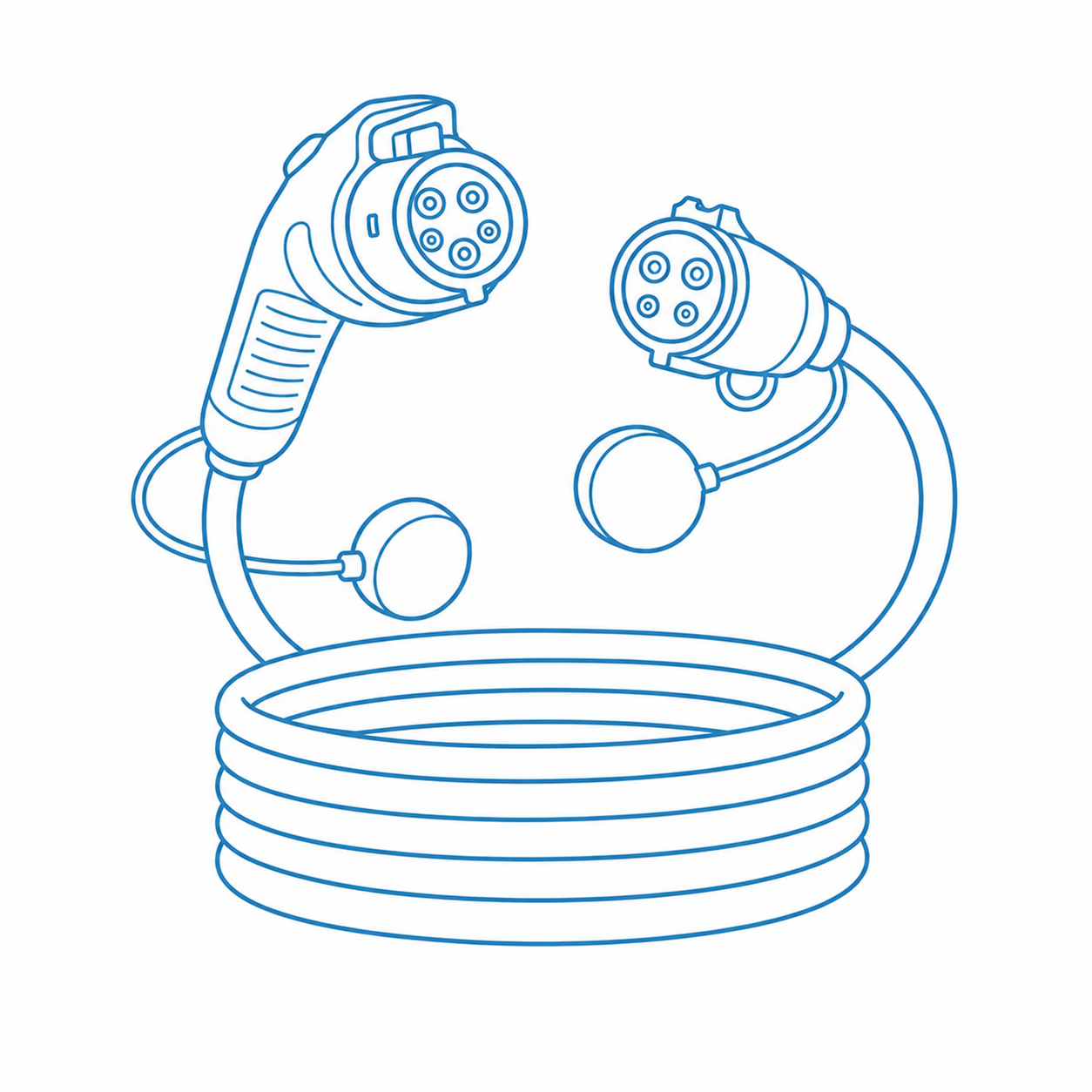
What “Type 1” Fixes — and What It Leaves Open
The name fixes the connector shape and the kind of power: single-phase AC through the five-pin J1772 interface. It does not fix the cable’s rating or length — those belong to the individual product, printed on the cable or its specification:
| Check | Where to read it | Why it decides |
|---|---|---|
| Current rating | Markings on the connector or cable, and the product specification | The session runs at the lowest rating in the chain — charger setting, cable rating, the car’s limit |
| Stated length | The product specification, as a single figure | Decides whether the cable reaches the inlet; see our cable length guide |
| Condition | Your own inspection: jacket, connector face, latch | A cut jacket, bent pins or a latch that will not click are stop-and-replace findings |
One boundary: a Type 1 cable runs from charger to car in one piece. It is not designed to be lengthened with household extension cords or joined to another charging cable.
Handling and Buying Checks
- Match the rating to the charger. The cable must be rated for the charger’s setting in use — lower the setting or use a correctly rated cable.
- Buy the stated length, not a guess. Measure the run from charger to inlet, then buy against the maker’s stated figure.
- Keep the connector off the ground. Coil it after use and keep the connector face clean and dry; dirt ages the contacts and cold stiffens the jacket — see our cold-weather charging guide.
- Never charge through visible damage. A damaged cable is replaced, not taped; a tethered lead goes to the manufacturer’s repair route.
- Buy from the charger maker or a reputable seller. The rating markings are the contract — an unmarked cable gives you nothing to check against.
A Type 1 Cable on EVDANCE Hardware
The EV-AC04001U is a 40 A J1772 portable charger: 9.6 kW, NEMA 14-50P plug, SAE J1772 connector, IP66, with a 25 ft cable stated in its listing. That cable is a Type 1 cable in tethered form; its stated 25 ft is the figure to measure your parking layout against. It fits any car with a J1772 inlet; NACS-port cars only through a suitable adapter such as the JT02 (AC, up to 80 A, IP65).

Frequently Asked Questions
Is a Type 1 cable the same as a J1772 cable?
Yes. Type 1 is the IEC name and J1772 the SAE name for the same connector, so cables named either way carry the same plug.
Can a Type 1 cable fast-charge?
No — it carries AC for Level 1 and Level 2. DC fast charging on this family needs the CCS1 plug, which adds two DC pins below the Type 1 section — see how J1772 works with CCS.
How long is a Type 1 cable?
It varies by product; there is no standard length to assume. Read the maker’s stated figure — the EV-AC04001U above states 25 ft — and measure your own parking run against it.
Related Reading
- What Is J1772? The North American EV Plug Explained
- EV Charger Cable Length Guide: 5 m, 7.5 m or Longer?
- Cold-Weather EV Charging: What Happens to Chargers and Cables Below Freezing
- Does J1772 Work With CCS? CCS Connectors Explained

