
The chargers that suit France are sorted by one check first: the phase supply your sites actually have, confirmed in writing. Sites confirmed three-phase take the three-phase Type 2 class — 22 kW wallbox and portables; sites confirmed single-phase take the single-phase class at about 7 kW. Connector family follows the cars your customers drive, and the stated IP rating follows the siting. No French grid figure is assumed anywhere in this method: each site class is surveyed, then matched.
Key Takeaways
- Sort by confirmed phase supply first: three-phase sites take the 22 kW Type 2 class, single-phase sites the about-7 kW class.
- Connector family comes from your own survey of the cars your customers drive.
- Stated IP ratings settle siting: IP66 builds for exposed use, IP54 stations under cover.
- The DC unit’s connector variant and every model’s market version are confirmed in writing before ordering.
The Phase Check Sorts the Range First
Phase is not a setting on a charger; it is the build of the product. A three-phase model at a single-phase site is unsold stock, so survey the supply at each class of site you serve — homes, workplaces, shared bays — and let the confirmed answer sort the range. Our explainer on single-phase vs three-phase charging sets out what each supply supports, and the 11 kW vs 22 kW wallbox comparison for European distributors covers the stocking choice inside the three-phase class.
| Confirmed supply at the site | The class that fits | EVDANCE examples, as stated | Confirm next |
|---|---|---|---|
| Three-phase, fixed bay | 22 kW wallbox | EV-ACT3204PE: 22 kW three-phase, tethered Type 2 cable, RFID and app, IP66, CE | Access control needs and the installation sign-off for the site |
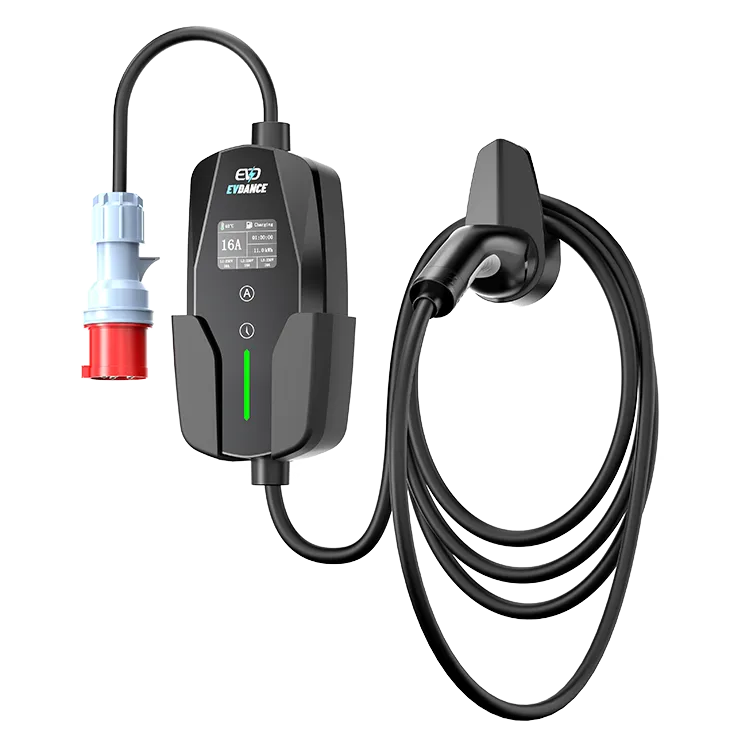
| Three-phase, portable use | 22 kW or 11 kW CEE portables | EV-ACS3205PE (32A CEE plug) and ACS1605PE (16A CEE 5-pin, 7.6 m cable), both Type 2, IP66 | That the site’s socket form matches the plug the model states |
| Single-phase | About 7 kW portable | EV-ACS3210E: single-phase, about 7 kW, Type 2, IP66 | The circuit capacity at the confirmed setting |
| Shared or public bays, three-phase | Dual-connector AC station | EV-AC03201T: 22 kW wallboxes, one per bay | Covered siting for the IP54 build, and the platform you will run it on |
| Short-stay DC | Compact DC unit | EV-RHDC30K-L: 22 kW DC, OCPP 1.6J, IP54 | The DC connector variant — the listing names none, so it is confirmed in writing |

Connector Family Follows the Cars
With the phase sort done, fix the connector family from the cars your customers actually drive — a survey of your own dealers and fleets, not a regional assumption. The European part of the EVDANCE range is built in Type 2 form; the NACS and J1772 models are North American builds with NEMA plugs, stocked only where your survey says those inlets dominate. Our comparison of Type 2, J1772 and NACS connectors and the guide to CEE plugs for three-phase portables work through the forms and their sockets.
Siting: Read the Stated IP Rating
The last sort is where the unit will live. The portables and wallbox above state IP66 or the IP65/IP66 pair — the dust-tight end of the scale — while the two stations state IP54, which belongs in a covered bay where the roof does the work the rating does not claim. Match the stated rating to the exposure, keep connectors off the ground and covered when idle, and treat any site harsher than the rating as a written question to the supplier before ordering, not after the first fault.
EVDANCE is a Shenzhen manufacturer founded in 2011, exporting to 30+ countries, with a 3-year standard warranty. Work the phase sort against the full product range, and confirm each model’s market version in writing through the distributor program or contact us before quantities are fixed.
Frequently Asked Questions
Can a single-phase site use the 22 kW wallbox?
No. Phase is the product’s build, not a setting: a three-phase wallbox belongs on a confirmed three-phase supply. Single-phase sites take the single-phase class — that is what the survey is for.
Should I stock only Type 2 for France?
Stock the family your own fleet survey supports. The Type 2 builds are the European form of this range; the survey of the cars your customers drive is what fixes the mix, in writing, before the order.
Is the compact DC unit a corridor fast charger?
No — at 22 kW DC it sits below the 50–350 kW band the U.S. DOT describes for public DC fast charging. It is a short-stay DC unit for sites the band does not fit, and its connector variant is confirmed in writing before ordering.
Related Reading
- Single-Phase vs Three-Phase EV Charging: 7kW, 11kW and 22kW Explained
- 11 kW vs 22 kW Wallbox: Which Should Distributors Stock for Europe?
- Type 2 vs J1772 vs NACS: Which EV Charger Connector Does Your Market Need?
- CEE Plugs Explained: Choosing 16A or 32A for a Three-Phase Portable EV Charger

