
In a multifamily garage, the EV-ACT5006T works as an assigned charger: one wallbox, one marked space, one household. Assignment ties cost and access to a unit — the space, the circuit feed and the paperwork say whose charger it is. That suits this model — a fixed 48 A wallbox, not a networked station keeping per-user accounts. Buildings that need session-by-session billing should spec a different class of unit.
Key Takeaways
- Assign the charger to a unit — space, circuit feed and paperwork together — and cost and access answer themselves.
- The EV-ACT5006T fits the assigned pattern: hardwired as a fixture, 60 A circuit per charger at 48 A, 7.6 m cable per space.
- Attribution with this model follows the wiring and the agreement, never charger-side accounts.
- If the building needs per-resident billing and session records, spec an RFID or OCPP unit instead.

What Assignment Actually Decides
Without assignment, a shared-garage charger creates the same argument every month: anyone could have used it, so no one agrees to pay. Assignment settles three things in writing before the first unit is mounted:
- Whose space it is. The charger serves the household the space is assigned to, labelled with that unit number.
- Whose electricity it draws. The circuit’s feed point — the household’s own supply where wiring allows, or the house supply — decides where the energy lands.
- What happens at move-out. A hardwired charger stays with the space; the assignment transfers on paper to the next household.
The charger records none of this: attribution lives in the assignment and the wiring, which is why it has to be written down properly. Our guide to apartment and condo charging in shared parking covers the building-level planning around these decisions.
Three Assignment Patterns
| Pattern | How it works | How the cost reaches the right unit |
|---|---|---|
| Per-space charger, fed from the unit’s own supply | Each EV household’s space gets a wallbox on a circuit from that household’s panel or meter, where the layout allows | By construction — the energy is on that household’s meter |
| Per-space charger, fed from the house supply | Chargers are wired to the building’s common supply; each serves one assigned space | By agreement — a flat arrangement in the lease or condo documents |
| Chargers matched to EV-owning units | The building installs for today’s EV units and moves the assignment — not the hardware — as tenancies change | Follows the assignment: the named household carries it |
Fitting This Wallbox to an Assigned Space
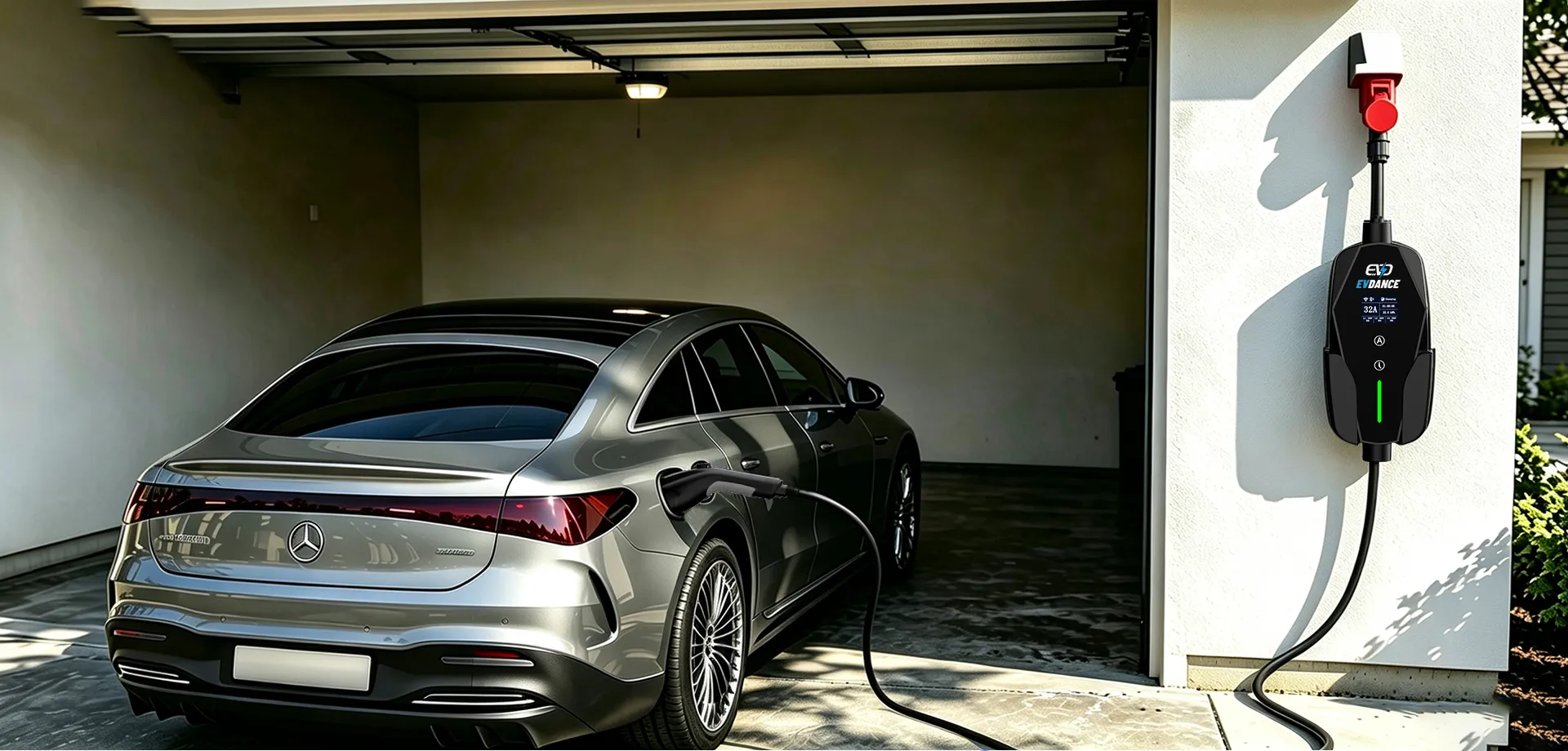
The EVDANCE EV-ACT5006T suits the assigned pattern. Hardwired, it reads as a fixture of the building rather than an appliance: no plug at the wall to be disturbed. Each charger at its full 48 A sits on a 60 A circuit (continuous load) — so a multi-space plan starts with the building’s spare capacity and an electrician’s load calculation, not the charger count. Its 7.6 m cable must reach the charge port in that space, as residents actually park. Two limits belong in the plan from the start:
- The connector is NACS. A household with a J1772 car needs an AC adapter such as the EVDANCE JT02, rated up to 80 A; confirm with the car maker’s guidance before permanent use.
- Open garages are weather. The unit’s IP65/IP66 ratings are the lines that matter for an unsheltered structure; the installer confirms placement.
When Assignment Is Not Enough
Assignment answers “whose charger is this?” It does not answer “how much did each resident use last month?” If the building needs per-resident accounts, card access and session records, that is a different class of hardware: the EV-ACT3204E wallbox carries RFID and app control, and the EV-AC03201T dual-connector station adds OCPP 1.6J for platform billing. Choosing the simple wallbox first and discovering the billing requirement afterwards is the expensive order — decide the building’s question before the first circuit goes in.
Frequently Asked Questions
Can one EV-ACT5006T be assigned to two units?
The building can write any rota it likes, but the charger keeps no per-user accounts, so the split runs on the agreement — turns, days, a shared flat arrangement. If per-user records matter, spec the networked class.
Who pays for the electricity an assigned charger uses?
It follows the feed point and the paperwork. A circuit fed from the household’s own supply puts the energy on that household’s meter. A circuit on the house supply is settled by the flat arrangement the lease or condo documents set out. Decide which one applies before installation, not after the first bill.
What happens to the charger when the household moves out?
A hardwired unit stays with the space. The assignment transfers to the incoming household on paper — which is why the move-out clause belongs in the original assignment.
Related Reading
- Apartment and Condo EV Charging: Solutions for Shared Parking
- How to Charge an EV When You Live in an Apartment
- Can I Have an Electric Car Charger at Home? Houses, Rentals and Condos
- OCPP Explained: What Charge Point Operators Need From EV Charger Hardware

