
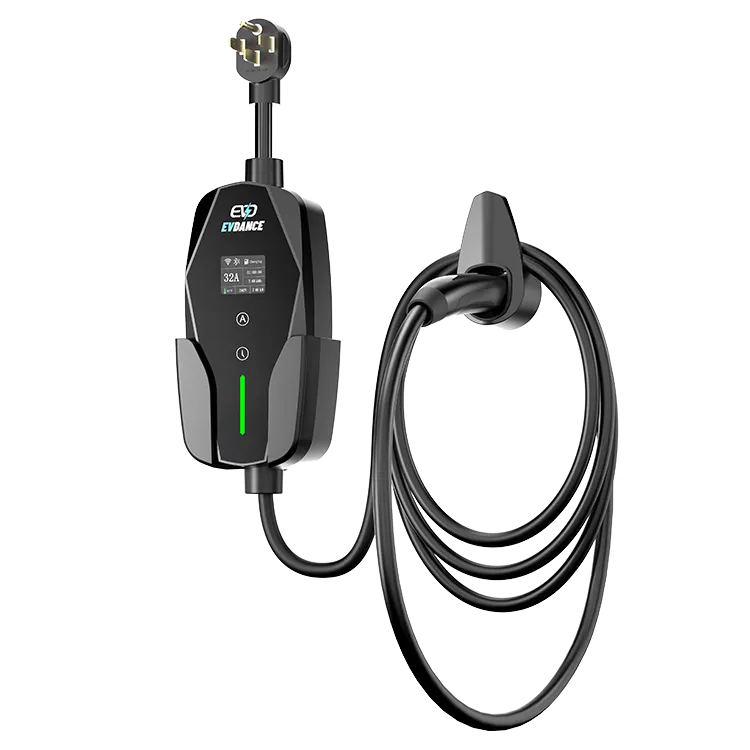
Usually, yes — at a current the house can spare. Older homes rarely fail on the charger; they fail on arithmetic: a smaller service, a busy panel, wiring from another era. The EVDANCE EV-ACS3210T is built for that negotiation, with six current steps from 10 A to 32 A. Your electrician names the ceiling; there is a step at or below it. But the step is picked after the check — never instead of it.
Key Takeaways
- The electrician’s load calculation names the ceiling first; the charger is chosen to fit under it.
- The EV-ACS3210T’s six steps — 10 A to 32 A — map onto circuit sizes from 15 A to 40 A, each step under the NEC 125% rule.
- Even the low steps deliver two to four times Level 1 — enough for modest daily mileage overnight.
- When no step fits, the honest answer is electrical work first; no setting creates capacity a panel does not have.
The Check That Comes First
First, the assessment every older home needs before a charger is chosen. A licensed electrician checks the service, the panel’s condition and spare capacity, and the wiring on the charger’s route — era wiring such as aluminium branch circuits or knob-and-tube is theirs to assess, and remediation is never a DIY project. The decision is a load calculation, not a count of free breaker slots. The method is covered in what size charger your panel can support, and whether you can install a Level 2 charger yourself draws the line between your jobs and theirs. The visit produces a number; the rest of this article is about meeting it.
Matching the Ladder to the Number
Under the National Electrical Code (NFPA 70) continuous-load rule, the breaker is sized at 125% of the load — so every step on this charger has a circuit it belongs on. The houses below are labelled examples; your electrician’s number governs.
| Example outcome of the check | Step to use | Power at 240 V | Drawn in a 10-hour night |
|---|---|---|---|
| A 40 A circuit can be spared | 32 A | 7.7 kW | About 77 kWh |
| A 20 A circuit can be spared | 16 A | 3.8 kW | About 38 kWh |
| Only a 15 A circuit is available | 12 A | 2.9 kW | About 29 kWh |
| The tightest case the charger offers | 10 A | 2.4 kW | About 24 kWh |
Figures are arithmetic at 240 V, before losses. Read from your constraint downwards: the house decides the row, and a step waits on nearly every row — including a 10 A floor for houses whose alternative is no Level 2 charging at all.

What the Low Steps Still Deliver
A low step sounds like a compromise until it meets the baseline. Level 1 runs at about 1 kW; the 10 A step delivers roughly two and a half times that, the 12 A and 16 A steps three to four times it. For modest daily miles, 24–38 kWh overnight — the examples above — is the whole commute and more. Test it against your mileage, not against a newer house’s ceiling.
When Even 10 A Is Not the Answer
- The load calculation leaves nothing. If the panel cannot spare a continuous load at any step, no setting fixes that — a step limits the charger; it does not create capacity.
- The wiring on the route is condemned. Era wiring an electrician will not sign off must be renewed first; the charger waits behind the house’s repairs.
- The panel itself is at end of life. Then the sequence is electrical work first — a panel or service upgrade, possibly with load management — and charging second. A bigger project, but the honest one — done once.
The EV-ACS3210T in an Older Home
The EV-ACS3210T is a 32 A NACS portable, adjustable in six steps — 10, 12, 16, 20, 24 and 32 A — with a NEMA 14-50 plug, a 1.77-inch screen and an IP66 body. Its value here is the ladder: start at the step your house allows today; step up if the panel is upgraded later. EVDANCE has built charging equipment since 2011; its chargers carry a standard three-year warranty.
Frequently Asked Questions
Can I skip the electrician and just use the 10 A step?
No — the step limits the charger; it does not certify an old circuit, a tired breaker or era wiring. Even the lowest step is a continuous load held for hours.
Will charging at a low step harm the car?
No. The car takes what is offered, up to its own limit; a lower step means a longer session. Slower is not harmful.
Does an older house always need a panel upgrade for EV charging?
No. Many land on a middle step; the upgrade conversation starts only when even the lowest steps do not fit.
Related Reading
- What Size EV Charger Can I Have at Home? Panel Capacity Explained
- What Size Breaker Do I Need for an EV Charger?
- Can I Install a Level 2 Charger Myself?
Sources & Standards
- National Electrical Code (NFPA 70) — continuous-load sizing.
- DOE Alternative Fuels Data Center — Charging EVs at Home — home charging levels, including Level 1.

