
A kilowatt-hour costs the same at 32 A as at 10 A. The tariff sets the price per kWh; the current setting on the EV-ACS3210T only decides how long the session runs. What it changes is whether the session finishes inside your off-peak window — energy that spills past its end is billed at peak.
Key Takeaways
- The tariff sets the price per kWh; the current setting only sets how long the session runs.
- The same charge costs the same at any setting — if it finishes inside the off-peak window.
- Overflow past the window’s end is billed at peak — overflow energy times the rate gap.
- Use your own two rates; 18.31 cents is only the US average.
The Tariff Sets the Price; the Setting Sets the Clock
Your bill is energy multiplied by the rate in force while it flowed. Nothing in that multiplication involves amps. Charge 30 kWh at the full 32 A or stepped down to 16 A and the meter records the same energy — the slower session just runs about twice as long. How time-of-use tariffs divide the day is covered in our guide to smart charging and time-of-use tariffs.
One real rate can be quoted here: the EIA puts the US average residential price at 18.31 cents per kWh. Your own peak and off-peak rates will differ — they are on your tariff sheet; no article can quote them. Every other rate below is an invented example, labelled as such.
One Charge, Four Settings
A labelled example: adding 30 kWh to the battery. With roughly 10% allowed for losses, the wall supplies about 33 kWh. What each setting does with that energy at 240 V:
| Setting | Power | Time for the same 33 kWh | Cost, all off-peak |
|---|---|---|---|
| 32 A | About 7.68 kW | About 4.3 hours | Identical |
| 24 A | About 5.76 kW | About 5.8 hours | Identical |
| 16 A | About 3.84 kW | About 8.7 hours | Identical at every setting |
| 10 A | About 2.4 kW | About 13.9 hours | Identical at every setting |
Read the last column as the point: stepping down is not a discount. It is a scheduling choice — sometimes a necessary one — and it has a price only when it pushes energy across the boundary of the cheap window. For your own numbers, start from how many kWh a charge takes.
Where the Saving Leaks: Overflow Past the Window
Now give the example a six-hour window and two invented rates — 10 cents off-peak, 25 cents at peak. The same charge, two ways:
- At 32 A: about 4.3 hours — finished inside the window. Cost: about $3.33.
- At 16 A: the session needs about 8.7 hours. Six hours of it — about 23 kWh — lands off-peak; the remaining roughly 10 kWh runs past the window’s end at peak. Cost: about $4.88.
- The difference, about $1.55, is charged on the overflow energy only.
The rule travels with any rates: the penalty is the overflow energy times the rate gap. A small overflow on a small gap costs cents; a daily overflow on a wide gap is the leak worth fixing — by stepping up where the circuit allows, or starting the session earlier inside the window.
The Charger in This Routine
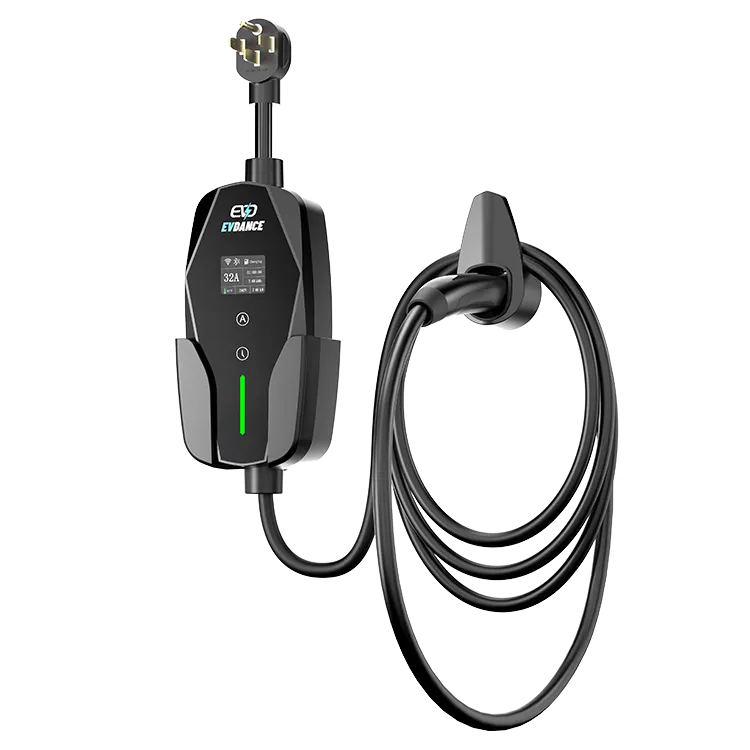
The EVDANCE EV-ACS3210T is a 32 A NACS portable charger: about 7.7 kW at its top step, six settings from 10 A to 32 A, a NEMA 14-50P plug, a 1.77-inch screen, and an IP66 housing. It has no timer of its own; the car’s schedule, or plugging in when the window opens, does the timing. Its highest usable step is set by the circuit, not the charger: under the NEC continuous-load rule, 32 A belongs on a 40 A breaker — our guide to how many amps an EV charger needs covers that matching. Within that ceiling, choose by the window: the fastest step your circuit allows is likeliest to keep the session on the cheap rate.

Frequently Asked Questions
Does charging at a lower current setting make each kWh cheaper?
No. The rate depends on when energy is taken, not how fast. A lower setting stretches the same energy over more hours; if they are all off-peak, the cost is unchanged.
What off-peak rate should I use in my own maths?
Your own tariff’s. The only published figure quoted here is the EIA’s US average of 18.31 cents per kWh — a benchmark, not your rate. Your two prices are on your bill or tariff sheet.
I step down because my circuit is shared. How do I limit the extra cost?
Start as early in the window as you can, and count only the overflow — the only energy billed at peak. On big refill nights, stepping up for the first hours pulls the finish back inside the window.
Related Reading
- Smart Charging and Time-of-Use Tariffs: How Scheduling Cuts EV Charging Costs
- How Much Does It Cost to Charge an Electric Car at Home?
- How Many kWh Does It Take to Charge an EV?
- How Many Amps Does an EV Charger Need?

