
A small hotel can start offering EV charging this week, without an installation project: one portable Type 2 charger, an existing socket near parking confirmed by an electrician, and a simple routine at reception. It plugs in per guest, goes back into storage at checkout, and its app records each session. Treat the first months as a pilot: the demand you observe later justifies — or rules out — a fixed installation.
Key Takeaways
- A small hotel can pilot guest charging with one portable Type 2 unit, a confirmed socket and a reception routine — no installation project.
- Set the current once, for the building’s spare capacity, on an electrician’s judgement; never per car.
- Track each session’s cost from the app record against your own tariff; the app figure tracks, it does not bill.
- Let the pilot’s bookings evidence decide whether a fixed, platform-managed phase has earned its cost.

The Pilot Kit: What You Actually Need
- The unit. One portable charger, kept at reception, brought out when an EV guest checks in.
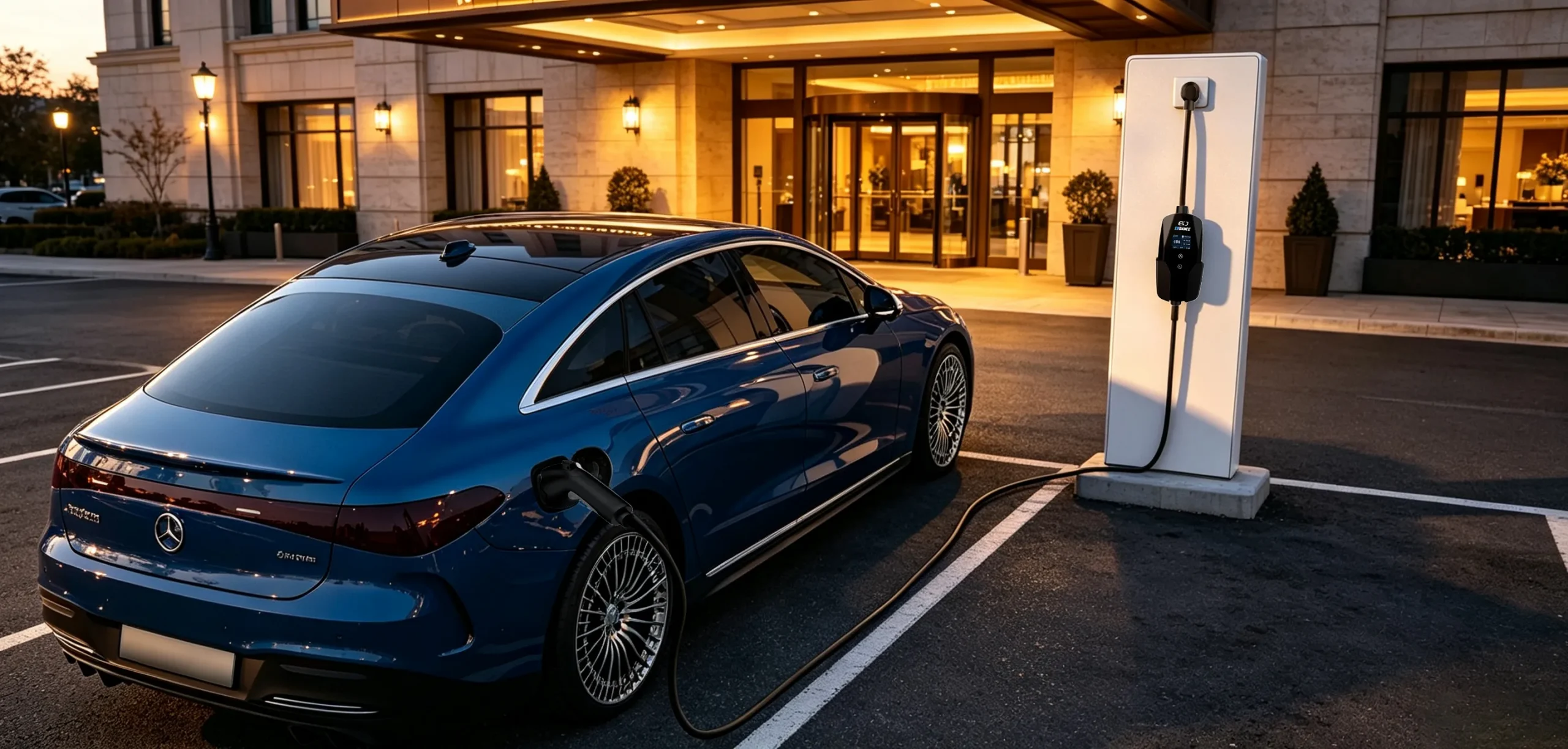
- A confirmed socket. An existing socket near parking, checked by an electrician for a load that runs for hours. The unit’s current is set once to what the building can spare (it adjusts from 10 A to 32 A) and left there.
- One marked bay within cable reach of that socket, plus a line on your booking page so guests know to ask.
- A bookings note. Every use logged against the room, so the pilot produces evidence, not impressions.
| The portable pilot | A first fixed phase | |
|---|---|---|
| What you commit | One unit; nothing installed | An installation project: chargers, cabling, electrical work |
| Guest capacity | One car at a time | Several connectors charging at once |
| What you learn | How many guests ask, which nights, what a session costs you | Usage reports from a managed platform |
| The exit | The unit goes back in the cupboard | The works stay, whether they earn or not |
The fixed phase is the graduate step, planned in our guide to hotel EV charging that pays off. The pilot tells you whether your guests will ever ask for it.
Running It From Reception
- Hand it out like a key. The unit goes to the guest at check-in, or staff fit it on request.
- Set the current once. The building’s spare capacity is an electrician’s judgement, made before the first guest. Staff never adjust the setting per car.
- Give guests one instruction line. Where to park, plug the Type 2 connector into the car, and tell reception if a session does not start.
- Check it back in. Cable coiled, connector undamaged, unit in storage, session visible in the app, ready to cost.
The Money: Track First, Charge Later
After a stay, read the session energy in the app and multiply by your own tariff. A guest session of 38 kWh at an example tariff of €0.30 per kWh costs €11.40 — an illustration, not an average. While trialling, fold a sum that size into the room or parking, with the real figure tracked.
Charging guests per session is a different arrangement: it needs a payment route and records a guest can be billed against. The app’s figure is a tracking record, not a certified meter or a billing system. Hotels that reach that point move to platform-managed hardware, the step covered under commercial EV charging — and the pilot’s log sizes it.
The Unit for the Pilot
The EV-ACS3210E is a 32 A Type 2 portable charger: single-phase at about 7 kW, current adjustable from 10 A to 32 A, app control with per-session energy monitoring, OCPP-ready, a 7.5 m cable and an IP66 housing. Type 2 is the connector European guest cars carry — no adapter drawer to manage. When nights outgrow one portable, the fixed step up is the EV-ACT3204PE 22 kW wallbox with RFID and app control, or the dual-connector EV-AC03201T station for managed, platform-run charging.
Frequently Asked Questions
How many portable units should a small hotel buy first?
One. A second portable is the cheap response to proven demand — bought in a week, ahead of any fixed works.
Can we bill a guest per kWh from the app figure?
The app figure tracks energy; it is not a certified meter reading, so treat it as your cost record, not a guest invoice. Per-session guest billing belongs to platform-managed setups. Until then, fold charging into the room or parking, as our overview of whether hotel charging is free describes.
What if two guests need charging on the same night?
One unit, one car at a time: run a simple order — first booker first, or a half-charge each with a swap at reception. Occasional clashes are manageable; repeated ones are the pilot doing its job — evidence a fixed phase has earned its cost.
Related Reading
- Hotel EV Charging: How to Plan Guest Charging That Pays Off
- Do Hotels Have Charging Stations for Electric Cars?
- Is EV Charging at Hotels Free?
- RFID and User Management for Shared EV Chargers

