
For a car that can accept the full 22 kW of three-phase AC power, the EV-ACS3205PE stores about 20 kWh in the battery per hour once charging losses are counted. But portable sessions are rarely full charges — they are windows: about 10 kWh in a half-hour stop, about 20 kWh in an hour, about 40 kWh in a two-hour slot. The session ends when the window ends, so the useful question is not “how long to full?” but “how much fits in the time I have?”
Key Takeaways
- At a sustained 22 kW with losses counted, about 20 kWh reaches the battery per hour.
- Portable sessions are windows: roughly 10 kWh per half hour, 40 kWh in two hours.
- An 11 kW car halves the table; a tapering battery trims the end of a long window.
- The portable matches a wallbox’s rate — the session’s context is what changes.
Think in Windows, Not Full Charges
A wallbox session usually runs until the car is done. A portable session runs until something else needs the socket, the bay or the car: a vehicle waiting for collection, a charger borrowed from another building, a top-up while other work happens around it. That is why the arithmetic below is organised by window length. All figures are worked examples at a sustained 22 kW with about 10% allowed for losses, so roughly 20 kWh reaches the battery per hour.
| Window you have | Energy stored (approx.) | What that means in practice |
|---|---|---|
| 30 minutes | About 10 kWh | A meaningful top-up — roughly a sixth of a 60 kWh battery |
| 1 hour | About 20 kWh | About a third of a 60 kWh battery |
| 2 hours | About 40 kWh | Most of a working day’s driving for many cars |
| 3 hours | About 60 kWh | A full charge for a mid-size battery, if the car holds the rate |
The Three Gates on Every Window
The window table assumes all three gates are open. Each one that closes stretches every figure:
- The socket. The full rate exists only at a 32A five-pin CEE socket on a three-phase supply. At the 16A class of socket, the ceiling halves before the car is even involved.
- The car. Most cars accept 11 kW of AC power, not 22. An 11 kW car on this charger stores about 10 kWh per hour after losses — halve the table, or double the window you allow.
- The taper. Near a full battery every car reduces what it accepts. A window that starts at 85% delivers less than the division promises; windows in the middle of the battery behave as tabulated.
Our comparison of charging time at 7 kW, 11 kW and 22 kW works through the full-charge arithmetic for each rate, and the explainer on single-phase vs three-phase charging shows why the car’s own rating decides which column is yours.
Three Windows From Real Use
A 45-minute while-you-wait slot stores roughly 15 kWh — enough to send a customer or a colleague out with a comfortable margin. A two-hour slot while the socket is free between jobs stores about 40 kWh, a substantial refill rather than a top-up. And when the portable stays plugged in overnight at a socket nobody else needs, the session stops being window-shaped at all and behaves like a fixed charger’s: the car fills at its own rate and tapers at the end, exactly as the full-charge comparison describes.

The EV-ACS3205PE as the Example
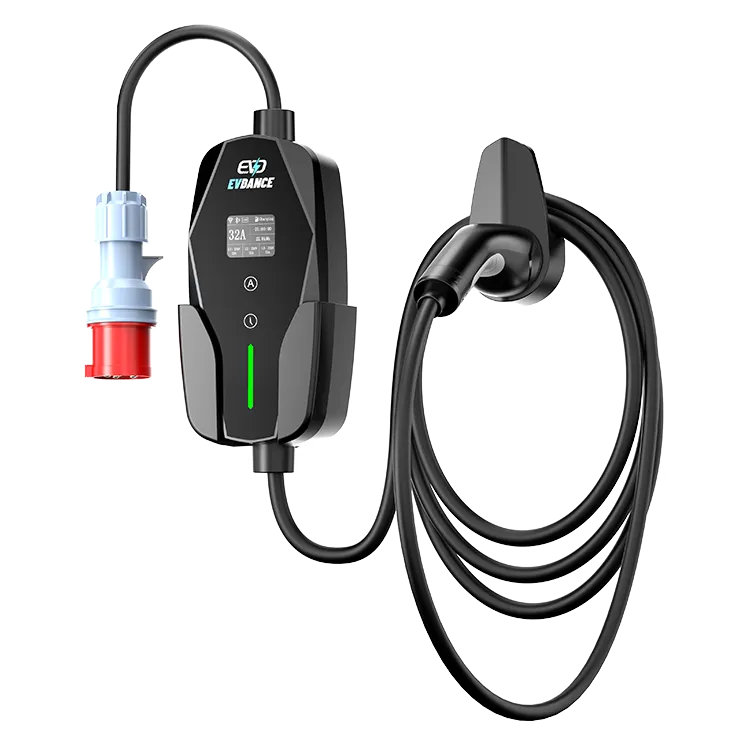
The EV-ACS3205PE is EVDANCE’s 22 kW three-phase portable charger: 32 A on a 380–400 V supply, CEE five-pin plug, Type 2 to the car, a 1.77-inch screen and an IP66 rating. Its rate is the wallbox rate — what differs is the setting: the session happens wherever a suitable socket exists, for as long as that socket is yours.
Frequently Asked Questions
So how long does a full charge take on this charger?
It depends on the battery size and the car’s acceptance, which is why the full-charge tables are organised by rate in our 7 kW, 11 kW and 22 kW comparison. With a portable, plan by windows first — a full charge is simply the longest window.
My car accepts 11 kW. What changes?
Your stored energy per hour roughly halves, to about 10 kWh after losses. The window thinking still applies — you just allow about twice the time for the same energy.
Is the portable slower than a fixed 22 kW wallbox?
No. The ceiling is the same 22 kW and the same gates apply. What differs is the context: a wallbox session ends when the car is full, a portable session often ends when the window closes.
Related Reading
- How Long Does It Take to Charge an EV at 7 kW, 11 kW and 22 kW?
- Single-Phase vs Three-Phase EV Charging: 7kW, 11kW and 22kW Explained
- Portable EV Charger Types Explained: 10A, 16A, 32A and Three-Phase Models

