
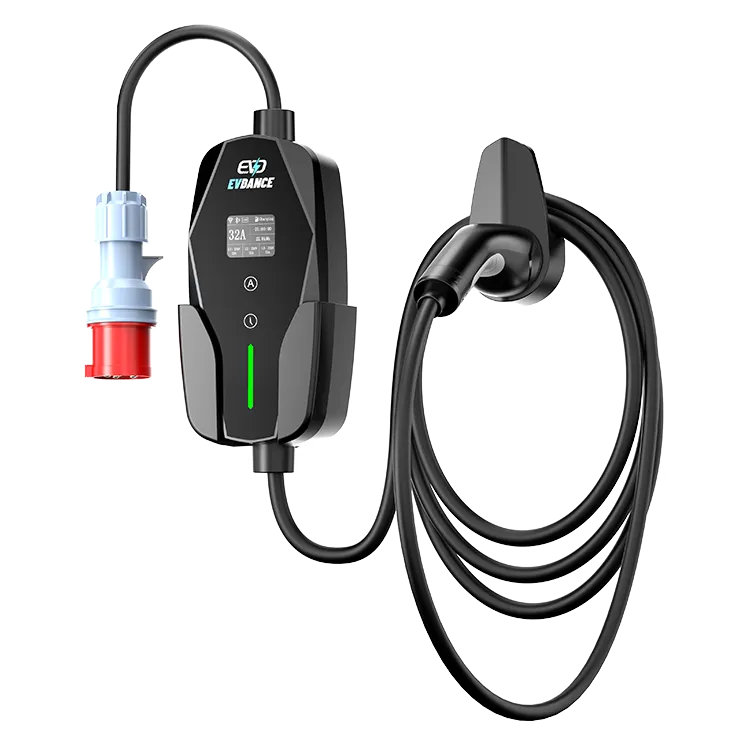
Both chargers top out at the same place: 22 kW of three-phase AC power into a Type 2 car. The difference is where the hardware lives. The EV-ACT3204PE is hardwired to one wall, with RFID cards and an app for control; the EV-ACS3205PE plugs into a 32A CEE socket and travels. So the choice is not about speed — it is about whether your charging happens in one fixed bay or at several sockets.
Key Takeaways
- Both units deliver the same 22 kW three-phase to a Type 2 car.
- The portable plugs into 32A CEE sockets and travels; the wallbox is hardwired to one wall.
- Shared, everyday, one-bay charging with card control is the wallbox’s case.
- Several sockets, rented premises or moving work is the portable’s case.
The Same 22 kW, Two Different Homes
| EV-ACS3205PE (portable) | EV-ACT3204PE (wallbox) | |
|---|---|---|
| Output | 22 kW three-phase, 32 A | 22 kW three-phase, 32 A |
| Connection to the building | CEE 32A five-pin plug — uses an existing or fitted socket | Hardwired — an installer connects it permanently |
| To the car | Type 2 | Type 2 cable or socket |
| Control | On the unit, with a 1.77-inch screen | RFID cards and app |
| Where it lives | Wherever it is needed — bay, yard, another building, the boot | On one wall, always in place |
| Weather rating | IP66 | IP65/IP66 |
When the Portable Wins
Choose the portable when the sockets already outnumber the charger. Workshops, farms and multi-building sites often have 32A CEE sockets in several places and vehicles that park in all of them — one travelling unit serves each in turn, and no building gets a charger bolted to it for the one car that visits monthly. It also fits rented premises, where a permanent installation may not be yours to make, and work that moves: the charger goes in the vehicle it supports. The precondition is the socket: where no 32A five-pin CEE socket exists, an electrician fitting one is the only fixed work involved.
When the Wallbox Wins
Choose the wallbox when one bay does the charging every day. It is always there, always connected, with nothing to fetch, carry or store — and for shared use it adds the control layer a portable does not claim: RFID cards decide whose car may charge, and the app manages access and sessions. A car park, a small fleet corner or a home where several drivers plug in is wallbox ground. What it asks in return is commitment: an installer, a fixed position, and a circuit sized for it — the right answer when the position will not change.

One Fixed Bay or Many Sockets?
Reduce the decision to a single question: in a normal month, how many different places do cars need to charge? If the honest answer is one, the wallbox’s permanence is worth more than the portable’s freedom. If it is three or four — different buildings, different bays, a yard with a socket at each end — the portable turns sockets you already have into charging points, and a second unit can follow when one stops being enough. Our guide to CEE plugs for three-phase portable chargers covers the socket side, and the overview of portable charger types places both units among the other ratings.
Frequently Asked Questions
Is one of them faster?
No. Both offer 22 kW, and the car decides what it takes — a car that accepts 11 kW charges at 11 kW on either. Speed is the tie; location and control break it.
Can the portable be my only charger?
Yes, if your charging points are 32A CEE sockets and you do not need card-based access control. It is a complete charger, not a backup — it simply is not fixed to a wall.
Which suits a rented workshop?
Usually the portable: it uses the sockets the building has and leaves with you. Fitting a new socket, where one is needed, is still an electrician’s job and a conversation with the landlord.
Related Reading
- CEE Plugs Explained: Choosing 16A or 32A for a Three-Phase Portable EV Charger
- Portable EV Charger Types Explained: 10A, 16A, 32A and Three-Phase Models
- Single-Phase vs Three-Phase EV Charging: 7kW, 11kW and 22kW Explained

