
Film units relocate, markets return to the same pitch every week, and outdoor venues open for a season — but all three share one problem: the cars and the power are rarely in the same place for long. The EV-ACS3205PE works in these venues because it follows them: a 22 kW three-phase portable charger that plugs into a 32 A CEE socket wherever the venue’s work happens. What makes it succeed is not the hardware but the routine around it.
Key Takeaways
- The charger follows the venue: film base, market pitch or seasonal car park — routine matters more than hardware.
- A named owner, agreed sockets and hours, and an end-of-day check keep shared supplies peaceful.
- Cable placement is daily housekeeping: out of walkways where possible, covered where not.
- No app or account is involved; the venue controls access by keeping and issuing the unit.
Three Venues, Three Movement Patterns
| Venue | How the charger moves | The charging pattern |
|---|---|---|
| Film set / unit base | Travels with the production from location to location | Unit and cast cars top up between call times |
| Market | Same site, same day, every week | Traders’ vans and early customers share the site’s supply across a long day |
| Outdoor venue | Stays for the season, stores over winter | Staff cars first, guests later; follows the car park in use, not the stage |
The hardware question is identical in all three — is there a 32 A five-pin CEE socket where the cars stop? Our explainer on CEE plugs, 16 A or 32 A, covers telling the classes apart. Everything after that question is operations.
The Routine That Makes It Work
- A named owner. One person issues the charger, stores it and checks it. Between uses it sleeps dry, indoors or in a sealed case — IP66 sealing protects it in use, not in storage.
- Shared-socket manners. On a supply shared with stalls, workshops or other crews, agree the socket and the hours in advance. Never unplug someone else’s session to take the socket: ask, rota, or wait.
- An end-of-day check. Coil the cable without tight bends, and look at the plug pins and socket face. Dirt, damage or a loose fit stops the session there — that socket goes to the site electrician, not back into service.
- A place in the load conversation. The venue’s electrician or power lead knows what the charger draws — one continuous 32 A load — before the day starts, not when a breaker explains it.
Cables, Crowds and Cars
Placement is a decision the venue makes at every setup. The charger lives next to its socket; the cable should run where people do not walk where that is avoidable, and where a run must cross a walkway, the venue’s own cable covers or ramps go over it. Emergency access stays clear. None of this is engineering; it is the same housekeeping a venue applies to every trailing cable on site.
Two honest limits shape the layout. The listing states no cable length for this model, so measure the physical unit’s cable against your parking arrangement before the day, not during it. And the car’s charge-port position decides which way each car parks; a painted bay arrow saves more arguments than any etiquette sign.

The EV-ACS3205PE in Venue Service
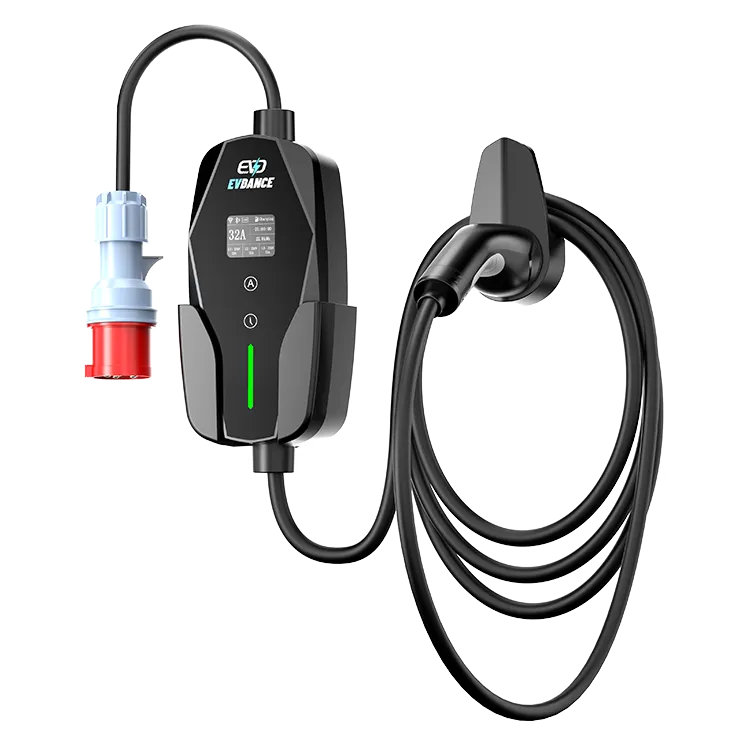
The EV-ACS3205PE delivers up to 22 kW three-phase at 32 A on a 380–400 V supply, through a CEE five-pin plug and a Type 2 car connector, with a 1.77-inch display and IP66 sealing. The listing names no app or card system for this model, and that fits venue work: access is controlled the venue’s own way, by where the unit is kept and who it is issued to. Where a venue outgrows one roaming charger and wants fixed, managed points, that is the step up to the stations on our commercial charging page.
Frequently Asked Questions
Can one charger cover a whole market day?
One car at a time — but at up to roughly 22 kWh per hour of parked time (planning arithmetic at full rate, before losses and the car’s own limits), most traders’ vans need a top-up, not a full charge. A simple rota covers more vehicles than drivers expect.
What happens when it rains at an outdoor venue?
The unit itself is IP66-sealed for outdoor use. The socket’s condition still matters: a damaged or flooded socket is a stop sign, and the session waits for the site electrician. Sealing protects the charger, not the connection.
Do drivers need an app or an account to charge?
Not with this unit: the listing states no app. A session starts at the charger itself, and the venue manages access physically — the unit is issued to the driver, or kept at the pitch, office or unit base.
Related Reading
- CEE Plugs Explained: Choosing 16A or 32A for a Three-Phase Portable EV Charger
- Portable EV Charger Types Explained: 10A, 16A, 32A and Three-Phase Models
- What Is an EV Mobile Charger?
- Can I Charge an Electric Car With a Generator?

