
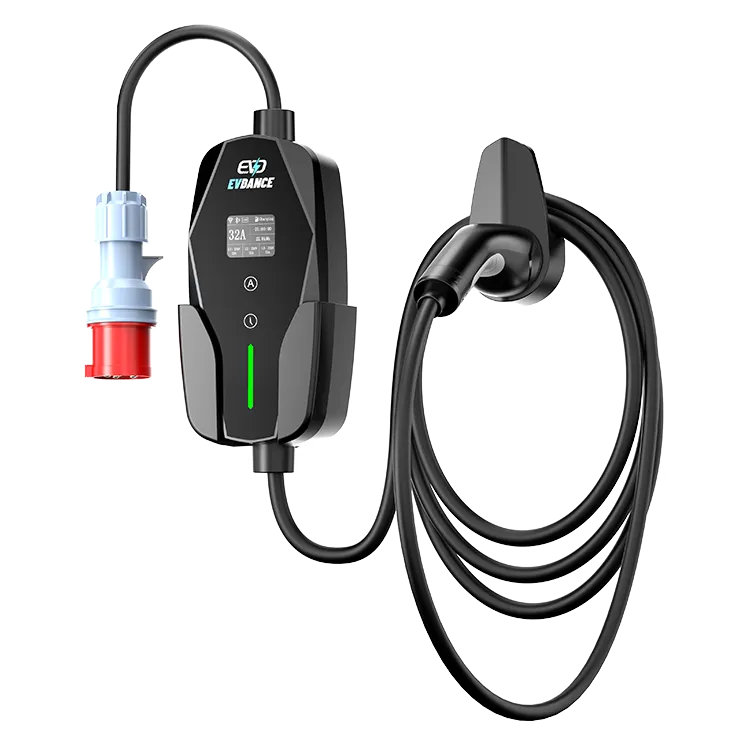
IP66 on the EV-ACS3205PE means its housing is dust-tight and tested against powerful water jets, so yard rain, washdown splash and dusty industrial air are inside the rating. It does not cover immersion in standing water, knocks and impacts, or heat and chemicals. On an industrial site the rating is also only half the story: a portable is carried, coiled and stored between uses, and handling decides how long the seal’s promise holds.
Key Takeaways
- IP66 on this unit means dust-tight and sealed against powerful water jets — yard rain, splash and dusty air are covered.
- Immersion, impacts, heat and chemicals are outside the code; no impact rating is stated for this model.
- A portable’s sealing survives only with handling: raised dry storage, a capped connector, and a stop on housing or jacket damage.
- The socket and supply on an industrial site are the site’s equipment — the rating covers the charger, not the installation.
What the Two Digits Promise
An IP code grades two tests. The first digit covers solids: 6 means dust-tight. The second covers water: 6 means the housing passed against powerful water jets — a stronger test than the 5 level’s ordinary jets. Our comparison of IP ratings for EV chargers sets the full scale out, and our explainer on whether portable EV chargers are waterproof covers the same boundaries for portables generally. For this model the listing gives IP66 — but there are exposures the code never tests at all.
Industrial Exposures: Inside the Rating, Outside It
Industrial sites add exposures a driveway rarely sees. Read each against what the code actually grades:
| Site exposure | Inside IP66? | What decides it |
|---|---|---|
| Wind-driven rain on a yard or depot charger | Yes | Powerful jets are a stronger test than driven rain |
| Dust-laden air in warehouses, workshops, aggregate yards | Yes | The housing is dust-tight |
| Splash from nearby washdown work | Yes, as splash and jets | A pressure-washer lance at close range beats the test — keep it away from the unit and joints |
| Standing water, flooded bay, unit sitting in a puddle | No | Immersion is a separate, higher grade — keep the unit raised, out of the drainage line |
| Knocks, drops, a vehicle or forklift strike | Not an IP property | No impact rating is stated for this unit; placement and handling decide |
| Heat, direct sun, oils and solvents | Not an IP property | The code grades dust and water only; the manual is the source for temperature limits |
The Portable Difference: Handling Between Sessions
A fixed wallbox is mounted once; a portable is plugged in where the work is, unplugged, coiled, carried and stored — every move a chance to defeat the rating the housing earned on the test bench. Habits that keep the promise intact:
- Store it raised and dry between uses. Off the floor, out of the puddle line, connector capped — not in the low corner where yard water collects.
- Keep the connector capped and off the ground. Seated in the car, the connection is made for wet use; lying open on wet concrete, it collects the site.
- Inspect before each session. Cable jacket, plug pins and housing, by eye. A cut jacket or cracked housing is where water stops being a surface question.
- Stop on damage. A damaged housing no longer carries its factory rating. Take the unit out of service and contact EVDANCE.

The Charger Behind the Rating
The EV-ACS3205PE is a 22 kW three-phase portable charger: 32 A at 380–400 V through a CEE 32 A five-pin plug, Type 2 connector, a 1.77-inch display, and the IP66 housing this guide covers. It plugs into a socket the site already has — our guide to CEE plugs for three-phase portable chargers covers which socket that is. Where a bay never moves, the fixed EV-ACT3204PE wallbox is the wall-mounted alternative in the same 22 kW class. EVDANCE is a Shenzhen manufacturer founded in 2011, and the model carries its 3-year standard warranty.
Frequently Asked Questions
Can the EV-ACS3205PE stay outside permanently on an industrial site?
The housing is rated for the weather. Permanent outdoor life is still a handling decision: unit raised out of standing water, connector capped, jacket and housing inspected regularly. The socket is the site’s equipment, with its own condition to check.
Does IP66 mean the charger can be pressure-washed clean?
No. The water test uses laboratory jets; a pressure-washer lance concentrates water far beyond it at close range. Wipe the unit down instead, and keep lances away from the housing and joints.
Does IP66 protect the connector as well as the housing?
The rating belongs to the charger’s closed housing. The connector is protected in use when it is seated in the car; between sessions it depends on the cap and on being stored off the ground, not open in the wet.
Related Reading
- IP Ratings for EV Chargers: IP54, IP65 and IP66 Compared
- Are Portable EV Chargers Waterproof? IP Ratings Explained for Drivers
- CEE Plugs Explained: Choosing 16A or 32A for a Three-Phase Portable EV Charger
- Portable EV Charger Types Explained: 10A, 16A, 32A and Three-Phase Models

