
If a session runs at roughly a third of this charger’s 22 kW rating — around 7 kW, one phase’s worth at 32 A — there are three explanations, and only one is a supply fault. The car may accept AC on one phase only: correct behaviour, not a failure. Or the supply may have lost a phase: an electrician’s job. Change one variable at a time, and the pattern names the branch.
Key Takeaways
- A session near 7 kW on a 22 kW three-phase portable is one phase’s worth of power — start with the arithmetic, not an assumption of failure.
- If the slowness follows the car, the car’s onboard charger is single-phase or capped: correct behaviour, nothing to repair.
- If it follows the socket, the supply is the suspect: the swap test is yours to run, the diagnosis is an electrician’s.
- The listing states no phase-monitoring behaviour for this unit — record intermittent patterns and send them to support.
Read the Evidence the Session Gives You
You need three observations, no instruments: the power the car reports, the energy added over a timed hour (full rate adds roughly 20 kWh after losses; one phase roughly 7 kWh — arithmetic on the ratings, not measurements of your car), and whether the pattern follows the car or the socket.
| What you observe | Branch it points to |
|---|---|
| Same car slow on every three-phase socket; other cars at full rate on the same socket | The car — its onboard charger is the limit |
| Every car slow on this socket; same cars at full rate on another known three-phase socket | The supply to this socket — an electrician’s diagnosis |
| The rate varies between sessions with the same car and socket | Record the pattern (car, socket, session power) and hand it to EVDANCE support |
Branch One: The Car Takes One Phase
On AC charging the car’s onboard charger sets the pace, and not every car accepts three-phase AC. A single-phase car draws on one phase only, and a 22 kW charger delivers that phase’s worth: about 230 V × 32 A, roughly 7.4 kW before losses. A car that accepts two or three phases at lower current lands somewhere between. Our explainer on single-phase vs three-phase EV charging sets out where those figures come from. In this branch nothing is broken and no charger can add phases the car does not take. Check the car’s own specification for its AC rating before suspecting the equipment.

Branch Two: The Supply Has Lost a Phase
If the evidence follows the socket instead — every car slow there, full rate elsewhere — the suspect is the three-phase supply feeding that socket. That diagnosis and any repair belong to a licensed electrician — do not test a live three-phase circuit yourself; there is no owner-level meter check for it. The one isolation test you can safely run is a swap: the same charger and the same car on a second, known-good three-phase socket, such as another bay’s outlet covered in our guide to CEE plugs for three-phase portable chargers. If full rate returns there, hand the electrician a precise report: this socket, these cars, one-phase power. One stop rule overrides every branch: warmth, discoloration or a loose feel at plug or socket means stop and have the socket checked.
What Not to Conclude
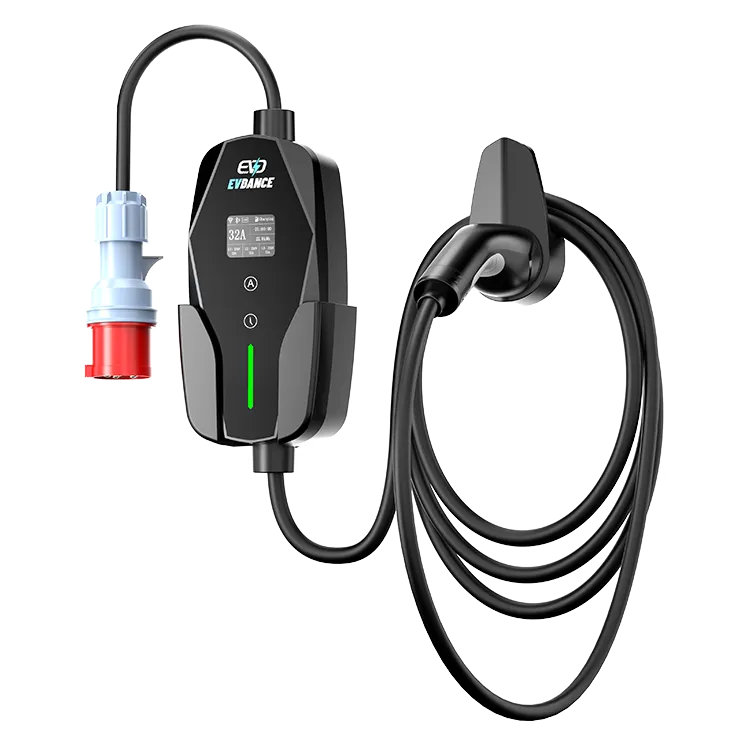
Do not credit the charger with diagnosing any of this. The published specification for the EV-ACS3205PE — 22 kW three-phase, 32 A at 380–400 V, CEE five-pin plug, Type 2, 1.77-inch display, IP66 — states no phase-monitoring behaviour. Treat the unit as a witness, not a diagnostician: what it and the car show during a session is evidence, and the split above is how to read it. If the pattern is intermittent and follows neither car nor socket, record two or three sessions (car, socket, power shown) and send them to EVDANCE via the contact page, under the model’s 3-year standard warranty.
Frequently Asked Questions
Is charging on one phase harmful to the car or the charger?
For a single-phase car it is that car’s normal mode — no harm, nothing to fix. If the cause is a supply fault, the slow session is a symptom: do not keep running a circuit you suspect; let an electrician confirm the supply.
Can I test the socket’s phases myself with a meter?
No — live testing on a three-phase supply is an electrician’s job. Your part is the swap evidence: same car, same charger, different socket. It is safe, and for the electrician genuinely useful.
How do I confirm whether it is the car?
Charge a car you know accepts 22 kW three-phase AC on the same socket. Full rate there clears the socket and charger — the first car’s onboard charger is the limit. One-phase power again points at the supply.
Related Reading
- Single-Phase vs Three-Phase EV Charging: 7kW, 11kW and 22kW Explained
- CEE Plugs Explained: Choosing 16A or 32A for a Three-Phase Portable EV Charger
- Portable EV Charger Types Explained: 10A, 16A, 32A and Three-Phase Models

