
Phase rotation is the order in which a supply’s three phases arrive — L1, L2, L3 in one sequence, or the same phases in a different order. Both orders exist: two sockets can be correctly wired yet present different sequences. For AC charging, though, the sequence is rarely why sockets behave differently: what matters is that all three phases are present and balanced, and differences usually trace to those — or to the car.
Key Takeaways
- Phase rotation is the order the phases arrive; both sequences occur in correct installations, and the socket face cannot tell you which.
- Presence and balance of phases — and the car’s acceptance — explain differing behaviour far more often than sequence.
- This charger’s published specification claims no rotation detection, alarm or correction; do not credit it with any.
What Phase Rotation Actually Is
A three-phase supply delivers three alternating currents, evenly offset from each other. Rotation — also called phase sequence — is the order in which their peaks arrive. Set by how the installation was wired, it is invisible at the socket — nothing on a CEE outlet’s face shows the sequence behind it. The order matters to motors, which turn one way or the other with the sequence they are fed — why installers check rotation when wiring three-phase equipment. Our explainer on single-phase vs three-phase charging covers what the phases contribute to a session.
Why the Sequence Alone Rarely Changes a Session
An EV’s onboard charger converts AC to DC. The three phases are simply power to be rectified; the car’s electronics work with whichever phase is connected where, and speed is set by how many phases the car takes and at what current — not by peak order. So if the same car charges at 22 kW on one socket and differently on another, rotation sits on an electrician’s checklist — below these commoner explanations:
| What you observe | First explanations to consider |
|---|---|
| Session runs at about one phase’s worth of power on every car at this socket | A phase missing from this socket’s supply — an electrician’s diagnosis |
| One car is slow everywhere; others are fast on the same socket | The car: not every model accepts three-phase AC; single-phase cars draw on one phase only |
| Speed varies between sockets and between sessions | Load balance: a single-phase car lands on one phase, and that phase may be busy elsewhere in the building |
| Equipment with sequence-sensitive protection refuses to run | Phase rotation itself — some equipment checks the sequence; whether a device does is in its specification |
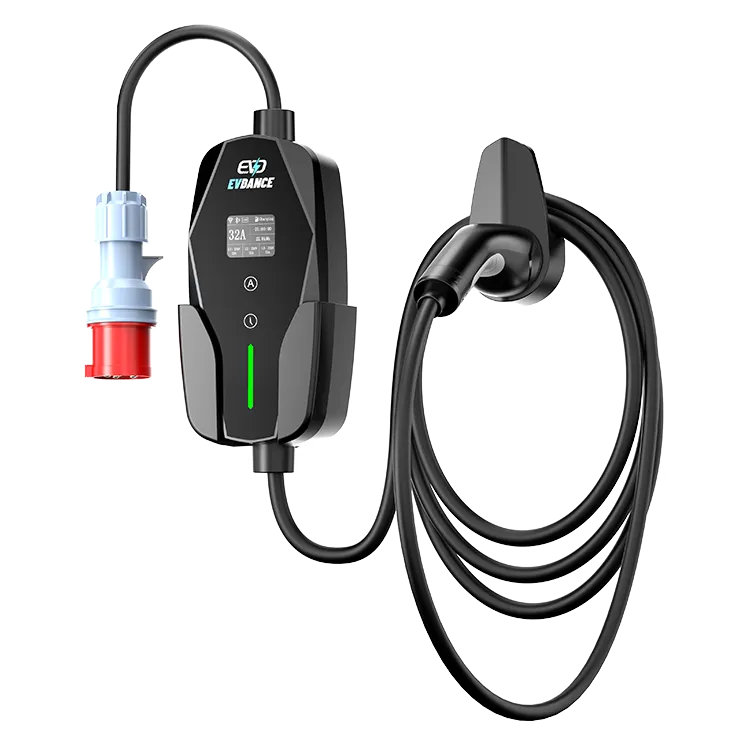
What This Charger’s Specification Does and Does Not Say
Hold this model to its published specification: the EV-ACS3205PE is a 22 kW three-phase portable — 32 A at 380–400 V, CEE five-pin plug, Type 2 connector, 1.77-inch display, IP66. The specification states no phase-rotation detection, no alarm and no correction, and this article credits it with none. If a session behaves oddly on one socket and normally on another, the charger is a witness, not a diagnostician. Nor does the specification promise indifference to every wiring irregularity — which is why sequence and supply checks sit with the installer.
The Electrician’s Side of the Question
Rotation is measured with an instrument on a live supply: a licensed electrician’s job, with no owner-level version — do not probe a three-phase socket yourself. What the owner can do is keep the record an electrician works from:
- Note the socket, not just the symptom: which outlet, at which site — the pattern is in the comparison.
- Note the car and session: what power it reported, and whether other cars matched it there.
- Hand over both together: “Socket B differs from A for every car” is a finding an electrician can act on, sequence check included; a lone slow session is not.
One stop rule overrides all of this: warmth, discoloration or looseness at plug or socket means stop and have the socket checked.

Frequently Asked Questions
Can wrong phase rotation damage the charger or the car?
Not as a blanket statement, and this article makes no such claim. Consequences depend on the equipment’s design — sequence matters greatly to some three-phase machines and little to rectifying loads — which is why installers verify rotation at installation. If in doubt, stop using the socket and ask an electrician.
Can I check a socket’s phase rotation myself?
No — it requires instrument testing on a live supply, an electrician’s job. Your contribution is the comparison record: same car, same charger, different sockets, session powers noted.
My car charges at different speeds on two three-phase sockets. Is it rotation?
Probably not the first suspect. Work through the common causes first — the car’s acceptance, a phase missing at one socket, load balance — and let an electrician settle the sequence question with instruments if the pattern follows the socket. Our CEE plug guide covers the socket side.
Related Reading
- Single-Phase vs Three-Phase EV Charging: 7kW, 11kW and 22kW Explained
- CEE Plugs Explained: Choosing 16A or 32A for a Three-Phase Portable EV Charger

