
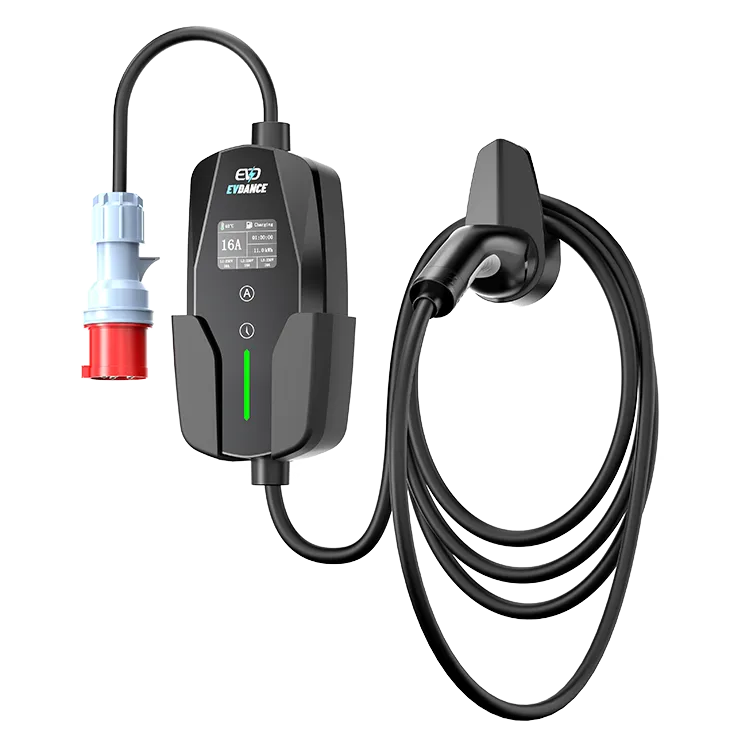
Head to head, the difference is the supply each unit drinks from. The ACS1605PE delivers up to 11 kW from a three-phase CEE socket at 16 A per phase; the EV-ACS3210E delivers up to about 7 kW from a single-phase socket, adjustable from 10 A to 32 A. For a one-car home that settles the comparison: match the unit to the supply at the parking space. A two-car home often ends it differently — not either/or, but one of each, because the cars park in different places with different sockets.
Key Takeaways
- One-car homes choose by supply; two-car homes often end the comparison with one of each.
- The 11 kW unit anchors the garage car; the adjustable 7 kW unit serves the second car and travels.
- Running both at full rate can put 48 A on one phase (labelled arithmetic) — an electrician’s question.
- The adjustable unit’s lower settings are the pressure valve on shared nights.
The Short Version of the Choice
| ACS1605PE | EV-ACS3210E | |
|---|---|---|
| Charging power | Up to 11 kW | Up to about 7 kW |
| Supply | Three-phase | Single-phase |
| Current | 16 A on each of three phases | 10–32 A adjustable, on one phase |
| Wall plug | CEE five-pin, 16A class | To match your socket — confirm when ordering |
| Cable | 7.6 m | 7.5 m |
| Connected features | 1.77-inch display; no app listed | App with energy monitoring, OCPP-ready |
Where 7 kW and 11 kW come from is covered in our explainer on single-phase vs three-phase EV charging. This article is about what happens when a household stops choosing between the two and runs both.
Why Two-Car Homes End Up With Both
The pairing follows the parking, not the spec sheet. The car that lives in the garage, where the three-phase CEE socket is, takes the 11 kW unit. The second car — on the driveway, in a carport — usually finds a single-phase socket, and that is the adjustable unit’s ground. Each charger stays where its socket is, and nobody queues for the one “good” charger.
- The garage car gets the faster overnight refill: at 11 kW, roughly 79 kWh lands in eight hours after losses (labelled arithmetic) — more than most batteries hold.
- The second car gets flexibility instead of speed: the EV-ACS3210E turns down to suit a modest socket, and it is the one that travels, because single-phase sockets are everywhere.
- Each car keeps its own routine. The app-monitored unit gives the second car’s sessions a record; the three-phase unit simply charges, night after night.
Running Both at Once: the Load Conversation
Two chargers raise one honest question: can both run at full rate at the same time? The arithmetic is easy — the answer belongs to your supply. If both draw from the same three-phase supply, one phase carries the ACS1605PE’s 16 A plus up to 32 A for the single-phase unit on a circuit fed from that phase: up to 48 A on that phase, about 18 kW across the house (labelled arithmetic). Whether your supply carries that comfortably is a licensed electrician’s judgement, not a product claim.
In practice, two levers keep the pairing easy. The adjustable unit is the pressure valve: on nights when both cars charge, set it to 16 A or 10 A and let the garage car have the phases. Or stagger the sessions — start the second car later, when the first is nearly done. Most nights neither lever is needed, because a 10–20 kWh top-up finishes long before either car is a load problem.

Which Half of the Pair to Buy First
Buy for the car that drives the most and parks in the same place every night; that car’s socket decides the first unit. Add the second when the second car arrives. Both units are in the wider family of portable EV charger types, and the CEE plug guide helps confirm which socket class your garage actually has.
Frequently Asked Questions
Our second car only charges single-phase. Which unit serves it better?
The EV-ACS3210E. A single-phase car on the three-phase unit draws on one phase at 16 A — about 3.7 kW (labelled arithmetic) — while the adjustable unit offers up to 32 A on one phase, about 7 kW, where socket and circuit allow.
Can both chargers really run at the same time?
Yes, if each has its socket. The question is only whether both run at full rate together on your supply — that combined-load judgement is the electrician’s, and the adjustable unit’s lower settings exist for exactly those nights.
Is one of them redundant if we later fit a wallbox?
No. A wallbox takes over one parking space; the portables keep serving the other car and every socket away from home.
Related Reading
- Single-Phase vs Three-Phase EV Charging: 7 kW, 11 kW and 22 kW Explained
- CEE Plugs Explained: Choosing 16A or 32A for a Three-Phase Portable EV Charger
- Portable EV Charger Types Explained: 10 A, 16 A, 32 A and Three-Phase Models
- How Long Does It Take to Charge an EV at 7 kW, 11 kW and 22 kW?

