
For most layouts, yes. The ACS1605PE is listed with one cable, 7.6 m, and that covers a garage or workshop bay where the socket sits on the parking side. The real question differs from the one a household charger raises: the fixed end of this cable is a three-phase CEE socket, and those sockets live where the three-phase circuit is — a workshop wall, a garage, an outbuilding — not always where the car sleeps. Measure from that socket, not from the house.
Key Takeaways
- The ACS1605PE is listed with one cable, 7.6 m — the question is whether it fits your socket’s geography.
- A three-phase CEE socket sits where its circuit is, often a workshop or outbuilding wall; measure from there.
- Parking direction moves the charge port between the near and far corner — worth metres of cable.
- An extension lead is never the fix for a short route on a continuous load.
The Socket Decides Where the Cable Starts
A household socket can often be added near a parking space. A 16 A five-pin CEE socket is placed by the circuit behind it, and that circuit was often run for machinery or a workshop — so the socket sits on the wall the supply reached. Moving one is an electrician’s job on a three-phase circuit. Our cable length guide covers choosing between lengths; with a fixed-length portable, the work is checking the fit.
The 7.6 m is then spent in predictable places:
- The drop from the socket. A socket mounted high spends cable before the cable reaches the ground.
- The route along the ground. Run along an edge, out of walking and driving lines — edges are longer than diagonals.
- The car’s own length. The port sits on one corner; a far-end port spends metres alongside the car.
- Slack at both ends. A cable that only reaches pulled taut does not reach; it should arrive in a gentle curve.
Common Layouts: Where 7.6 m Lands
| Layout | Does 7.6 m reach? | If not, the fix |
|---|---|---|
| Garage with the CEE socket on the parking wall | Yes, comfortably | — |
| Workshop socket, car parked just outside the door | Usually yes | Park closer to the door side the socket is on |
| Socket on an outbuilding, car across a yard | Often not | A socket placed for the parking area, fitted by an electrician, is the permanent answer |
| Charge port at the far rear corner from the socket | Marginal | Park the other way round — it moves the port to the near end |
| Two cars sharing one socket point, second car behind the first | Often not for the farther car | Measure for the farther car’s port |
Parking direction is the cheapest variable: the same car can be inside 7.6 m one way round and outside it the other, because the port moves between corners.

Measure Before You Order
Park the car where it will live, in the orientation you actually use. Run a tape along the route the cable will take: down from the socket, along the edge, alongside the car, to the port. If the tape reads close to 7.6 m, treat it as too short — the real cable curves; it does not stretch. If you park both ways round, measure both and buy for the worse one.
When 7.6 m Honestly Falls Short
First, change the parking, not the charger: direction is free and instant. Second, consider the socket — moving it is an installer’s job, and it is never replaced by an extension lead, because hours of continuous current are not what extension leads are made for, as our piece on extending an EV charging cable explains. Third, accept the verdict: if the route exceeds 7.6 m in every orientation, a wallbox sited for the parking area is the better buy.
The Charger Behind the Number
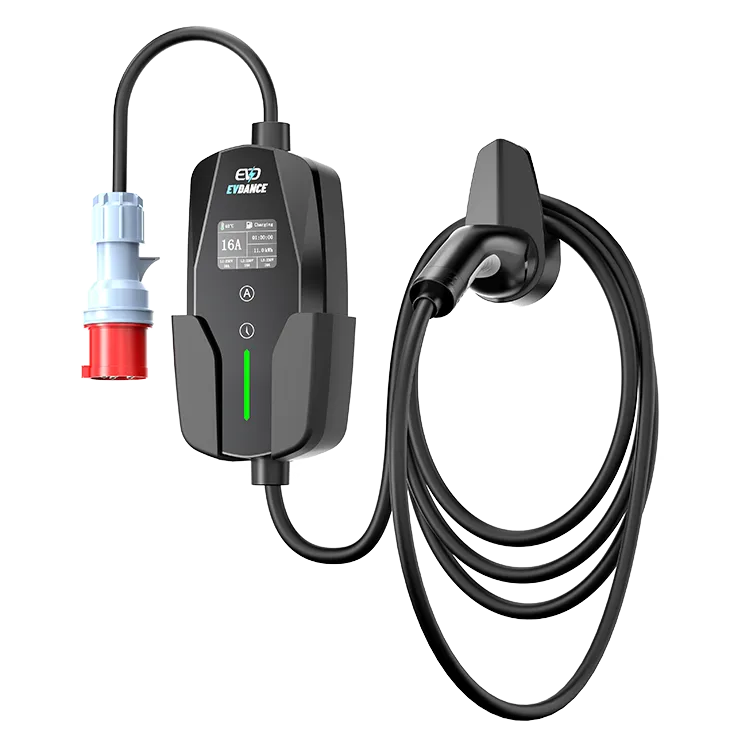
The ACS1605PE is an 11 kW three-phase portable charger: 16 A at 230/400 V, a CEE five-pin plug, a Type 2 connector, a 1.77-inch display and an IP66 rating. It goes where a 16 A three-phase socket already exists — which is why its cable length is judged against socket geography, not against a driveway.
Frequently Asked Questions
Can I order the ACS1605PE with a longer cable?
The listing gives one cable length, 7.6 m, with no longer variant. If your route needs more, the answer is a different format or a relocated socket.
Can I add an extension lead just on the nights I park further away?
No. An extension lead is not a safe answer at any frequency: the load is continuous current for hours. Park the other way on those nights, or treat the longer route as your real measurement.
Does the 7.6 m include the part inside the charger?
Treat the listed figure as the working cable and measure against it with slack to spare.
Related Reading
- EV Charger Cable Length Guide: 5 m, 7.5 m or Longer?
- Can You Extend an EV Charging Cable?
- CEE Plugs Explained: Choosing 16A or 32A for a Three-Phase Portable EV Charger
- Portable EV Charger Types Explained: 10A, 16A, 32A and Three-Phase Models

