
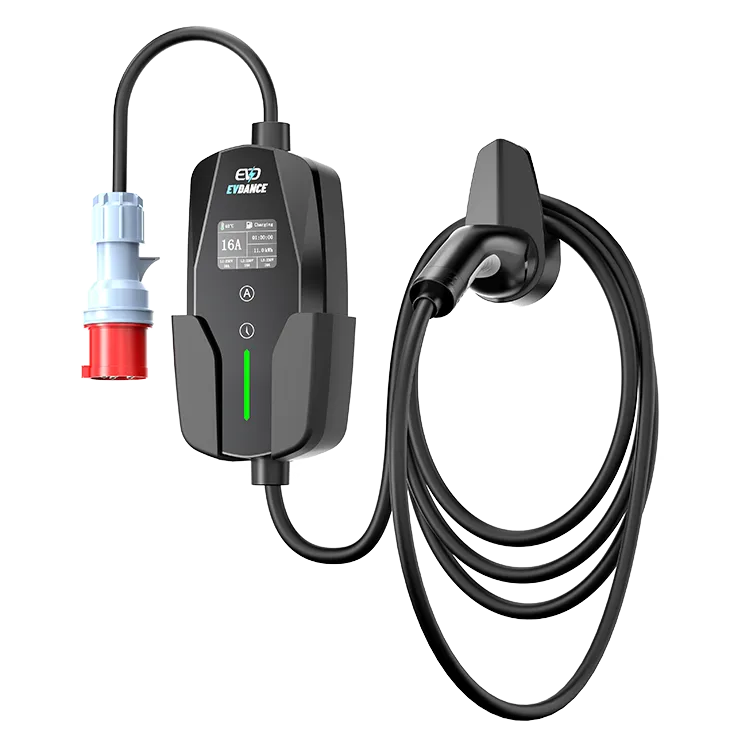
First use of the ACS1605PE is a plug-in sequence, not an installation: check the contents against the manual’s packing list, confirm your socket is the 16 A five-pin CEE class on a three-phase supply, plug in, connect the car, and confirm the session on the unit’s display and the car’s screen. There is no current setting to choose and no app to pair — the listing states neither. The one planning item that matters comes before the box is opened: the 7.6 m of cable between socket and charge port.
Key Takeaways
- First use is a sequence: box check against the manual’s list, right socket, plug in, connect, confirm on two displays.
- There is nothing to configure — no current setting and no app are stated for this model.
- The 7.6 m cable is the one planning item: measure the real route with the car parked where it will charge.
Before the Box: The Socket and the 7.6 Metres
The matching socket is a 16 A, five-pin CEE outlet on a three-phase 230/400 V supply, identified by its pin count and the rating printed on it — our guide to CEE plugs, 16 A vs 32 A, shows the identification. A 32 A socket is a different class and does not mate with this plug; a single-phase socket cannot feed a three-phase charger. If the building has neither, fitting one is a licensed electrician’s job.
Then the cable: the length is stated — 7.6 m — so rehearse the route with a tape measure before unboxing, car parked where it will normally charge:
| Where the socket sits | What the 7.6 m has to cover | The check |
|---|---|---|
| On the wall beside the parking place | A short run to either end of the car | Walk it with the car in place |
| Across the building from the parking place | The room’s width, plus every bend on the route | Measure the real path, not the straight line |
| Charge port at the far end of the car | The car’s length added to the run | Park the other way round and the same socket may suddenly reach |
Keep the run relaxed, never stretched taut.
Unboxing: Check Against the Manual’s List
- Contents against the packing list. The manual — not an article — defines what should be in the box; anything missing or damaged goes to the seller before the first session, not after. Then read the manual’s safety pages.
- CEE plug: pins straight and clean, housing uncracked.
- Cable: jacket uncut, no crushed sections from transit.
- Type 2 connector: face clean and dry, latch moving freely, and the 1.77-inch display intact.
The First Session, Step by Step
- Push the CEE plug fully into the socket. The unit powers up (indication per the manual).
- Run the cable out in wide loops — no tight bends, no drive-over path.
- Plug the Type 2 connector into the car until it seats and locks.
- Confirm the session twice: the unit’s display shows it running, and the car’s screen shows the rate it is accepting — up to 11 kW where the car takes it in full.
- After a few minutes, check both ends: plug, socket and connector no more than warm.
- To finish: end the session, unplug the car first, then the wall plug; coil the cable wide.

If the First Session Does Not Start
- Nothing lights up: reseat the CEE plug fully. Still dark: the socket’s supply is a site question — its breaker first, then an electrician.
- Unit on, car idle: reseat the Type 2 connector until it locks, then check the car for a charge limit or scheduled window.
- Anything hot, discoloured or smelling of hot plastic: stop, unplug, have the socket checked — the stop signs in our portable charger safety guide apply.
The charger in this guide is the ACS1605PE: an 11 kW three-phase portable — 16 A at 230/400 V, CEE five-pin plug, Type 2 to the car, a 1.77-inch display, IP66 and a 7.6 m cable — made by EVDANCE (Shenzhen, founded 2011) with a 3-year standard warranty. For 32 A sockets, the EV-ACS3205PE is the 22 kW portable.
Frequently Asked Questions
Do I need an electrician to use it for the first time?
Not to plug into an existing, matching 16 A CEE socket — only to fit one, or to confirm a circuit you are unsure about.
Is there a current setting or an app to set up first?
Neither is stated for this model — no settings to choose, no app to pair. The rate is settled by the supply and the car.
How do I know the car is really charging?
Two witnesses: the unit’s display, and the car’s charging screen showing the rate it is accepting. Check both at the start and again after a few minutes.
Related Reading
- CEE Plugs Explained: Choosing 16A or 32A for a Three-Phase Portable EV Charger
- Portable EV Charger Types Explained: 10A, 16A, 32A and Three-Phase Models
- Portable EV Charger Safety Guide 2026: NEC Rules, Extension Cords, and What to Avoid

