
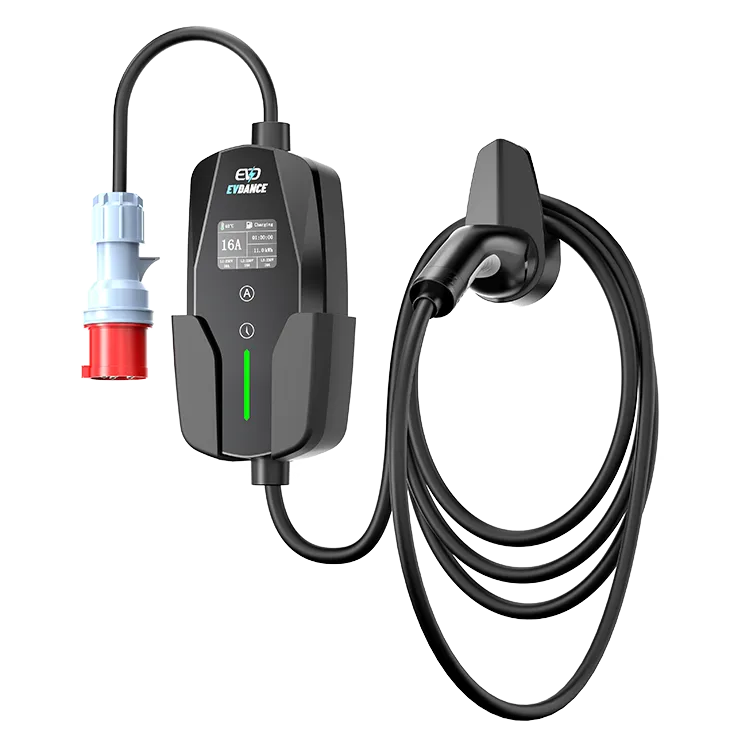
The headline line of the ACS1605PE spec sheet compresses three facts. 16 A is the current it draws on each of three phases. 230/400 V is one three-phase supply written the standard way — 230 V from any phase to neutral, 400 V from phase to phase. Type 2 is the car’s connector. Read together, they produce the rating: √3 × 400 V × 16 A ≈ 11 kW.
Key Takeaways
- 16 A is per phase; √3 × 400 V × 16 A ≈ 11 kW is the ceiling, and the car’s acceptance decides the session.
- Type 2 is the car end; the 16 A five-pin CEE socket is the gate at the wall end.
- The sheet names a display size and a cable length — and no app, settings or marks: missing lines are questions, not assumptions.
230/400V: Two Numbers, One Supply
The slash notation confuses buyers because it looks like a choice or a range. It is neither. A three-phase supply has three live conductors and a neutral: measure from any phase to neutral and you get 230 V; measure between any two phases and you get 400 V. Both are true at once, on the same supply — each does a different job in the sums that follow.
It matters practically: a single-phase building has the 230 V side only, no 400 V side, and sits outside this sheet entirely. The charger is built for the supply the pair describes — hence the notation, not a single voltage.
| On the sheet | What it measures | Why it is printed |
|---|---|---|
| 230 V | One phase to neutral | The per-phase voltage behind the current figure |
| 400 V | Phase to phase | The figure the three-phase power sum is built on |
| 16 A | Current drawn on each phase, continuously | The load the socket’s circuit is planned around |
| 11 kW | The output ceiling | Arithmetic on the lines above; the car must accept it |
Where the 11 kW Comes From
Three-phase power is √3 × phase-to-phase voltage × current per phase: √3 × 400 V × 16 A ≈ 11.1 kW, the 11 kW as rated. The same sum shows why the headline is a ceiling, not a constant: at the lower end of the class (380 V phase-to-phase) it gives about 10.5 kW.
The ceiling has a second condition: the charger offers the power, the car’s onboard charger sets what a session draws. A car accepting 11 kW of three-phase AC can take the full figure; a car accepting less charges at its own rate. Our explainer on single-phase vs three-phase charging works through the 7, 11 and 22 kW steps side by side.
Type 2 at the Car, Five Pins at the Wall
Type 2 names the car end. The wall end is the CEE five-pin plug, and it is the gate — it works only where a matching 16 A five-pin CEE socket is fitted, identified by pins and printed rating; our guide to CEE plugs, 16 A vs 32 A, covers that identification. The enclosure line, IP66, describes the housing — dust-tight, sealed against powerful water jets — a rating for the casing, not for the circuit behind the socket.

The Short Lines — and the Missing Ones
- Display: 1.77 inch. A size is stated, and that is all — no readings or fields are named.
- Cable: 7.6 m. A stated length — measure your socket-to-charge-port route against it before ordering. Our cable length guide covers the measuring.
- No app, RFID or OCPP is claimed. Sessions are run at the unit itself.
- No adjustable current steps are listed — one rating is stated, not a range of settings.
- No certification marks are named beyond the IP66 enclosure rating. If a mark matters for your purchase, it is a document to request, not a line to assume.
The charger behind the sheet is the ACS1605PE: EVDANCE’s 11 kW three-phase portable (Shenzhen, founded 2011), covered by a 3-year standard warranty. Anything the sheet does not carry is a written question via the contact page. For 32 A sockets, the sibling EV-ACS3205PE is the 22 kW portable.
Frequently Asked Questions
Is 230/400 V two different supplies?
No — one three-phase supply measured two ways: 230 V phase-to-neutral, 400 V phase-to-phase. A single-phase building has only the 230 V side and cannot feed this charger.
Will it deliver 11 kW to any EV?
Only to a car whose onboard charger accepts 11 kW of three-phase AC; others charge at their own lower rate — the charger offers, the car decides.
Does the sheet include an app or charge cards?
No — neither is claimed for this model, and no current settings are listed either: one rating is stated, sessions are run at the unit.
Related Reading
- Single-Phase vs Three-Phase EV Charging: 7kW, 11kW and 22kW Explained
- CEE Plugs Explained: Choosing 16A or 32A for a Three-Phase Portable EV Charger
- Portable EV Charger Types Explained: 10A, 16A, 32A and Three-Phase Models

