
Yes — charging through winter in an unheated barn or workshop is normal working use for the ACS1605PE: the unit is sealed to IP66 and plugs into the building’s 16 A CEE socket in January exactly as in June. What winter changes in an outbuilding is damp and handling, not the electrics — condensation on cold metal, a stiffer cable, and a car that accepts charge more slowly while its battery is cold. One limit stated plainly: the listing publishes no minimum operating temperature, so the manual is the authority for its rated range.
Key Takeaways
- Winter in a working outbuilding is a damp-and-handling problem, not an electrical one.
- IP66 seals the charger, not the building’s socket: wipe dry before connecting, and skip a wet or iced socket.
- The listing states no minimum operating temperature — the manual’s rated range is the authority.
An Outbuilding Makes Its Own Damp
An unheated building tracks the outdoor temperature. The damp is the local part: a working building generates moisture indoors, and in winter it condenses on the coldest surfaces — plug pins and connector face included. Each source has a habit that answers it:
| Where the damp comes from | Where it lands | The habit |
|---|---|---|
| Vehicles and machinery brought in wet | Condensation on cold metal, plug pins included | Wipe the plug and connector dry before connecting |
| Livestock, bedding and stored feed | Humid air all day, settling on everything | Keep the Type 2 connector capped between sessions |
| Washing down and wet floors | Splash and standing water near the socket | IP66 seals the charger, not the building’s socket — keep the plug out of wash-down paths; never connect wet |
| A cold roof in a mild spell | Drips from the roof sheets onto whatever rests below | Rest the unit out of the drip line, off the floor |
What freezing does to chargers and cables outdoors is covered in our cold-weather EV charging guide. Indoors the exposure is smaller, but the damp is closer: it is made on the premises.
Cold Handling on a Working Day
- The cable stiffens. Uncoil it in wide loops; never force a sharp bend or pry a stiff loop open. Coil it back wide at day’s end, while it still moves, instead of fighting it in the morning. Stiffness alone is not damage; a cracked or split jacket is — stop and contact EVDANCE.
- The CEE joint gets a look before every session. Frost, damp or a loose feel at the socket means skip until dry: never force a frozen plug in, never lever one out. The same socket often serves machinery, so it earns the glance any working socket gets.
- The display may look sluggish in deep cold. Screens respond more slowly when cold — an observation, and a fault only if it persists once warm.
- Dust is a winter resident too. Hay, straw and grit settle on a resting unit; a capped connector and an off-floor rest keep most of it out of the joint.

The Car Is the Slow Part in Winter
The charger’s offer does not change with the season — up to 11 kW, as ever. A cold car is another matter — its battery management limits how fast a cold pack accepts charge, and part of the incoming energy goes into warming the pack. Sessions run longer on cold mornings; the planning answer is dwell, not equipment: leave the car plugged in for the whole job rather than a timed hour. Where the car supports preconditioning while plugged in, that warm-up happens on wall power instead of battery power.
The Unit in This Scene
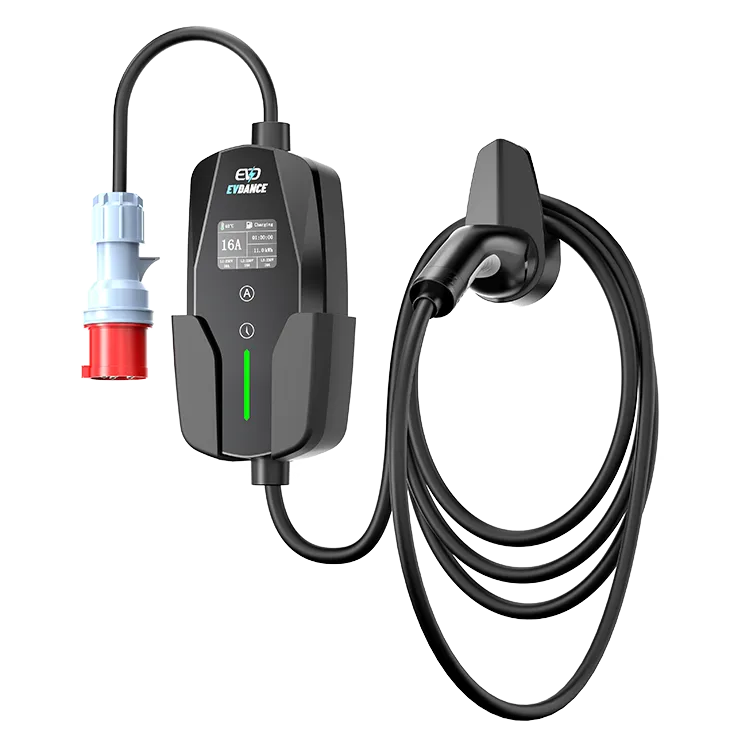
The ACS1605PE is EVDANCE’s 11 kW three-phase portable: 16 A at 230/400 V, a CEE five-pin plug, Type 2 to the car, a 1.77-inch display, an IP66 enclosure and a 7.6 m cable, covered by a 3-year standard warranty. Its published facts state a sealing rating, not a temperature range — so the manual’s rated range governs, and a building that regularly sits below it is a storage question for EVDANCE via the contact page.
Frequently Asked Questions
Can the unit live in the outbuilding all winter?
Its IP66 sealing covers dust and water, and a working building is its normal home. The storage temperature range is in its manual — check yours, and keep the practical side: off the floor, connector capped, out of the drip line.
There is condensation on the plug. Can I connect?
Wipe everything dry first. If the socket itself is wet or iced, skip the session until it dries — a damp joint and a continuous load do not belong together.
Does the cold reduce the charger’s output?
The charger’s rating does not change with the season. A cold car may accept less while its battery warms — the limit sits in the car, and lifts as the pack warms.
Related Reading
- Cold-Weather EV Charging: What Happens to Chargers and Cables Below Freezing
- How Long Do EV Charging Cables Last, and Can They Be Repaired?
- CEE Plugs Explained: Choosing 16A or 32A for a Three-Phase Portable EV Charger

