
Start from what your home already has. If a Swiss or Austrian home has a three-phase supply and a red 16 A CEE socket near where the car parks, the ACS1605PE plugs straight into it and charges at up to 11 kW — no wallbox to mount. The basics below cover what three-phase means, how to tell what your home has, and which questions belong to a local installer.
Key Takeaways
- The basics: three phases at 16 A each give this unit its 11 kW; a single-phase car takes one phase’s share, about 3.7 kW.
- The red five-pin CEE socket is the visible sign of the matching supply — if it exists near parking, the charger plugs straight in.
- No socket does not prove no three-phase supply; fitting the socket is a local electrician’s job.
- Registration, notification and subsidy questions are local — this article states no Swiss or Austrian rules.
Three-Phase Basics: Where 11 kW Comes From
A single-phase supply brings power on one live feed at 230 V; a three-phase supply brings three feeds. Charger sheets write this as 230/400 V: 230 V is each phase measured to neutral, 400 V is the voltage between phases. This unit draws 16 A on each of the three phases — that is where its 11 kW comes from, plain arithmetic, not a special mode.
| Your car’s onboard charger | What it draws from this unit |
|---|---|
| 11 kW three-phase | The full rate — all three phases at 16 A |
| 22 kW three-phase | Still 11 kW — the charger sets the ceiling here |
| Single-phase | One phase’s share: 16 A at 230 V, about 3.7 kW (labelled arithmetic) |
Our explainer on single-phase vs three-phase charging works through the 7, 11 and 22 kW classes in full.
Telling What Your Home Has
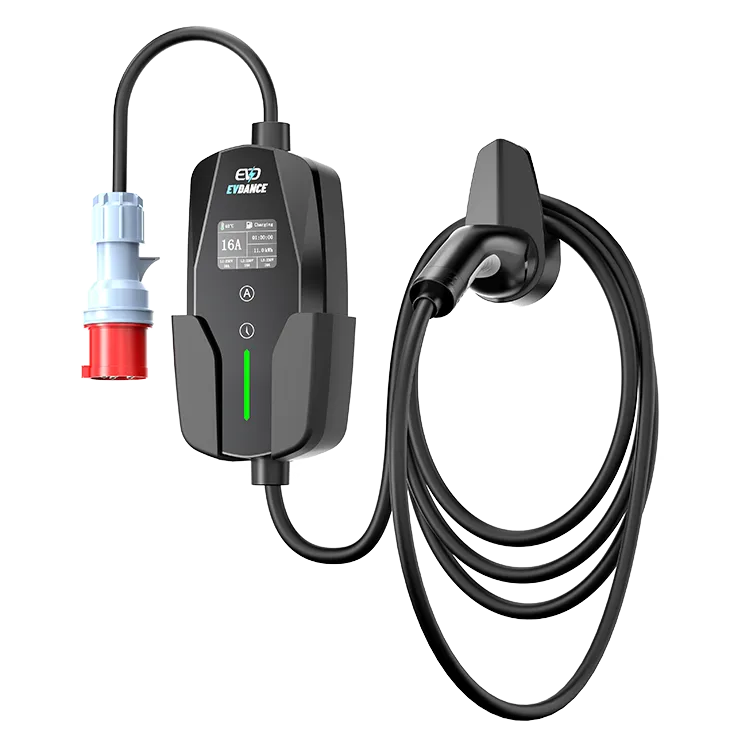
The visible sign is the socket itself. A red five-pin CEE socket — in a garage, a workshop corner or an outbuilding — is usually a leftover of machinery: a saw, a compressor or a heater. If one sits within cable reach of your parking, you already own the fixed half of this setup. No such socket does not settle whether your home has a three-phase supply — the supply can exist without the socket. It settles the route instead: the socket is fixed electrical work, fitting one is a local electrician’s job, and after that this charger needs nothing else. Colours mark the classes — a blue CEE socket is the single-phase class, matched by a different unit; our CEE plug guide works through identifying them by sight.

The Questions That Belong to a Local Installer
This article states no Swiss and no Austrian rules, deliberately. Three questions are local by nature:
- Is this socket and its circuit fit for the load? A socket that ran machinery in bursts is now asked to carry 16 A per phase for hours — EV charging is a continuous load, and whether it is fit for that is an installer’s judgement.
- Does using the socket this way carry any local duty — a notification, a registration, anything similar where you live? This article does not answer that, because the answer is local. Ask before the first session.
- Does any support or subsidy apply to your situation? Also local — an installer’s or the relevant local office’s answer, not a figure from a product page.
The ACS1605PE in Short
The ACS1605PE is an 11 kW three-phase portable charger: 16 A per phase at 230/400 V, CEE five-pin plug, Type 2 to the car, a 1.77-inch display, IP66 sealing — useful in outbuildings that are not fully dry — and a 7.6 m cable. The listing names no app and no access control for this model: at home, the session is started and stopped at the car. Our overview of portable EV charger types sets out the wider family. It carries the 3-year standard warranty.
Frequently Asked Questions
My socket is blue, not red. Is that a problem?
Yes — the colours mark different classes. A blue CEE socket is single-phase; this unit needs the red five-pin three-phase socket. For a blue socket, the match in this range is the single-phase EV-ACS3210E.
Do I need to register the charger or notify anyone before using it?
That is a local question, and this article deliberately does not answer it. Duties differ by place, and a local installer confirms the position for your home. Ask before the first session.
The socket is in an outbuilding, not by the car. Can I extend the run?
Only within the 7.6 m cable’s reach, with the car parked beside the building. Do not extend the run with extension leads or adapter chains — a second socket nearer the car is an electrician’s job.
Related Reading
- Single-Phase vs Three-Phase EV Charging: 7kW, 11kW and 22kW Explained
- CEE Plugs Explained: Choosing 16A or 32A for a Three-Phase Portable EV Charger
- Portable EV Charger Types Explained: 10A, 16A, 32A and Three-Phase Models
- Should an EV Charger Be Inside or Outside the Garage?

