
One dual-connector station serves more cars than one single-connector pedestal whenever both its bays stay busy — two cars charge at once instead of one. The honest trade is in the session, not the count: a pedestal’s 22 kW is dedicated to its single car, while the EV-AC03201T’s two connectors share a 43 kW ceiling, so a paired session can run slightly longer. Cars served per day is points times turnover; turnover is set by the energy each car needs and the rate it actually receives, so dwell and arrivals matter more than the nameplate.
Key Takeaways
- Cars served equals points times turnover; the dual station doubles the points per installed unit.
- Two 22 kW cars sharing 43 kW lose only minutes; the real trade is a guaranteed rate versus a shared pool.
- Pedestals win for single bays, scattered bays, gradual growth and failure independence.
- Measure your busiest two hours — dwell and arrivals beat nameplates.
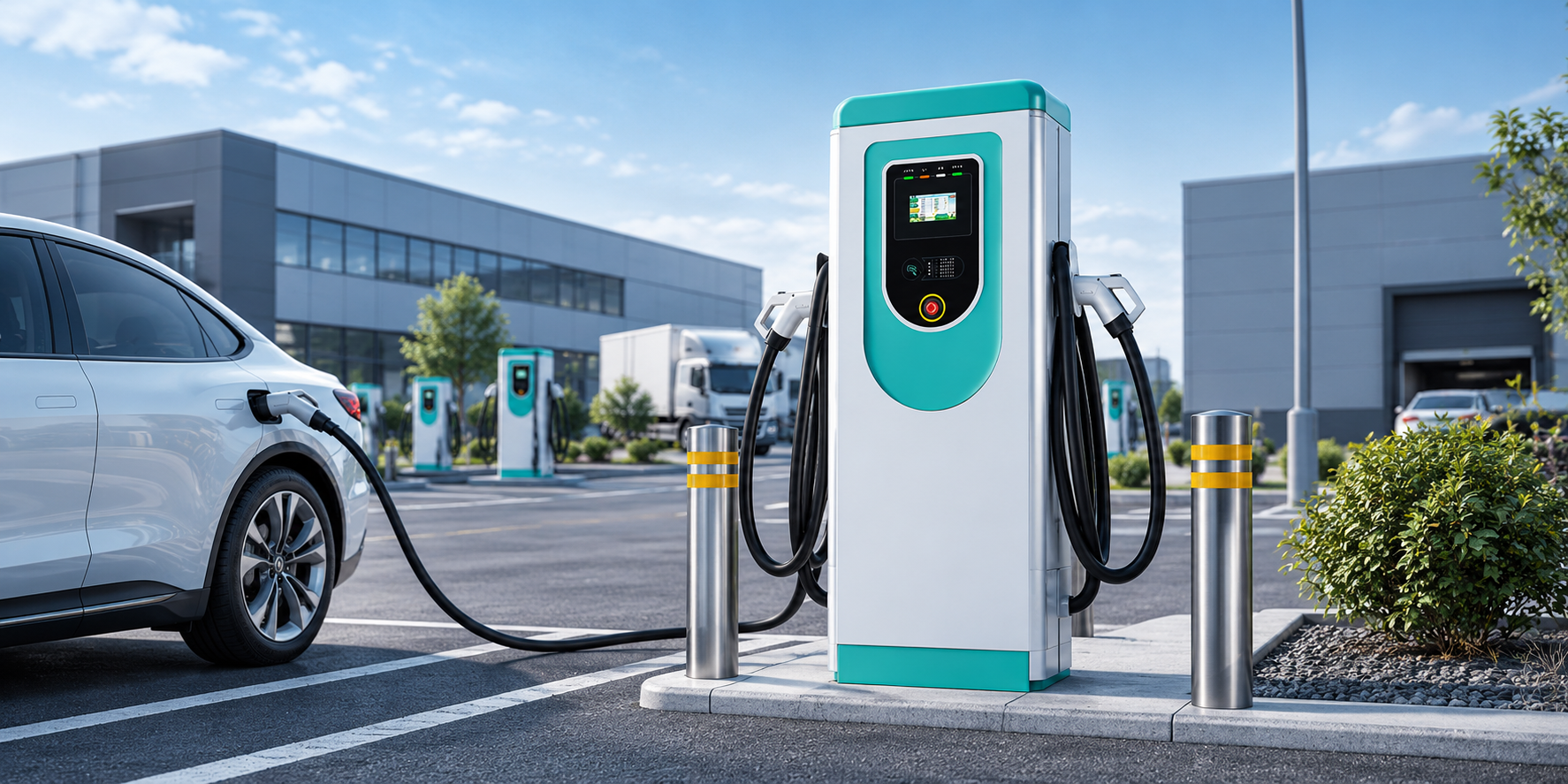
The Arithmetic: Points Times Turnover
A car needing about 20 kWh stored takes it at whatever rate the pairing allows; allow roughly 10% for losses in every figure below, and remember the car caps the rate — many accept less than 22 kW on AC. The table assumes back-to-back arrivals and no changeover gap.
| Arrangement | Cars charging at once | Session for about 20 kWh | Cars served in 10 hours |
|---|---|---|---|
| Single-connector pedestal, 22 kW dedicated | 1 | About 1 hour | About 10 |
| Dual station, one connector in use | 1 | About 1 hour (22 kW per-connector ceiling) | About 10 on that connector |
| Dual station, both connectors busy | 2 | About 1 hour each, if the 43 kW split evenly (about 21.5 kW per car) | About 20 across the station |
| Either format, cars that accept 11 kW | 1–2 | About 2 hours (the car sets the rate) | About 5 per connector |
Two things stand out. The sharing penalty for two 22 kW cars is small — an even split is about 21.5 kW each, minutes across an hour’s session. The station’s ceiling (43 kW) and two dedicated pedestals (44 kW) deliver almost the same daily energy; pedestals never lend each other anything, the station allocates one pool. Our explainer on dual port chargers covers the format in general.

When the Single-connector Pedestal Serves Better
The pedestal wins in clear cases:
- One bay, or bays added one at a time. Pedestals grow in single steps; a dual station grows in pairs.
- A guaranteed rate matters more than a second bay. A pedestal’s 22 kW is always there for its one car; the station’s per-connector rate depends on what the other connector is doing.
- Failure independence. One pedestal down leaves other points running; one station down closes both its bays.
- Scattered bays. A pedestal stands at its own bay; the station serves the two bays beside it.
What the Count Leaves Out
Cars served is not the same as drivers satisfied. Idle minutes between cars, the arrival peak and how long drivers genuinely stay — the dwell question our guide to charging for restaurants and retail works through — move the real number more than any nameplate. A site with four cars a day gains nothing from either maximum; a site with a 6 pm queue gains from every simultaneous point. Count your busiest two hours before choosing.
The Dual-connector Option From EVDANCE
The EV-AC03201T is a floor-standing dual-connector AC station: two Type 2 connectors, up to 43 kW shared (22 kW per connector) with dynamic power allocation, OCPP 1.6J, RFID access, a 7-inch touchscreen and an IP54 enclosure. For a single point, EVDANCE’s own unit is the EV-ACT3204PE 22 kW wallbox — a wallbox, not a pedestal; the pedestal form belongs to the wider class compared above. Both appear in the commercial charging range. EVDANCE is a Shenzhen manufacturer founded in 2011, and its chargers carry a 3-year standard warranty.
Frequently Asked Questions
Does sharing 43 kW make each car much slower?
In the even-split illustration, two cars accepting 22 kW see about 21.5 kW each — minutes on an hour-long session. Cars accepting less are limited by the car, not by sharing. What sharing removes is certainty: the pedestal’s rate is fixed; the station’s per-connector rate depends on the pair.
Two pedestals or one dual station for two bays?
On cars served, close to a tie while both points stay busy. Decide on structure: two pedestals mean two supply runs, two foundations and independent failures; one station means one of each and a shared ceiling. Price both on the same site plan.
Which figure should I use for my own site?
Your busiest two hours: count the EVs arriving, the energy each needs and how long each stays. Points times turnover on those numbers — not the brochure maximum — is your figure.
Related Reading
- What Is a Dual Port EV Charger? How It Works and How to Choose
- What Is a Pedestal EV Charger?
- What Is the Best Commercial EV Charging Station? How to Choose
- EV Charging for Restaurants and Retail: Turning Dwell Time Into Visits

