
At 250 kW, the cable on a DC fast charger is thick, stiff and heavy, and its connector has to be pushed squarely home through the adapter into the car’s inlet. A handle makes that a controlled job instead of a wrestle: it gives your hand a proper grip, so alignment and the seating push come from your arm, not your fingertips. The handle changes handling only. The JT09 carries the same ratings family and the same two conditions as any DC adapter: your car maker must approve third-party DC adapters for your car, and the station must be open to your car under the network’s current terms.
Key Takeaways
- At 250 kW the cable is thick, stiff and heavy; seating its connector squarely is a handling task before it is anything else.
- A handle adds grip, alignment and leverage — control over the seating push and the removal pull.
- It changes nothing electrical: same ratings family, same session speeds, same two conditions.
- Never modify a DC adapter for grip; the JT09 is the handled form of the same bridge.
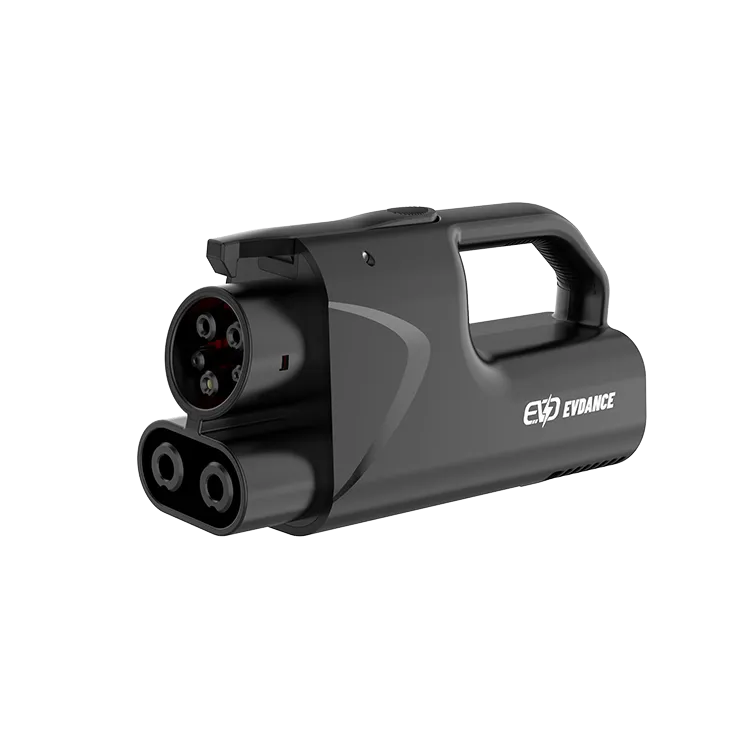
What 250 kW Hardware Feels Like in Your Hands
A cable built for hundreds of amps is not the cable on a home charger. The conductors are thick, the assembly is heavy, and it resists bending — more so in cold weather, when everything stiffens. At the car, you are managing that weight and stiffness while lining up two connectors at once: the station’s plug into the adapter, and the adapter into the inlet. If the angle is off, the connection will not seat properly, and a DC session will not start on a half-seated connector. The physical task is small, but it is the whole job: lift, align, push home, in whatever weather the stop happens in.
What the Handle Changes
| Task at the car | Gripping a bare adapter body | With a handle |
|---|---|---|
| Lift and align | Fingers around a smooth body while the cable’s weight pulls the angle off | A full-hand grip that holds the adapter’s angle against the cable’s pull |
| The seating push | Pressure through your fingertips, easy to push crooked | A straight push from the arm, so the connector goes in square |
| Removal | A tug on the body, against a snug, weather-sealed fit | Leverage for a firm, controlled pull |
None of this is about strength. It is about control at the one moment that decides whether the session starts cleanly: a connector seated square and fully, without being forced. Gloves, rain and a cold morning all make a smooth body harder to manage; a handle is the simple answer to each.
What the Handle Does Not Change
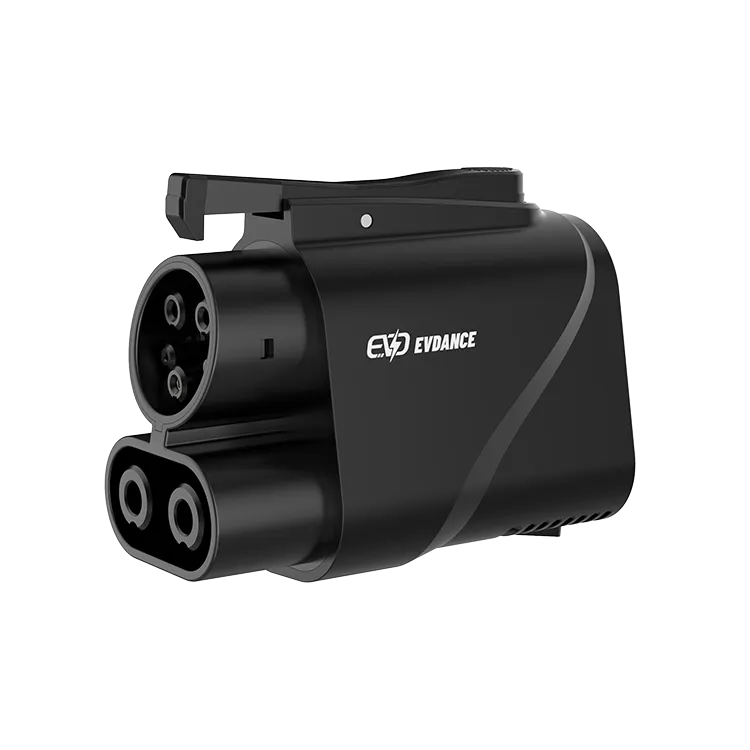
The handle is ergonomics, not electrics. It does not raise the ratings: the JT09 sits in the same 250 kW family at up to 500 A with IP66 sealing. It does not change your session speed, which the station and your car’s acceptance decide. And it does not touch the two conditions — car-maker approval of a third-party DC adapter, and the station being open to your car. The handleless JT08 is not an electrically lesser part for lacking one; it is the same bridge in a more compact form, as whether EV charging adapters are safe sets out for adapters generally.
The JT09 as the Worked Example
The EVDANCE JT09 is the handled member of the family: a NACS-to-CCS1 DC adapter rated up to 500 A, sealed to IP66, shaped so the seating push and the removal pull are one-handed, controlled movements even with a heavy cable behind them. It suits drivers who fast-charge often, and anyone who has wrestled a stiff connector in the rain. The conditions bear repeating, because the handle changes none of them: use it only where your car maker approves a third-party DC adapter for your car, and only at stations open to your car. If you charge rarely and prefer the smallest part in the glovebox, the JT08 covers the same ground.
Frequently Asked Questions
Does the handle make charging any faster?
No. The handle is on the outside of the adapter; the power and data paths are unchanged. Session speed is set by the station and your car’s acceptance, not by how the adapter is held.
Is the JT08 less safe because it has no handle?
No. Both adapters sit in the same ratings family with the same IP66 sealing and the same approval conditions. The handle is a handling preference, not a safety rating.
Can I add a grip or wrap to a handleless adapter?
Do not modify a DC adapter — no tape, wraps or add-on handles on a part that carries fast-charging current. If the handling matters to you, choose the handled model instead.
Related Reading
- Are EV Charging Adapters Safe?
- Can I Use a Tesla Charger for Other Cars?
- Is the Tesla Charger NACS? NACS, J3400 and Adapters Explained

