
If a Supercharger session through a JT08 or JT09 runs slower than expected, the adapter is the least likely cause. Both are pass-through parts with a 500 A ceiling: they add no power and throttle none away. Speed is set first by your car’s charging curve, then by what the station is delivering. Work through them in that order.
Key Takeaways
- A JT08 or JT09 adds no power and throttles none — look at the car’s curve first.
- The honest test is your own car at a CCS1 station — if the curve matches, the adapter is cleared.
- Suspect the adapter for damage and stopped sessions, not for clean slowness — and retire a damaged one.
Start With the Car: The Curve Sets the Speed
A DC session is a negotiation: the car tells the station how much power it can take, moment by moment, and the station supplies up to that request. Every car follows its own charging curve — the headline rate is a peak it asks for only at its best, with a low state of charge and a warm battery. As the battery fills the request steps down; that taper is the protection working as designed (see how DC fast chargers work). Arrive nearly full, or with a cold-soaked pack, and the peak may never appear. The honest test is your own car against itself: the same curve at a CCS1 station, with no adapter involved, clears the adapter — the curve travelled with the car, not the part.
| Cause, in the order to check | Where it sits | The check |
|---|---|---|
| The car’s acceptance curve and taper | The car | Watch rate vs state of charge; compare the same car’s curve at a CCS1 station |
| Battery state — high charge, cold pack, back-to-back stops | The car | Arrive lower; a trip’s first stop is the fairest test |
| The station’s side — a shared cabinet, a busy site | The station and network | Note a neighbour on the paired stall; try another stall |
| A connector not fully seated | The joint | One firm reseat, pushed straight home |
| The adapter’s ceiling | The adapter | The arithmetic below — it almost never binds |
The Station’s Share of the Answer
Stations have their own limits. Many DC sites feed paired stalls from shared equipment, so a neighbour plugging in can halve your stall’s offer — the session slows because the supply is divided, not because anything failed. How a network shares power is the operator’s practice: observable from the driver’s seat, not diagnosable there, and no adapter changes it. The practical test is another stall, or another hour.

Your Two Checks: Seating and the Ceiling Sum
Seating is the one part of the chain you control — and it rarely explains slowness. A DC connector not fully home usually ends the conversation rather than slowing it: the session faults or never starts. One firm reseat, pushed straight in, is still worth ten seconds; then look back at the car and the station.
Then do the ceiling sum. The adapters sit in the 250 kW class with a 500 A ceiling. As plain arithmetic: 250 kW at a pack voltage around 500 V draws about 500 A, and at higher voltages proportionally less. So the ceiling brushes the session only at the family’s headline corner; through the tapering half of a charge the current sits well below it. “The adapter is throttling me” is almost never the arithmetic answer.
The JT08 and JT09 in This Picture
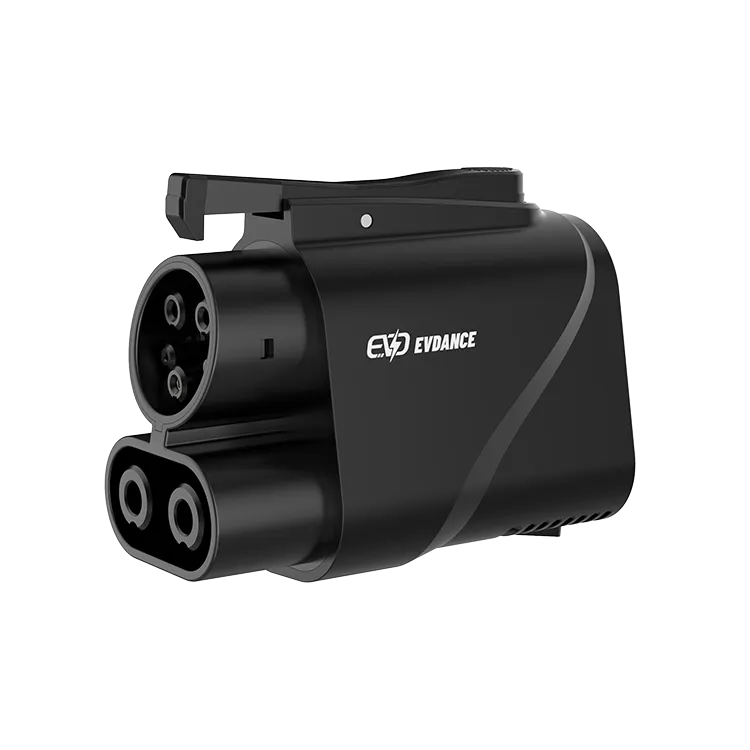
The EVDANCE JT08 and the EVDANCE JT09 are NACS-to-CCS1 DC adapters for a car with a CCS1 inlet at a NACS DC station, including Superchargers open to that car. Both are rated up to 500 A with IP66 sealing; the JT08 is also stated at up to 1000 V, and the JT09 adds a handle. Neither changes what the station delivers or the car requests. Both are used only where the car’s maker approves third-party DC adapter use for that car, and only at stations open to it. One real adapter fault does exist — visible damage, heat marks, a loose fit — and it shows as sessions that stop or refuse to start, not as clean slowness. The answer is retirement, as our guide to whether EV charging adapters are safe explains.
Frequently Asked Questions
Is the adapter throttling my session?
Almost never: the ceiling sum above puts the adapter’s 500 A ceiling at the top corner of a 250 kW-class session. The car’s curve and the station’s delivery explain slowness; damage explains stopped sessions.
Why was the first half fast and the second half slow?
That is the taper: the car reduces its request as the battery fills, adapter or not. Stopping lower and moving on beats waiting out the curve’s top.
Will the JT09 charge faster than the JT08?
No. Same ratings family, same pass-through session. The handle changes handling — grip and seating control — never power.

