
You retire a JT08 or JT09 on condition, not on age: no service life in years or mating cycles is published for these DC adapters. Work the checklist below — both connector faces, the housing, the seal, the JT09’s handle, and the evidence of your recent sessions. Any one hard sign takes the adapter out of service the same day; a DC adapter is replaced, never repaired.
Key Takeaways
- No age or cycle count retires a JT08 or JT09 — a failed check does.
- Inspect both faces, the housing, the seal, the JT09’s handle and the fit at both joints.
- Sessions failing with one adapter at several stations are evidence, even when the faces look clean.
- Any hard sign means out of service the same day: replace, never repair — and carry a spare if you depend on it.

The Checklist
Inspect unplugged, in good light, before a trip and after any drop. A DC adapter has two working faces, and both carry the session — check each one.
| What you inspect | Pass | Retire it |
|---|---|---|
| NACS-side face (to the station) | Face flat and clean, housing around the opening sound | Cracks, deformation, or any scorch or melt mark |
| CCS1-side face (to the car) | Contacts straight and even, as far as the eye can judge; face clean | Bent, pitted or darkened contacts; scorch marks; debris lodged in the face |
| Housing | Seams closed, shell rigid, no whitening at stress points | Any crack, split seam, or heat deformation |
| IP66 sealing | Seal sits evenly, still flexible, no grit trapped beneath it | Seal cracked, flattened or split; moisture visible inside a face |
| The handle (JT09) | Fixed firmly to the body, grip surface intact | Handle cracked, or any movement at its mount |
| Fit at both joints | Seats squarely at the station and the car with a positive engagement and no rocking | Needs force to seat, sits loose, or rocks at either joint |
The fit row judges only what your hands and eyes report — resistance, play, alignment. It makes no claim about any mechanism inside; if the feel has changed since the adapter was new, the change is itself the finding.
The Session Pattern Is Evidence Too
An adapter can pass the visual check and still indict itself in use. Sessions that fail to start, or drop mid-charge, with this adapter at more than one station — while other cars charge normally at those stations — point at the one common factor: the adapter. A single bad session points at the station; a pattern that follows the adapter across stations belongs to the adapter. When the pattern appears, stop testing it against more stations: retire it on the pattern, even if the faces still look clean.
What Retiring Means
Out of the car the same day — an adapter left in the boot “for emergencies” will be used in one. There are no user-serviceable parts inside: do not open it, file or bend contacts back, or tape a cracked housing. A retired adapter is replaced. EVDANCE’s standard warranty is 3 years, so if the adapter is within its term, contact the seller before buying the replacement. And if DC fast charging is your car’s only route home, carry a spare in known-good condition, so a failed check never strands you — the same discipline our guide to whether EV charging adapters are safe applies to any adapter.
The Adapters This Checklist Serves
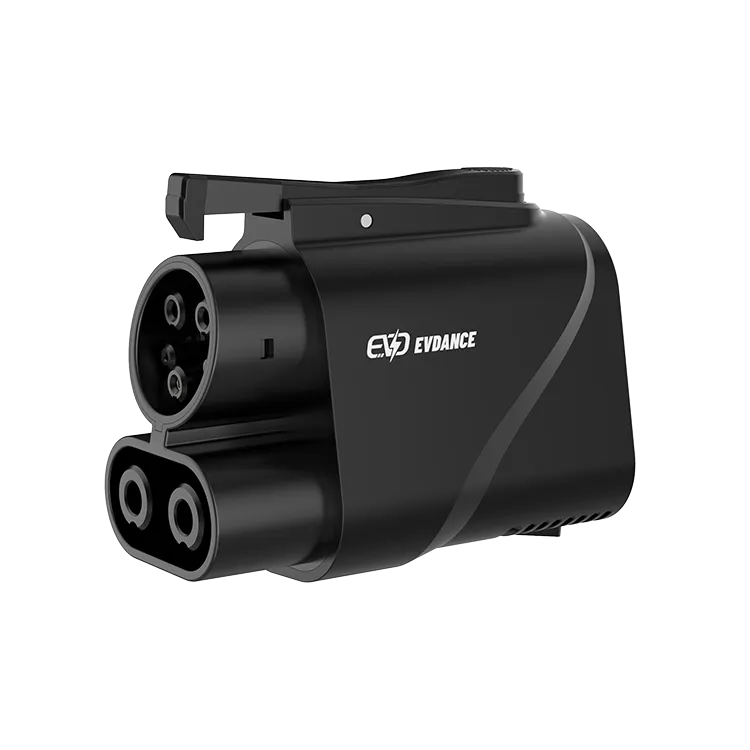
The EVDANCE JT08 (handleless) and EVDANCE JT09 (with handle) are NACS-to-CCS1 DC adapters in the 250 kW class, rated up to 500 A and sealed to IP66; the JT08 is also stated at up to 1000 V. They serve a car with a CCS1 inlet at a NACS DC station — including Tesla Superchargers open to that car — and only where the car’s maker approves third-party DC adapter use for it. Nothing in this checklist changes those conditions; it only decides whether a given unit is still the adapter its ratings describe.
Frequently Asked Questions
How often should I run this checklist?
On your own rhythm — before a road trip, after any drop onto hard ground, and whenever a session behaves oddly. No interval is published for these adapters; the triggers are events and patterns, not a calendar.
There is a small crack, but the adapter still charges. Can I keep it?
No. The housing aligns the contacts and carries the IP66 seal. A crack is a retire sign however well the last session went — take it out of service and replace it.
Can a damaged adapter be repaired?
Not by the user. There are no user-serviceable parts inside an adapter, and opening or modifying one ends any question of its rating holding. Replacement is the repair; check the warranty position with the seller first.
Related Reading
- Are EV Charging Adapters Safe?
- Is the Tesla Charger NACS? NACS, J3400 and Adapters Explained
- Does J1772 Work With CCS? CCS Connectors Explained

