
At the same NACS DC station, a car with a native NACS port and a CCS1 car using a JT08 or JT09 run the same kind of session: the station delivers DC, the car’s acceptance curve sets the rate, and the network’s price is the network’s price. What changes for the adapter driver is everything around the session — one extra connection to make and seat, one extra permission to hold, and one extra item to carry and not lose. Neither side is the better car; they are two routes to the same session.
Key Takeaways
- Same station, same kind of session: the car’s acceptance curve sets the rate for native and adapter-fed cars alike.
- What changes is around the session: an extra joint to seat, a maker approval to hold, and an adapter to carry and keep.
- Site openness is the network’s condition for everyone; maker approval is the adapter driver’s additional one.
- Neither route is the winner — the native port is the simpler path, the adapter is the wider map.
Side by Side at the Same Station
| Aspect | Native NACS port | CCS1 inlet with a JT08/JT09 |
|---|---|---|
| Connecting | The station’s connector plugs straight into the car | The adapter goes onto the station’s connector first, then into the car — one more joint to seat fully |
| Permission | The network’s openness to your car, on the network’s terms | The same openness, plus your car maker’s approval of third-party DC adapters for your car |
| Charging speed | Set by your car’s DC acceptance curve | Set by the same curve — the adapter’s 500 A ceiling sits above the session, not inside it |
| Extra hardware | None | The adapter itself: carried, stored, inspected — and easy to forget at a stall |
| If a document says no | Nothing extra to refuse; the port is the car’s own | If the maker’s guidance does not approve an adapter for your car, this route is closed, whatever the station allows |
What Does Not Change
The session underneath is identical in kind: the station delivers DC at the car’s battery voltage, the session is negotiated before power flows, and the rate rises and tapers on the car’s acceptance curve — the pattern behind how fast a DC fast charger is. U.S. DOT figures put DC fast charging as a class at 50–350 kW, and both drivers draw from the same hardware at the same post. The network sets the session’s price for both. An adapter driver is not buying a slower, lesser session — the same session, with extra steps in front of it.
The Adapter Driver’s Extra Discipline
- Approval, checked per car. The native driver never thinks about adapter approval because there is no adapter. You check your maker’s current guidance for your exact model and year — and re-check it when the maker revises it.
- Two joints, seated fully. Adapter to station connector, then the pair to the car. A half-seated joint is a session that never starts — and seating is entirely in your hands.
- Custody. The adapter leaves with you, every time. The native driver has no equivalent item; yours is a loose, valuable part whose favourite trick is staying behind in the station’s connector.
The Two Adapters in This Comparison
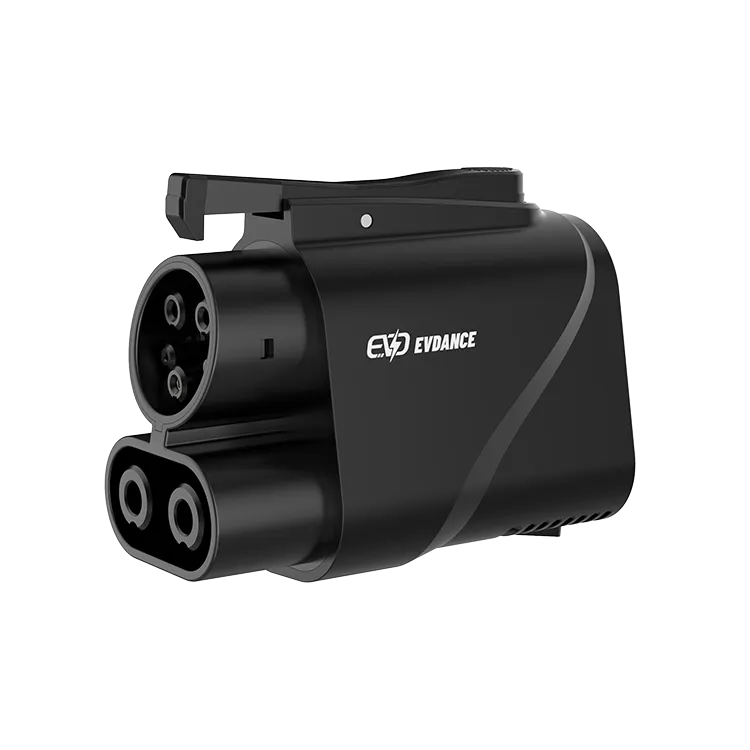
The EVDANCE JT08 (handleless, up to 500 A / 1000 V, IP66) and the EVDANCE JT09 (with handle, up to 500 A, IP66) are the CCS1 side of the table above: NACS-to-CCS1 DC adapters for stations including Tesla Superchargers that are open to your car. The comparison’s condition bears repeating from this side too: use either only where your vehicle maker approves third-party DC adapter use for your car, and only where the network has opened the station to it. How the two connectors relate is set out in whether J1772 works with CCS and in whether the Tesla charger is NACS.

Frequently Asked Questions
Does a native NACS car charge faster at the same station?
Not because of the port: each car’s acceptance curve sets its rate, and a native car with a modest curve charges slower than an adapter-fed car with a strong one. The adapter’s ceilings sit above the session, so the connector route limits neither.
Does a native NACS driver need approval too?
No maker approval — there is no adapter to approve. But station openness is the network’s condition for every car, native or not: a site the network has not opened to your car is closed to you on the same terms.
Does the adapter turn my CCS1 car into a NACS car?
No. The adapter bridges the connector for one session at a time and comes off again afterwards. Your car keeps its CCS1 inlet, and at a CCS1 station it charges exactly as it always did, with nothing in between.
Related Reading
- Does J1772 Work With CCS? CCS Connectors Explained
- Is the Tesla Charger NACS? NACS, J3400 and Adapters Explained
- Can I Use a Tesla Charger for Other Cars?
- Are EV Charging Adapters Safe?

