
Three instruments form the core of EV charger test equipment: a load bank that draws real power, an EV simulator that plays the car’s side of the charging handshake, and leakage and insulation testers that prove the safety barriers. Together they let engineers verify output, behaviour and safety on the bench — and for a brand or engineering buyer, a factory’s instrument list is evidence you can audit.
Key Takeaways
- Charger testing needs a vehicle-side partner and a power-side load at the same time — hence dedicated instruments.
- Load banks verify delivered power, simulators verify behaviour, leakage and insulation testers verify the safety barriers.
- Calibration records are part of the equipment; ask for them when you audit a factory.
Why a Charger Cannot Be Tested With a Plug and a Meter
An EV charger delivers nothing until it has negotiated with a vehicle: it listens for the car’s signals, advertises the current it can offer, and only then closes its contactors. So a meaningful test needs two partners at once: something that behaves like a car on the signal side, and something that absorbs real energy on the power side — hence dedicated instruments rather than general workshop tools. (Testing an installed charger in the field is a different job — see our guide on how to test an EV charger.)
The Three Core Instruments
| Instrument | What it stands in for | What it verifies | Where it is used |
|---|---|---|---|
| Load bank | The energy a car battery would absorb | Delivered current and power at each setting; behaviour over a sustained run, including heating | Development bench, production line, repair bench |
| EV simulator | The vehicle side of the control-pilot and proximity signals | Start/stop logic, current following, responses to vehicle states and faults | Development, end-of-line screening, service diagnostics |
| Leakage and insulation testers | The fault conditions the protective design must survive | Earth-leakage behaviour, protective trip functions, insulation integrity | Production safety-test station, certification support |
The three are complementary, not interchangeable. A simulator can persuade a charger that a car is connected and asking for power, but absorbs little or none of it. A load bank absorbs the power but cannot perform the handshake. A leakage tester proves a different thing again: that the protective response happens when insulation fails. A complete station normally combines all three roles.
The Supporting Kit Around Them
Around them sits measurement equipment that turns a pass/fail run into engineering data:
- Power analysers and reference meters — confirm delivered energy and the charger’s own metering against a trusted reference.
- Signal monitoring — oscilloscopes show the handshake waveform when behaviour needs diagnosing, not just screening.
- Temperature logging — sensors on terminals and power components during load runs, so heating is recorded, not felt by hand.
- Calibration records — every instrument is only as trustworthy as its last calibration; records are part of the equipment.
What a Buyer Should Ask a Factory
If you buy chargers under your own brand, the test bench is part of what you are buying. Ask for the equipment list per test station, which instruments run at production stations and which stay in the lab, and each one’s calibration record. Our factory audit checklist for importers shows where these questions sit in a wider audit; our guide to testing a charger sample before a bulk order covers the check you run yourself.
Sourcing Chargers From EVDANCE
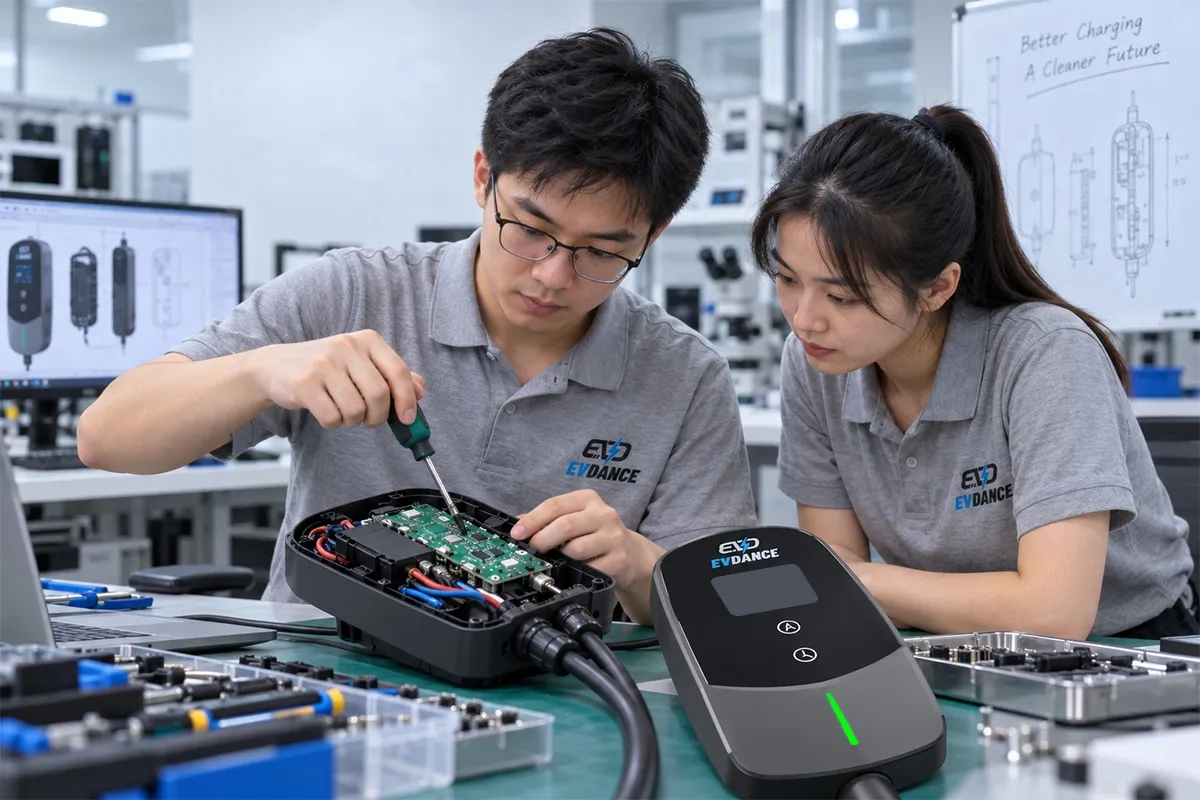
EVDANCE is a Shenzhen manufacturer founded in 2011, with its own factory and exports to more than 30 countries. Units verified on such benches range from portables such as the EV-ACS4005T to wallboxes such as the EV-ACT5006T. We do not publish a station-by-station equipment list, so request the test-equipment list and calibration records for your models in writing, as part of the order — as you would with any factory. Start through the OEM and private-label programme or contact us.
Frequently Asked Questions
Can you test a charger with a real car instead of this equipment?
Partly. A real car proves the charger works with that car, on that day. It cannot repeat the same state a hundred times, present controlled faults safely, or absorb power on a production schedule — hence simulators and load banks, with real vehicles as a final complement.
What is the difference between a load bank and an EV simulator?
They cover the two halves of the test: the simulator provides the vehicle-side signals that persuade the charger to start; the load bank absorbs the energy the charger then delivers. Most full-power tests need both at once.
How does a buyer know the factory’s test equipment is accurate?
Through calibration. Ask for each instrument’s calibration certificate or record, with dates, and check the station’s instruments are in date. Uncalibrated test equipment produces numbers nobody should rely on.
Related Reading
- EV Charger Factory Audit Checklist for Importers
- How to Test an EV Charger
- How to Test an EV Charger Sample Before Placing a Bulk Order
- EV Charger Certifications Explained: CE, UKCA, UL, ETL, CB and What Buyers Should Ask For

