
A Chilean distributor does not stock for one climate. The same order book can hold a dry, dusty inland site, a humid coastal site and a wet site far to the south — so which EV chargers suit Chile is answered as a per-site exposure audit, followed by a per-site supply confirmation. Exposure is matched against the IP rating a model actually states and the temperature evidence you obtain in writing; supply is matched against the nameplate window. A model earns its place zone by zone, not by country label.
Key Takeaways
- Suitability in Chile is a per-site audit: exposure class first, confirmed supply second, connector family from the parc at that site.
- IP ratings answer dust and water only — salt corrosion and temperature range are written-evidence items.
- No EVDANCE listing publishes an operating-temperature range; get it in writing before quoting a model for an extreme zone.
- IP54 stations belong in covered bays; IP66 lines are the exposed-site candidates.
Audit Exposure Site by Site
Walk each class of site you sell into and name what the environment tests. The IP code answers part of it: in the code, the first digit rates protection against solids — 6 is dust-tight, 5 dust-protected — and the second rates water protection, as our IP ratings comparison decodes. The rest is evidence you request, because no IP code covers corrosion and no EVDANCE listing publishes an operating-temperature range.
| Exposure class | What it tests | Evidence to require |
|---|---|---|
| Dry, dusty inland sites | Dust ingress, heat load on an exposed enclosure | A stated IP first digit of 6, or a covered siting plan; the model’s stated temperature range, in writing |
| Humid coastal sites | Moisture ingress and salt-air corrosion of enclosures and contacts | The stated IP rating for water; written evidence on enclosure and contact corrosion protection — IP says nothing about salt |
| Wet sites with driving rain | Water jets and pooling around the installation | A stated second digit that matches the exposure, or a covered bay for IP54 equipment |
| Cold southern or high sites | Cable handling in the cold and enclosure behaviour at low temperature | The model’s stated temperature range, in writing, before the model is quoted for the zone |
For the dry end of the country, our guide to hot-climate EV charging covers siting practice — shade, cover and clearance — that applies wherever a charger lives exposed to sun and dust.

Then Confirm the Supply at the Same Site
Exposure sorts the enclosure; the supply sorts everything else. For each site, have the nominal voltage, frequency and phase service confirmed in writing, and read the model’s rating label against it — our explainer on rating labels and required markings shows where the input window sits, and our guide to single-phase vs three-phase charging covers what each service supports. Connector family follows the vehicles at that site, counted the same way as anywhere: the parc the buyer serves decides between the Type 2 lines and the North-American-format lines, site class by site class.
One Range, Zoned on Purpose
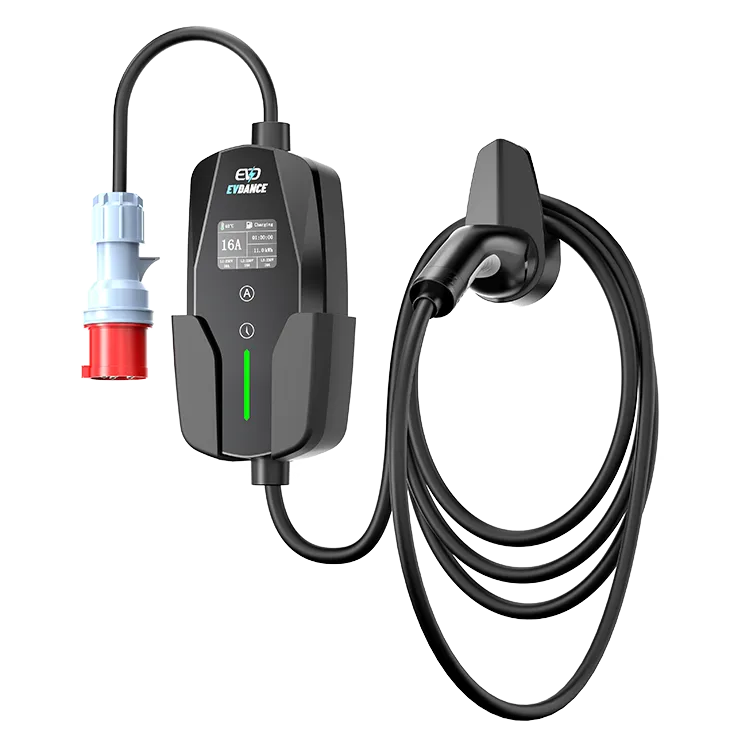
Applied to this range, the audit produces a zoned shortlist rather than a single winner. The IP66 lines — the EV-ACS3210E single-phase portable, the ACS1605PE and EV-ACS3205PE three-phase portables and the EV-ACT3204PE wallbox at its stated IP66 — are the exposed-site candidates. The IP54 stations, the EV-AC03201T and the EV-RHDC30K-L compact DC unit, belong in covered bays, where the roof does the work their rating does not claim; the DC unit’s connector variant is not named in its listing and is confirmed in writing. EVDANCE, founded in 2011 and exporting to 30+ countries with a standard 3-year warranty, answers zone questions per model — send your site classes via contact us or the distributor program.
Frequently Asked Questions
Is IP66 enough for a coastal site?
It answers dust and water — dust-tight, and protected against powerful water jets by the code’s definitions. It says nothing about salt corrosion, which the IP code does not test. For coastal sites, ask for the manufacturer’s written evidence on enclosure and contact corrosion protection alongside the rating.
Can one model cover every zone I sell into?
Sometimes — an IP66 portable with a nameplate window that matches each site’s confirmed supply can travel across zones. But the decision is made per zone from evidence, not once for the country: a model placed in a wet, exposed site on the strength of its dry-zone record is a claim waiting to happen.
What temperature evidence should I request?
The stated operating-temperature range for the exact model, in writing, before you quote it for a hot or cold zone. No EVDANCE listing publishes one, so treat any verbal figure as unconfirmed and site the unit with shade or cover in the meantime.
Related Reading
- IP Ratings for EV Chargers: IP54, IP65 and IP66 Compared
- Hot-Climate EV Charging: Protecting Chargers From Desert Heat and Sun
- Rating Labels and Required Markings on EV Chargers
- Single-Phase vs Three-Phase EV Charging: 7kW, 11kW and 22kW Explained

