
For Morocco, sort chargers by exposure first. Sun and dust decide where a unit may live: match the site’s conditions against the IP rating on the listing, treat heat as a siting question — shade, cover and clearance — because no listing publishes an operating-temperature rating, and get that figure from the manufacturer in writing. Then confirm each site’s supply against the model’s nameplate window, and fix the connector family from the vehicles your customers actually drive.
Key Takeaways
- Sort by exposure first: dust is answered by the stated IP rating — IP66 models are dust-tight; IP54 stations belong in covered bays.
- No listing publishes a temperature rating; handle heat by siting, and get the figure in writing before ordering.
- Confirm each site’s supply against the nameplate window in writing — per site, never by assumption.
- Fix the connector family from your own parc survey, and confirm the DC unit’s connector variant before ordering.
Exposure First: Dust and Heat Are Spec-Sheet Checks
In the IP code, the first digit rates protection against solids, dust included: 6 is dust-tight, 5 means dust-protected, where some ingress is permitted but must not interfere with operation. Our explainer on IP ratings for EV chargers works through both digits, and our guide to hot-climate EV charging covers siting practice for sun-exposed bays. Applied to a Moroccan shortlist, the checks run in this order:
- Exposed, dusty site: only a model whose listing states the dust-tight end of the code belongs there; a lower-rated unit is a covered-bay product, and the roof does the work its rating does not claim.
- Sun-baked bay: no EVDANCE listing publishes an operating-temperature range, so heat cannot be compared on paper — ask for the exact model’s stated range in writing, and site the unit in shade or under cover with the clearance its manual specifies.
- Connector care: dusty sites keep connectors off the ground and capped when idle, whatever the enclosure rating says.

Then the Nameplate Window, Site by Site
| Check | What you read | What you confirm in writing |
|---|---|---|
| Supply at the site | The model’s stated input window on its rating label and listing | The site’s confirmed voltage and phase supply, from the installer or the utility — per site, never assumed from another site |
| Connector family | The connector or socket the listing states | The inlets of the vehicle parc your customers actually run — survey first, stock second |
| Exposure | The IP rating the listing states | Whether the bay is covered or open, and the siting the installer will actually build |
| Market version | The variant named in the order documents | That the unit offered is the version built and documented for your market |
Where a site’s confirmed supply is single-phase, the stated single-phase portable is the EV-ACS3210E: about 7 kW, Type 2, IP66. Three-phase sites open the rest of the Type 2 range — and the supply at the actual site, confirmed in writing, is what decides which half of the range is even a candidate.
The EVDANCE Shortlist, as Stated
| Model | Stated facts | Where it fits |
|---|---|---|
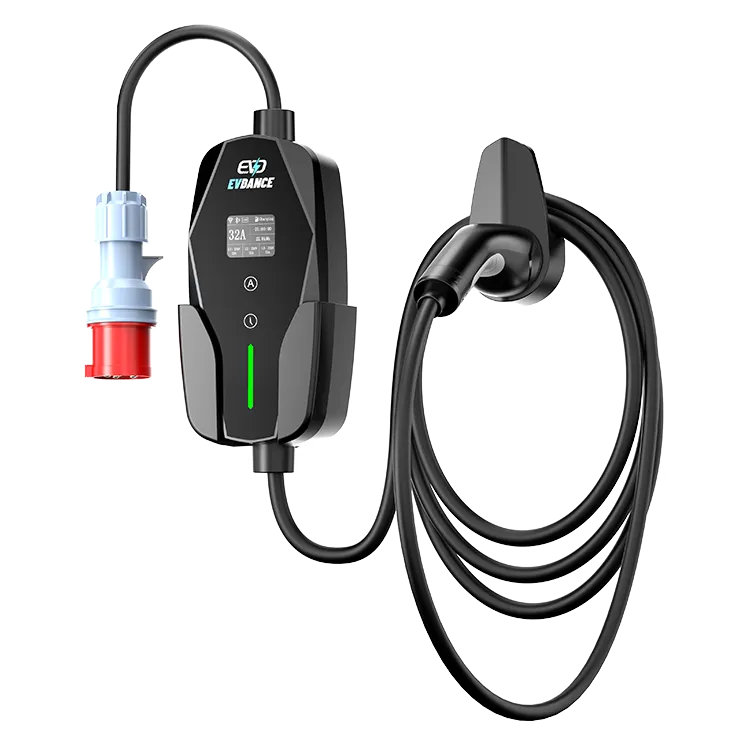
| ACS1605PE | 11 kW three-phase portable, CEE 5-pin plug, Type 2, 7.6 m cable, IP66 | Sites with CEE 16A supply points |
| EV-ACS3205PE | 22 kW three-phase portable, CEE 32A plug, Type 2, IP66 | Sites with CEE 32A supply points |
| EV-ACT3204PE | 22 kW wallbox, tethered Type 2 cable, RFID and app, IP66, CE | Fixed bays where access control matters |
| EV-AC03201T | Dual-connector AC station, up to 43 kW shared, OCPP 1.6J, RFID, IP54 | Covered, platform-run shared bays — the IP54 rating puts it under a roof |
The compact DC unit, the EV-RHDC30K-L, states 22 kW DC, OCPP 1.6J and IP54; its listing does not name the DC connector variant, so that is a written-confirmation item before ordering. The full range is on the products page; selection questions start via contact us.
Frequently Asked Questions
Is IP54 enough for an open, dusty site?
No. IP54 means dust-protected, not dust-tight, so an IP54 station belongs in a covered bay. Where a unit must live exposed, shortlist the models whose listings state IP66 and handle heat by siting and shade.
Are EVDANCE chargers rated for Moroccan summer heat?
No EVDANCE listing publishes an operating-temperature rating, so there is no figure to quote or compare. Ask for the exact model’s stated range in writing before ordering, and handle heat where you control it: shade, cover and the clearance the manual specifies.
Which connector family should I stock?
The one your customers’ vehicles carry. Survey the inlets of the parc you will actually serve before fixing the stocking mix — the connector stated on the listing must match the cars, and adapters change connector shape only; they add no power and convert no protocol.
Related Reading
- Hot-Climate EV Charging: Protecting Chargers From Desert Heat and Sun
- IP Ratings for EV Chargers: IP54, IP65 and IP66 Compared
- Are Portable EV Chargers Waterproof? IP Ratings Explained for Drivers
- EV Charger Certifications Explained: CE, UKCA, UL, ETL, CB and What Buyers Should Ask For

