
The chargers that suit Egypt are sorted first by where the unit will sit. Class each site — indoor parking, covered bay, or open and exposed — and match that class against the enclosure rating stated on the listing: the IP66 portables and the IP65/IP66 wallbox can be considered for exposed mounting, while the IP54 stations belong under cover. Heat is handled by siting and a written request, because no EVDANCE listing publishes an operating-temperature range. Phases and connectors come after, from the site’s confirmed supply and the vehicles that will charge there.
Key Takeaways
- Sort by siting class first: indoor, covered bay, or open — then match the stated IP rating to the class.
- IP54 stations belong under cover; exposed siting belongs to the stated IP66 portables and the IP65/IP66 wallbox.
- No listing publishes a temperature range: heat is a siting decision plus a written request, never a guessed figure.
- Phases follow the site’s confirmed supply; connectors follow the vehicle parc you counted.
Sort by Siting Class Before Anything Else
The IP code’s two digits grade protection against solids and water; our IP ratings comparison explains the scale. What matters is the match between that stated rating and the bay’s micro-environment — a generous rating indoors can be the wrong purchase on an open wall. Work class by class:
| Siting class | Stated rating that fits | EVDANCE models, as listed | Confirm in writing before ordering |
|---|---|---|---|
| Indoor or basement parking | Any stated rating; access and billing features decide instead | EV-AC03201T dual-connector station (IP54, OCPP 1.6J, RFID); EV-ACT3204E wallbox (IP65/IP66, RFID and app) | The site’s confirmed supply and phases; who operates the station and bills drivers |
| Covered bay or canopy | IP54 acceptable — the structure does part of the work | EV-AC03201T; EV-RHDC30K-L compact DC (22 kW, OCPP 1.6J, IP54) | The DC unit’s connector variant — its listing names none; the cover the installer will build |
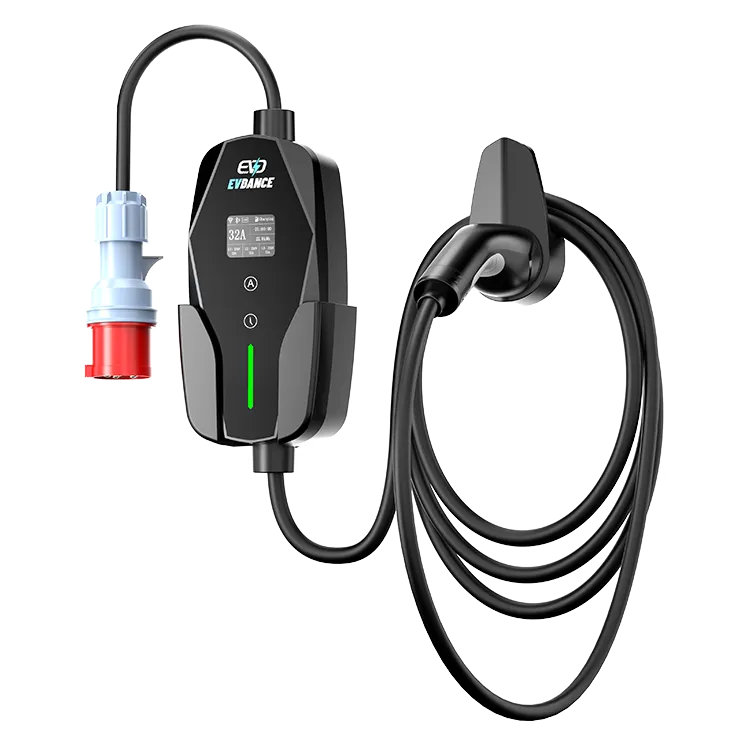
| Open yard or exposed wall | Dust-tight, jet-resistant ratings only | EV-ACS3205PE 22 kW three-phase portable (IP66); ACS1605PE 11 kW three-phase portable (IP66); EV-ACT3204PE (IP66) | The exact model’s stated temperature range — no listing publishes one; shade and clearance in the installation scope |

Heat and Dust Enter as Siting Decisions
Heat cannot be compared on paper for this range: no EVDANCE listing publishes an operating-temperature range, so there is no figure to rank models by. Two honest tools remain. The first is the written request — ask the manufacturer for the exact model’s stated range before ordering for exposed sites, and treat a silent datasheet as an open item. The second is siting: shade, cover, wall orientation and the manual’s clearance do the work a missing rating cannot, as our guide to hot-climate EV charging sets out. Dust is the mirror image: it is scored, by the IP code’s first digit, so exposed, dusty siting is a stated-rating decision, not a hope.
Then Phases, Then Connectors
With the siting class fixed, the electrical sort follows the site, not the catalogue. The supply confirmed at each site — voltage window and single-phase or three-phase, in writing from the installer or utility — decides which half of the range is a candidate: the single-phase EV-ACS3210E portable (about 7 kW, Type 2, IP66) on one side, the three-phase Type 2 lines on the other. How phases change what a bay can deliver is covered in our explainer on single-phase vs three-phase charging. Level 2 spans 7–19 kW in the U.S. DOT’s typical figures; where a site lands in that span is a property of its confirmed supply. Last, count the vehicles: their inlet types fix the connector family, as our guide to choosing plug, cable and connector by market works through. Which market version of each model Egypt requires is itself a written confirmation, closed with your importer of record as of October 2026 — put the siting class and site supply in the enquiry via contact us or the products page.
Frequently Asked Questions
Is IP54 enough for an outdoor charger in Egypt?
Only under cover — a covered bay or canopy. For open siting, shortlist models stating the dust-tight, jet-resistant end of the code, and handle heat by siting plus a written temperature-range request.
What voltage and phases do Egyptian sites use?
Deliberately not stated here: the binding answer is the supply confirmed at your site, in writing, by the installer or utility. Match the model’s nameplate window to it, per site.
Which connector should I order?
The one your sites’ vehicles carry. Count the parc’s inlets first; the listing’s stated connector must match them. For the compact DC unit, the variant is not named in its listing at all — close it as a written confirmation before any DC order.
Related Reading
- IP Ratings for EV Chargers: IP54, IP65 and IP66 Compared
- Hot-Climate EV Charging: Protecting Chargers From Desert Heat and Sun
- Single-Phase vs Three-Phase EV Charging: 7kW, 11kW and 22kW Explained
- Choosing Plug, Cable and Connector for an OEM Charger by Market

