
The three options do different jobs, and choosing starts there. RFID and app access, where a charger’s listing states them, control who can start a session and identify that driver to an account. A bank-card reader is payment hardware: it must be fitted or paired for the exact charger and backed by a payment service before any money moves — and no EVDANCE listing states one. Choose by who has to pay at your site, and how anonymous they are.
Key Takeaways
- RFID and app are access layers stated on the charger; a card reader is separate payment hardware plus a service.
- No EVDANCE listing states a bank-card reader or payment terminal — a touchscreen is a display, not a terminal.
- Known drivers need credentials; anonymous public drivers are the case that requires card acceptance.
What Each Option Actually Is
| Option | What it is on the unit | What else must exist before money moves | The written confirmation |
|---|---|---|---|
| RFID card or fob | Access control stated on the charger — it starts a session for a known card | An account holding the card list and tariffs: a platform, or the host’s own records on a closed site | How cards are issued, listed and revoked, and where the session records live |
| App | A driver account in an app, where the model states app access | The app operator’s account system, tariffs and payouts — the money is that service’s contract | Whose app it is, what it records, and that it is paired and tested with your exact model |
| Card reader / contactless terminal | Separate payment hardware — not a charger feature by default | A payment service plus a platform pairing: the terminal, the acquirer arrangement and the back-end working as one system | The supplier confirms the terminal and pairing for your exact charger model, in writing, before purchase |
| No payment hardware | Open or host-controlled access on a closed site | Nothing — the energy lands on the host’s electricity bill | Who may plug in, enforced by the site’s own access arrangements |
Two confusions cost buyers money. The first is treating an RFID reader as a payment terminal: an RFID card identifies a known user to an account — settlement happens in that account, not at the post. The second is treating a screen as a terminal: a display shows and prompts; it does not accept bank cards. Whether you may charge at all, and on what basis, is set by your market’s rules — settled before the hardware is specced.
Match the Hardware to the Driver Population
- Closed fleet or staff: the drivers are known and issued credentials. RFID or app access is usually the whole answer; payment, if any, is an internal account matter.
- Members and regulars: known drivers with accounts, paying through the platform. RFID plus app covers it; a card reader adds little.
- Anonymous public drivers: no account, no card issued by you. This is the population that needs card acceptance: U.S. NEVI rules require contactless card payment with no membership on funded stations.
- Mixed sites: layer them — access hardware for the known population, card acceptance for the public — and price the extra service contract honestly.
Choosing the platform behind these options is its own decision; the wider picture of RFID and user management for shared chargers shows what the access layer can and cannot administer.
EVDANCE Hardware, Stated Plainly
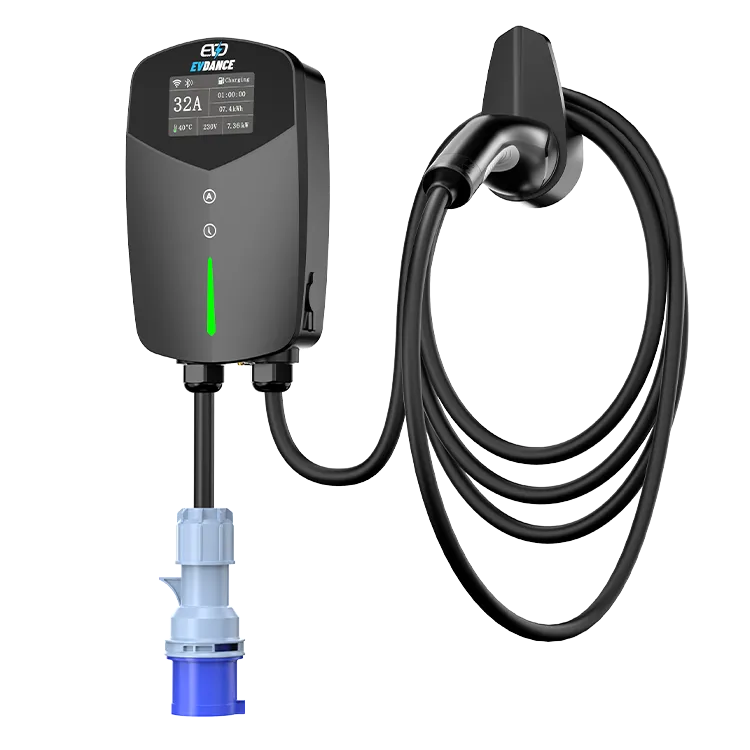
The EV-AC03201T dual-connector AC station lists RFID access and OCPP 1.6J: its 7-inch touchscreen is the driver’s display and interface, not a payment terminal, and no bank-card reader is stated for it. The EV-ACT3204E wallbox lists RFID and app access. The EV-ACS3210E lists app access with energy monitoring and is described as “OCPP-ready” — that exact phrase; its platform pairing is a written confirmation. If your site needs card acceptance, the terminal and its pairing are a specification line to close with the supplier for the exact model — start from our commercial charging page or contact us.
Frequently Asked Questions
Can drivers tap a bank card at an EV-AC03201T?
Not on the strength of its listing: no payment terminal or card reader is stated for the station. An operator may add card payment through its platform and terminal arrangement for a specific site — confirm it in writing for that site rather than assuming it from the model.
Is an RFID card the same as paying by card?
No. An RFID card identifies a known driver to an account; the charge is settled inside that account arrangement. A bank card pays directly through a payment service. The hardware, contracts and driver experience are all different.
Do we need RFID, app and a card reader together?
Only if your driver populations need all three. Each layer adds a service contract and an admin duty — cards to issue, an app account to run, a payment service to reconcile. Spec the layers your populations actually use.
Related Reading
- Do EV Charging Stations Take Credit Cards?
- RFID and User Management for Shared EV Chargers
- How Do Commercial EV Charging Stations Work?

