
Plan a solar canopy as three systems that share one site plan: a structure, a photovoltaic array, and the chargers underneath. Each system has its own designer, supplier and warranty, and the project works when those boundaries are drawn at the planning stage — not discovered at the first fault. This guide is the planning view; the concept itself is covered by our guide to solar panels and EV chargers.
Key Takeaways
- A canopy project is three systems — structure, PV, chargers — planned, priced and warranted separately.
- Array size comes from the PV designer’s study of the actual site; no borrowed figures.
- The site stays grid-connected; solar offsets charging energy, it does not guarantee it.
- EVDANCE supplies the chargers only, and no EVDANCE charger claims a solar-surplus mode.
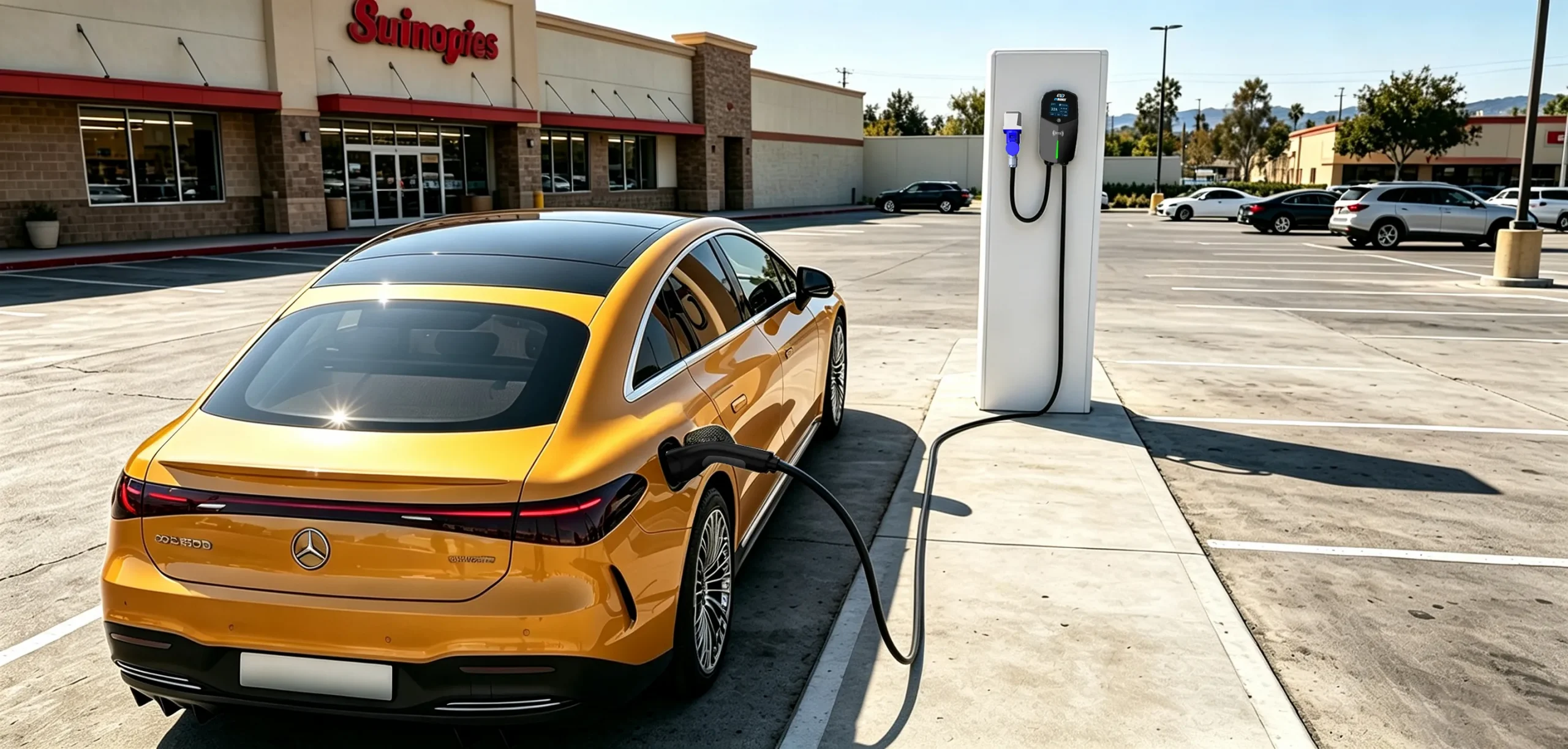
The Planning Table: Elements, Decisions, Owners
| Element | The decision the plan must record | Whose system it is |
|---|---|---|
| Canopy structure and foundations | Span, clearance and bay layout, engineered like any small building | The structural designer and builder; the permit set carries it |
| PV array and inverter | Array size from the designer’s yield study for this plane, shading and orientation — never a rule of thumb | The PV supplier’s design, specification and warranty |
| Export and grid connection | How surplus power leaves the site, and on what terms | The utility’s connection and export agreement |
| Chargers and bays | Charger class matched to dwell: Level 2 for hours-long stays, faster points where turnover demands them | The charging specification — standard commercial units |
| Cable routing and protection | Routes from the supply point to each bay, column mounting versus pedestals, vehicle protection at the columns | The electrical design in the project drawings |
| Approvals | Planning and building consent for the structure, electrical sign-off for the whole installation | The project’s authorities — confirmed for this site, not assumed |
The discipline in the right-hand column is the point. A canopy drawing that shows panels, steel and chargers in one colour invites one contractor to price all three — and three warranties to blur into one phone number. Price and document each system separately, then coordinate them.
Sizing the Solar Side Honestly
The PV array’s output belongs to the designer’s study of this site: its orientation, its shading, its local weather. No output figure belongs in the plan before that study exists, and no figure from another site transfers. What the planner can fix early is the relationship: the chargers stay grid-connected, solar offsets part of the charging energy when the sun is up, and the grid covers evenings, cloudy spells and peaks. Generation follows the season, so a canopy is an offset project, not an independence project — the operating picture in how commercial charging stations work applies unchanged.

After Handover: Three Owners, One Named Contact
When something fails, the driver does not care which system it belongs to — but the warranty route does. The structure answers to its builder, the array and inverter to the PV supplier, and the chargers to their manufacturer: EVDANCE chargers carry a 3-year standard warranty. Write the routing into the handover file at completion, with one named site contact who triages and forwards. A fault sent to the wrong owner is not refused; it is delayed — and delay is the complaint.
The Chargers Under the Canopy
EVDANCE makes chargers only — no panels, no canopies, no batteries — so the charging line of a canopy project is specified from the standard range. The EV-AC03201T dual-connector AC station (two Type 2 connectors, up to 43 kW shared, OCPP 1.6J, RFID, IP54) serves rows of bays from floor-standing units. The EV-ACT3204PE 22 kW three-phase wallbox (tethered Type 2 cable, RFID and app, IP66, CE) suits column-mounted positions. One honesty line: no EVDANCE listing states a solar-surplus or diversion mode. If the design requires surplus-following behaviour, that is an energy-management requirement to confirm in writing for the product that provides it — never a feature to write into the specification against a charger’s name. Discuss canopy charging lines via our commercial charging team or contact us.
Frequently Asked Questions
Will the canopy run the chargers on its own?
The site stays grid-connected: solar is used first, the grid covers the rest, surplus is exported under the connection agreement. The array offsets part of the charging energy; it never guarantees it.
Does EVDANCE supply the canopy or the panels?
No. EVDANCE manufactures chargers. The structure and the PV system come from the project’s own builder and solar supplier, under their own specifications and warranties.
Who sizes the PV array?
The PV designer, from a study of the actual site. Output claims made before that study — including any figure quoted from another project — are not planning inputs.
Related Reading
- Solar Panels and EV Chargers: How to Charge Your Car With Sunshine
- How Do Commercial EV Charging Stations Work?
- How Much Does It Cost to Install a Commercial EV Charging Station?
- Fleet Depot Charging: How to Size AC Chargers for Vans and Light Commercial Vehicles

