
Certification cost per unit is an arithmetic result, not a fee. A brand’s certification programme costs a largely fixed total — testing, samples, documentation, follow-up — divided by the units sold under the certificate. Spread the same pot over few units and certification is one of the largest lines in the product’s cost; spread it over many and it nearly vanishes. What enters the pot, how the division works, and which volume decisions it drives — below.
Key Takeaways
- Per-unit certification cost is a fixed programme pot divided by the units sold under the certificate.
- Include the recurring lines — surveillance, renewals, update re-tests — in the pot before dividing.
- The denominator is the certified configuration, in the certified markets, over the certificate’s life.
- Volume changes the decision: small runs favour an already-listed starting point; large runs can justify commissioning.
The Pot: Everything the Programme Costs
The total is built from the programme’s own quotations and records. Its drivers are scope (models, variants, markets), the laboratory work it requires, samples and their transport, documentation and administration, follow-up inspections, and renewals and re-tests as certificates age or standards update. No published price exists for any of it. The guide to EV charger certifications explains what the main marks are.
| Pot line | Fixed or recurring | Where its figure comes from |
|---|---|---|
| Laboratory testing and listing work | One-off, per programme scope | The laboratory’s quotation for the exact model, configuration and markets |
| Samples and their transport | One-off, rising slightly with variants | Your production records and sample-shipment freight documents |
| Documentation and administration | One-off, plus a line per design change | The brand’s own compliance file — hours, translations, filings |
| Follow-up inspections and surveillance | Recurring, for as long as the certificate lives | The scheme’s terms, as quoted |
| Renewals and standard-update re-tests | Recurring and event-driven | The certificate’s renewal terms and the standard’s edition changes |
Two disciplines matter first. The recurring lines belong in the pot: a spread on one-off costs alone flatters the first year. And the pot belongs to a scope — one certificate, one configuration, named markets; another programme’s costs never enter it.
The Division: One Worked Example
One invented example: suppose a programme’s full pot — one-off lines plus recurring lines over the certificate’s life — totals 12,000 in your accounting currency. Over 300 units of the certified configuration, that is 40 per unit. Over 1,200 units, it is 10 per unit. Nothing about the laboratory changed; only the denominator moved. The formula is the part to keep: per-unit spread equals the whole pot divided by the units of the certified configuration, sold in the certified markets, during the certificate’s life. Units of other variants, models or markets do not dilute this pot — they carry their own.
Why Volume Changes the Decision, Not Just the Number
- Small runs favour a certified starting point. Where a model’s listing already carries the marks a market needs, the brand’s own pot may be small or empty; where nothing is listed, the whole programme lands on the first run.
- Large runs can justify commissioning. At volume, certifying an exact configuration — your connector, branding, markets — becomes a rational spend.
- Variants divide volume. Each variant has its own effective denominator: a programme spread across five low-volume variants behaves like five small programmes.
- The anchor is your first committed quantity. EVDANCE’s private-label line starts at 100 units; commissioning a full new programme against a first run of that size means doing the division before committing.
Starting Positions in an EVDANCE Order
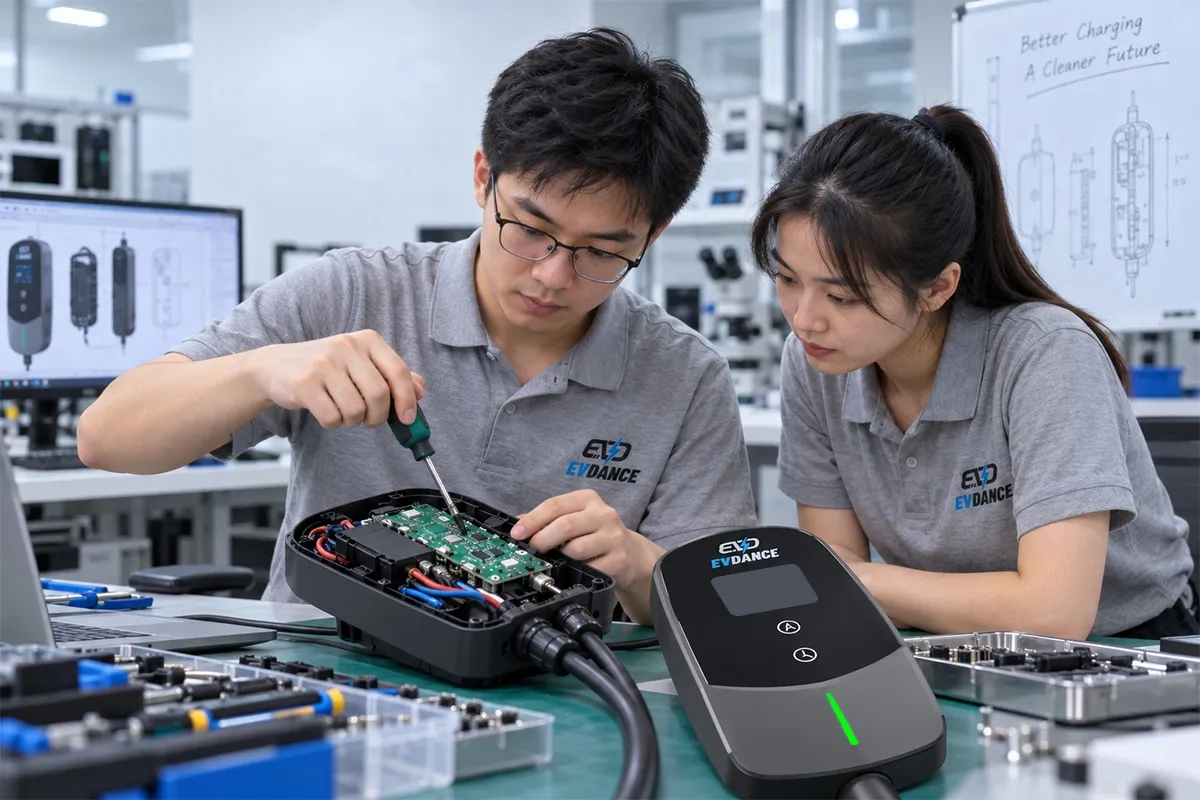
EVDANCE is a Shenzhen EV charger manufacturer founded in 2011, exporting to more than 30 countries, with private label from 100 units. Starting positions differ by model: the EV-ACT5006T listing states ETL, FCC and CE — marks to verify against the certificate documents for the exact configuration you order. The EV-ACS3210T listing states no certification marks, so what documentation exists for the exact model is a written question before any spread is planned. In a private-label order, who owns the certificate decides whose pot the programme is at all. See the OEM and private-label page and raise your market’s case through the contact page.
Frequently Asked Questions
If the manufacturer’s certificate covers the model, is my per-unit certification cost zero?
Only if your brand, configuration and market fall inside that certificate as written. Coverage is a property of the document — read it, and settle ownership and permitted use in the order paperwork.
Can I spread the pot over several years of expected sales?
Yes — over the certificate’s life, provided the recurring lines for those years (renewals, surveillance, re-tests) are inside the pot. Spreading one-off costs over five years while expensing renewals separately counts the benefit twice.
Does ordering more units reduce the laboratory’s price?
The pot is quoted per programme scope, not per unit sold, so volume does not shrink it — it shrinks your share of it.
Related Reading
- EV Charger Certifications Explained: CE, UKCA, UL, ETL, CB and What Buyers Should Ask For
- UL and ETL Listing for EV Chargers: How NRTL Certification Works
- Who Owns the Certificate in a Private-Label EV Charger?
- EV Charger MOQ Explained: What Sets Minimum Order Quantities

