
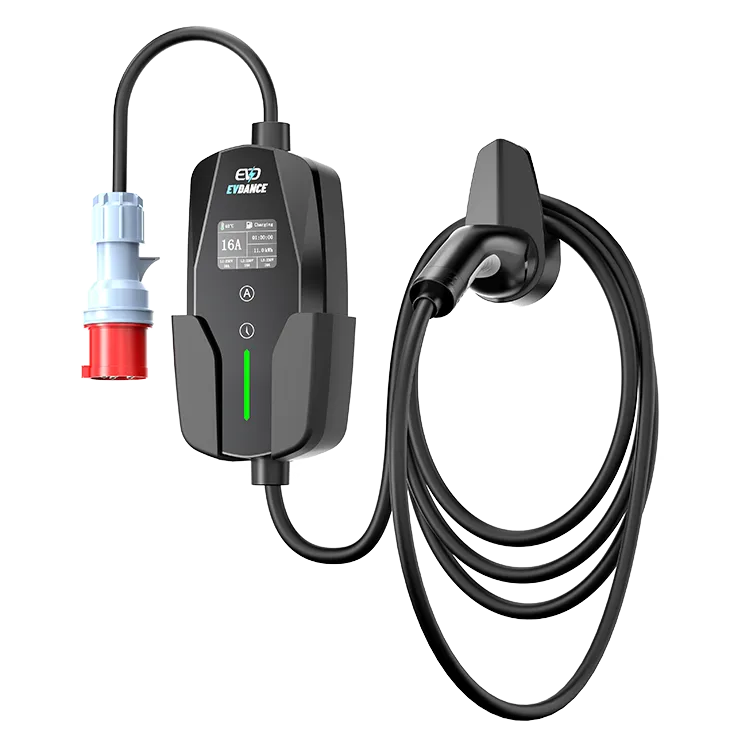
Many houses in Poland and Czechia already have a three-phase supply, which makes 11 kW home charging practical without major upgrades. The ACS1605PE plugs into a 16 A CEE five-pin outlet and charges at up to 11 kW, about three times a typical single-phase socket setup. An electrician should confirm that the main fuse rating and the rest of the house can carry the extra load and install a dedicated, protected outlet.
Key Takeaways
- Three-phase homes can charge at 11 kW on 16 A per phase.
- Check main fuse capacity and the outlet’s condition first.
- Most daily driving is replaced in one to two hours.
- Single-phase cars charge at lower power.
Why Three-Phase Homes Have an Advantage
Three-phase supply spreads power across three conductors. At 16 A per phase and 400 V between phases, a charger can deliver about 11 kW while drawing a modest current on each phase. On single-phase, reaching 11 kW would need around 48 A, which most homes cannot supply. Read single-phase vs three-phase charging and what three-phase charging is for the background.
What to Check Before Charging
| Check | Who | Why |
|---|---|---|
| Main fuse or connection capacity | Electrician, energy supplier | 11 kW plus household loads must fit |
| Existing CEE outlet condition | Electrician | Garden or workshop outlets may be old or shared |
| Dedicated circuit and protection | Electrician | Correct RCD type and overcurrent protection |
| Earthing arrangement | Electrician | Required protective measures depend on it |
| Outlet location | Owner and electrician | Near the parking spot, protected from impact |
Many homes have a 16 A CEE outlet in a garage or workshop for tools. It may be on a circuit shared with other loads. Have it checked before using it for hours of charging every night.
Charging Time at 11 kW
At 11 kW, a car with a 60 kWh battery goes from 20% to 80% (36 kWh) in roughly three and a half hours, allowing for small losses. Most daily driving is replaced in an hour or two. Cars with a single-phase onboard charger will charge at lower power, so check your car’s specification. Our guide on charging times at 7, 11 and 22 kW has more examples.
Using Cheaper Night Tariffs
Many suppliers in both countries offer time-based tariffs. Charging at 11 kW fits easily into a short night window. Set your car’s charging schedule to start when the cheaper period begins, and check your contract for the exact hours.
Portable or Fixed?
A portable unit suits owners who also charge at a weekend house, a workshop or another family property with a CEE outlet. A fixed wallbox suits a single location and may be required by some subsidy schemes, so check the rules of any programme before buying.
The ACS1605PE is an 11 kW three-phase portable charger at 16 A, 230/400 V, with a Type 2 connector, CEE five-pin plug, 1.77-inch display, IP66 protection and a 7.6 m cable. For 22 kW, see the EV-ACS3205PE.
Frequently Asked Questions
Can I charge at 11 kW from a garage CEE outlet?
Often, if it is a 16 A three-phase outlet on a suitable circuit in good condition. Have an electrician check it first.
Will 11 kW charging trip my main fuse?
It can if large loads run at the same time and the connection is small. An electrician can check capacity.
Do all cars charge at 11 kW on three-phase?
No. Cars with single-phase onboard chargers charge at lower power.
Related Reading
- Single-Phase vs Three-Phase EV Charging: 7kW, 11kW and 22kW Explained
- What Is Three-Phase EV Charging and Does Your Home Have It?
- How Long Does It Take to Charge an EV at 7 kW, 11 kW and 22 kW?
- CEE Plugs Explained: Choosing 16A or 32A for a Three-Phase Portable EV Charger

