
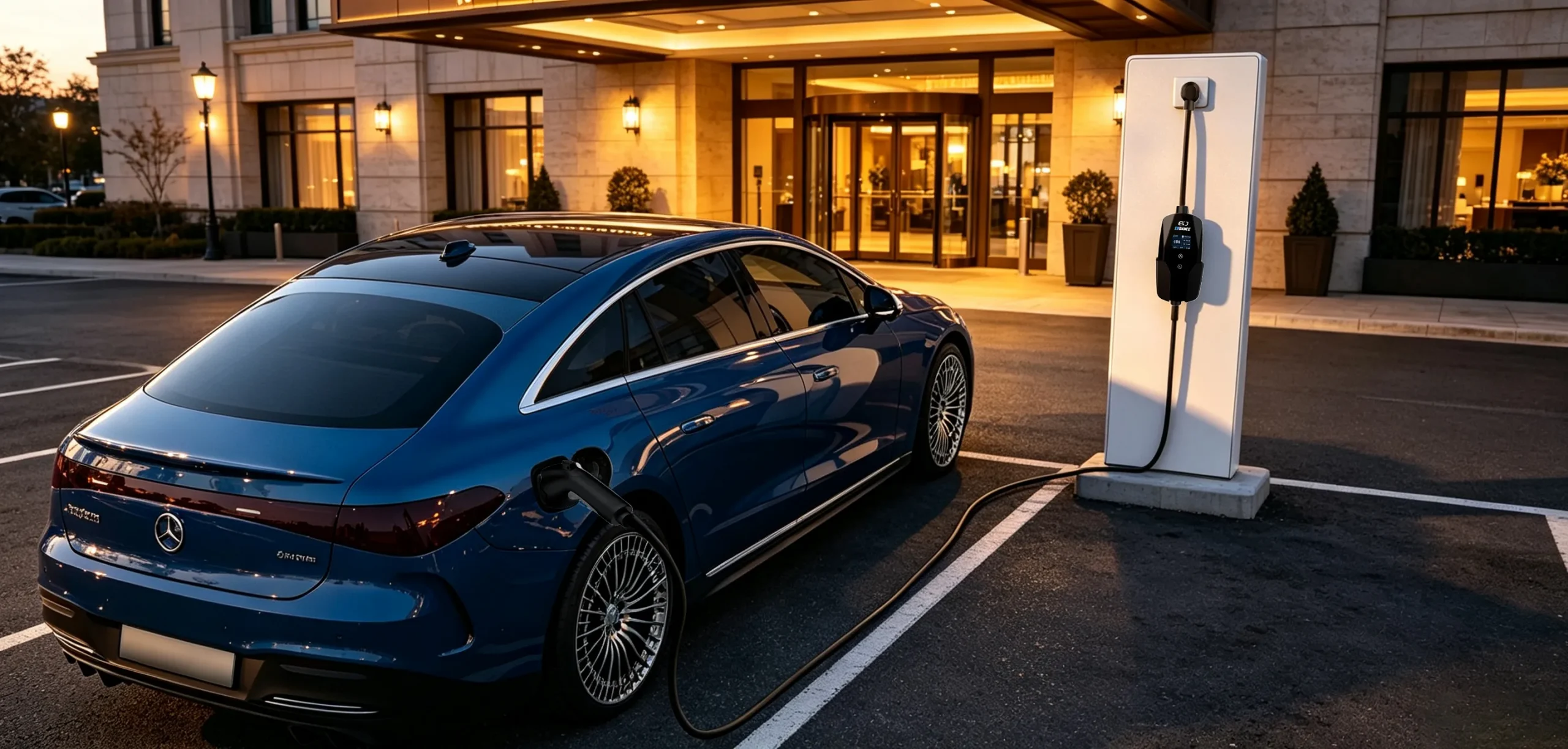
A destination charger is an AC Level 2 charging unit installed at a place you are visiting anyway — a hotel, workplace, shopping centre or attraction. The name describes where the charger stands, not a special technology: any ordinary Level 2 wallbox or post doing that job is a destination charger. Expect Level 2 pace — the U.S. DOT rates the class at 7–19 kW, adding roughly 10–20 miles of range per parked hour.
Key Takeaways
- A destination charger is an ordinary AC Level 2 unit named for its setting — a hotel, workplace or car park.
- Expect roughly 10–20 miles of range per parked hour, and a session that runs on the host’s terms.
- The label says nothing about price or availability; check the listing or the host.
- At socketed destination posts you bring your own cable; at tethered ones the cable is attached.
A Label for the Place, Not the Machine
Nothing inside a destination charger is different from any other Level 2 unit. The electricity is AC, the conversion happens in your car, and the hardware is the same wallbox or post you could bolt to a garage wall — where it would simply be called a home charger. What the label adds is the setting: the unit belongs to a host, serves guests, staff or customers who are parked for hours, and runs on the host’s terms. That is also why the word shows up in station apps and hotel listings: it tells you the charger is there for the visit, not for a quick top-up on a journey. How it compares with the other classes is set out in Level 1 vs Level 2 vs DC fast charging.
| The label tells you | The label does not tell you |
|---|---|
| AC Level 2 class — a top-up across a parked stay, at roughly 10–20 miles of range per hour | Whether charging is free — the host decides, and bills or includes it as they choose |
| A long-stay setting — the car is meant to sit for hours, so nobody queues for it | Whether a bay is free when you arrive — check the app or the host before you rely on it |
| The host manages access — an app, an RFID card, or simply an open post | Whether a cable is provided — tethered units carry one, socketed posts need yours |
Recognising One When You Arrive
Look for a slim wallbox or post in the marked bays at a hotel, office, gym or car park — nothing like the large cabinet of a DC fast charger. Starting a session follows the host’s posted instructions: plug in and go at some sites, an app or card tap at others, a word at reception at a few. If the post is a socket rather than a fitted cable, you will need your own cable — the difference between the two forms is explained in tethered vs socketed wallbox chargers. Before a trip, station maps and apps will usually show the charger’s class, so the word “destination” in a listing is your cue to plan a long stop, not a short one.
The Hardware That Usually Wears the Label
On the site’s side of the fence, a destination charger is typically a managed AC unit: access control for guests or staff, and session records for the operator. EVDANCE’s EV-AC03201T dual-connector AC station is built in that shape — two Type 2 connectors sharing up to 43 kW (22 kW per connector), with OCPP 1.6J for the operator’s platform and RFID for managed access, in an IP54 floor-standing enclosure. For a smaller workplace or hotel wall, the EV-ACT3204PE 22 kW three-phase wallbox, offered with a tethered Type 2 cable, does the same job at a single bay. Hosts planning bays like these start from our commercial charging solutions.

Frequently Asked Questions
Is a destination charger free to use?
Sometimes. The host sets the price: some include charging in the room rate or parking, others bill per session or per kWh through an app. Our guide to whether hotel EV charging is free works through the most common case.
How much range will a destination charger add during my visit?
At the DOT’s Level 2 rate of roughly 10–20 miles of range per hour, a three-hour visit adds about 30–60 miles — typically the trip there and back. It is a top-up scaled to your stay, not an empty-to-full refill.
Do I need my own cable at a destination charger?
Only at a socketed post. Tethered destination chargers carry their own cable; socketed ones — common at European public and workplace sites — need the cable from your boot. The charger listing usually shows which form it is.
Related Reading
- Is Hotel EV Charging Free?
- Where to Find EV Charging Stations: Maps, Apps and Tips
- Are EV Chargers AC or DC?
- Level 1 vs Level 2 vs DC Fast Charging: A Practical Comparison

