
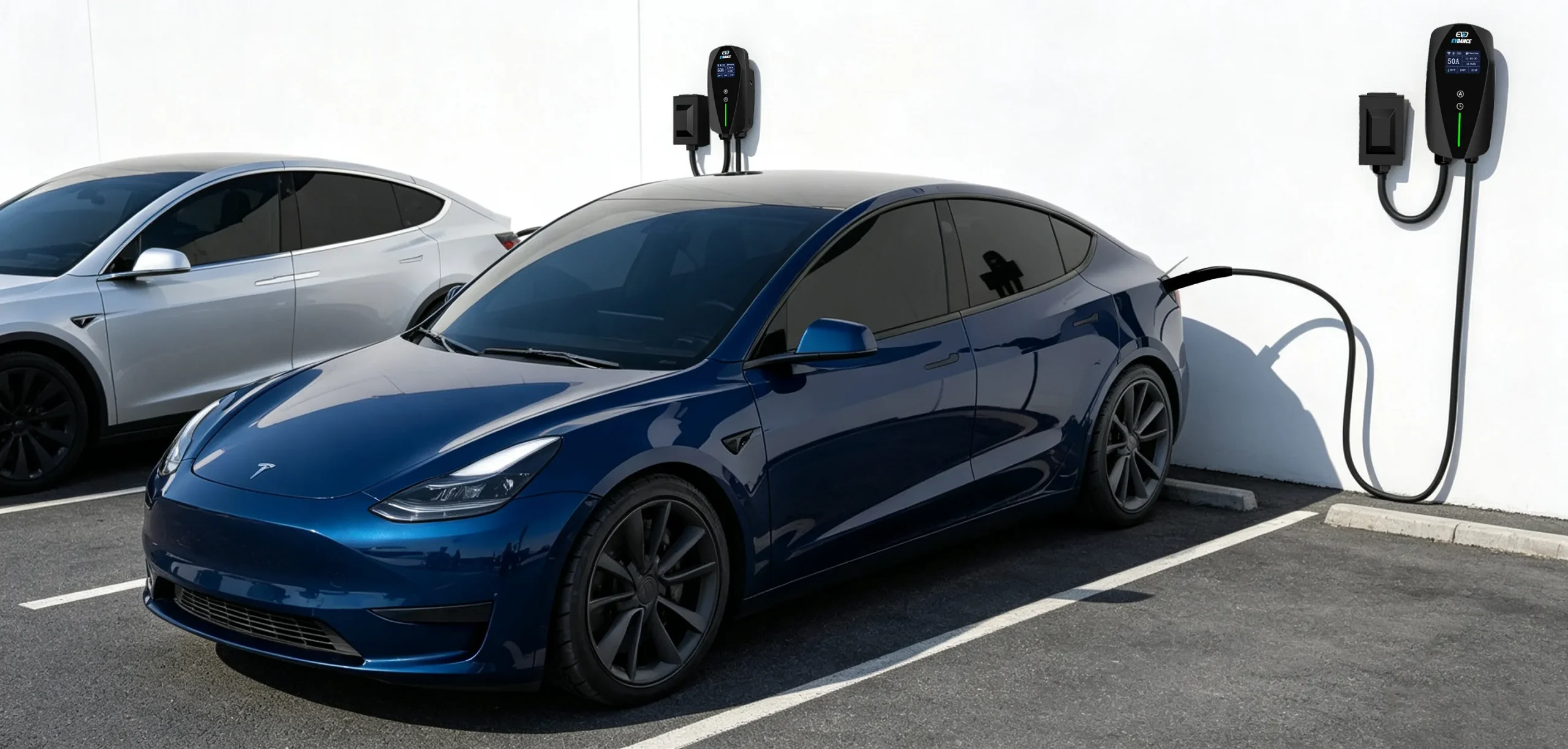
An EV charging parking space is a parking bay equipped and set aside for charging an electric vehicle. It has a charger serving it, markings or signs that identify it, and terms of use — who may park there, whether the car must be charging, and how long it may stay. A space an EV simply parks in is not a charging space; the equipment and the reservation make it one.
Key Takeaways
- A charging space = a bay + a charger serving it + identification + terms of use; remove one and it is ordinary parking.
- It is not the same as an EV-only space (no charger) or a charging station (the whole site).
- The binding rules for a space are the operator’s posted terms under local rules — read them at the bay.
- Site owners decide equipment, identification, signing and terms.
The Three Parts That Make the Space
The concept has three parts; remove any one and an ordinary parking space is left:
| Part | What it contributes |
|---|---|
| The charger | The equipment at the head of the bay — a wallbox, a post or a shared station — with a connector that reaches the car’s inlet. |
| The identification | Ground markings and a sign naming the bay as a charging space, usually with a bay number matching the charger or app listing. |
| The terms of use | The operator’s posted rules: charging only or any EV, a stay limit if there is one, how charging and parking are paid for. The binding values are the operator’s terms under the local rules for that site — read them on the sign. |
How It Differs From the Neighbouring Ideas
Three similar phrases describe three different things, and sites use them loosely:
- An ordinary parking space has no charger and no reservation; an EV parked there is just parked.
- An EV-only space is reserved for electric vehicles but has no charger. The reservation is a parking privilege — it does not let the car charge.
- A charging station is the whole location: the site with its chargers, of which each charging space is a single bay. One station can hold one space or dozens.
Some charging spaces are also accessible bays, built with more room around the car and a step-free route to the charger. Accessibility is a property of the installed site; layout values come from the authority for that jurisdiction, confirmed at design stage — not from the charger supplier.
What a Site Owner Actually Provides
For a workplace, retailer or property manager, creating a charging space is a small project with four decisions. The supply and a charger matched to how long cars stay — a working day, a shopping visit, an overnight stop — as our overview of how commercial charging stations work sets out. Bay identification matching the charger’s numbering, so space, post and app say the same name. Signing and marking in line with the local code — the local authority’s requirements, confirmed for the project, not copied from another car park. And the terms: who the spaces are for, and how charging is paid for. Shared sites decide once for a whole row — see our guide to apartment and condo charging in shared parking.

The Hardware Behind a Charging Space
One charger usually serves one space, but shared hardware serves two. The EV-AC03201T dual-connector AC station carries two Type 2 connectors sharing up to 43 kW (22 kW per connector), with OCPP 1.6J, RFID access and an IP54 floor-standing cabinet — one station creating two charging spaces. Its touchscreen is the session display; payment sits with the operator’s platform, not the cabinet. Sites planning several spaces can start from the commercial charging range or ask us via contact us.
Frequently Asked Questions
Can a petrol car park in an EV charging space?
The space is provided for charging, so treat it as reserved — but the rule that applies is the one posted at the site, under the local rules for that car park. What happens to a car that parks there without charging is a matter for the operator and local enforcement, and it varies by place.
Do I have to be charging, or is driving an EV enough?
It depends on the wording. “EV charging only” means the car must be plugged in and charging; “EV only” reserves the space for electric vehicles whether or not they charge. The sign at the bay is the site’s rule.
Does every car park have to provide charging spaces?
There is no single answer. Requirements, where they exist, sit in local building and parking rules and differ by jurisdiction and building type — confirm the position with the local authority before designing a layout.
Related Reading
- How Do Commercial EV Charging Stations Work?
- Apartment and Condo EV Charging: Solutions for Shared Parking
- Level 1 vs Level 2 vs DC Fast Charging: A Practical Comparison

