
There is no single “32 amp cable” to buy. A 32 amp charger involves two cables: the lead between the charger and the car, which comes with the unit, and the supply cable between your panel and the charger, which is building wiring. The supply cable is specified by a licensed electrician — sized for a 40 amp circuit, because charging is a continuous load and the National Electrical Code sizes the circuit at 125% of the charger’s current.
Key Takeaways
- A 32 amp charger has two cables: its own lead, which is fixed, and a supply cable your electrician specifies.
- Charging is a continuous load — 32 A of charging runs on a 40 A circuit, and the cable is sized for the circuit.
- Cable type, run length, conductor material and the local code decide the final size; no chart replaces the calculation.
- If the charger is set below 32 A, agree the setting before installation — it sizes the breaker and cable together.
Two Cables, Two Different Decisions
Most confusion comes from mixing the two cables up. They are chosen by different people, for different reasons:
| Cable | Who chooses it | What decides it |
|---|---|---|
| The charger’s own lead (charger to car) | The manufacturer — it is part of the listed unit | The charger’s design and certification; a plug-in portable’s lead ends in a fixed plug |
| The supply cable (panel to charger or outlet) | Your licensed electrician | The circuit rating, the local electrical code, cable type, run length and installation method |
If your charger plugs into an outlet, you never handle the supply cable at all — it is the wiring behind the outlet. If your charger is hardwired, the supply cable runs directly into the unit, and it is still the electrician’s specification, not a product option.
Start From the Circuit: 32 A of Charging Means a 40 A Circuit
The sizing chain starts with the current the charger will actually draw. EV charging counts as a continuous load, so the NEC rule is breaker = 125% of charger current: a charger drawing 32 A runs on a 40 A circuit, and the supply cable is chosen to suit that circuit — the wire follows the breaker, not the charger’s label. Our guides to breaker sizing and how an EV charger is wired cover that side.
One detail changes the starting point: many 32 A chargers are adjustable. If the unit is configured lower at installation — 24 A, say — the circuit is sized for the setting as installed, not the nameplate maximum. Tell your electrician the setting you intend to run before the cable is pulled; upsizing a finished run costs a second installation.
What Your Electrician Sizes From
The final size is a code calculation, turning on factors no product listing can know about your building:
- Cable type — assemblies and conductors in conduit carry different ratings.
- Run length — a long run can justify a larger size to limit voltage drop.
- Conductor material and terminations — copper and aluminium are sized differently and need matching terminals.
- Installation method — where and how the cable runs affects its rating.
- The local code — the NEC in much of the US, or its local equivalent, plus permit rules.
Our orientation guide to wire sizes for EV chargers shows the typical results of that calculation. Treat any chart as orientation only: the size that applies is the one your electrician specifies for your circuit, run and code.
Two 32 A EVDANCE Chargers, Two Cable Stories
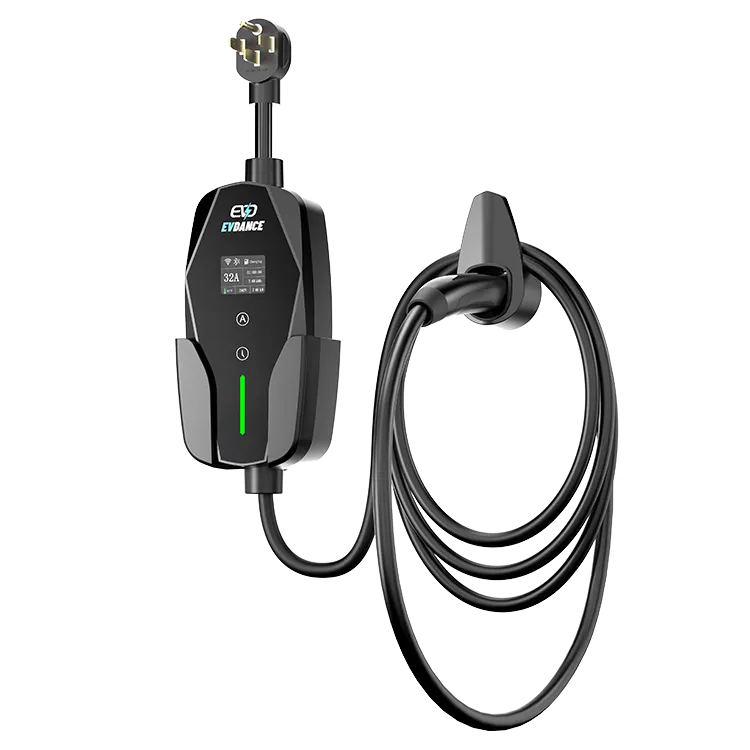
The EV-ACS3210T is the plug-in case: a 32 A NACS portable (about 7.7 kW) with six current steps from 10 to 32 A and a NEMA 14-50P plug. You choose nothing about cable: the steps let the electrician match the unit to the circuit that exists. The EV-ACT3204PE is the hardwired case: a 22 kW three-phase wallbox drawing 32 A per phase, where the supply cable is part of the installer’s specification. Either way, the charger’s lead is given and the supply cable is your electrician’s call.

Frequently Asked Questions
Can I just buy a thicker cable to be safe?
Oversizing is not a shortcut. The cable must match the breaker, the charger’s terminals and the installation method — an electrician confirms all three.
Does a 32 amp charger come with the supply cable?
No. Portables come with their own lead ending in a plug; hardwired wallboxes connect to the building’s wiring at installation. The supply cable belongs to the installation, not the box.
My charger can be set below 32 A. Does that change the cable?
Yes — the circuit, and so the cable, follows the charger’s configured setting. Agree the setting with your electrician before installation; it decides the breaker and the cable in one conversation.
Related Reading
- What Size Wire Do You Need for an EV Charger?
- What Size Breaker Do I Need for an EV Charger?
- How Is an EV Charger Wired? A Plain-English Overview

