
CCS charging works as a negotiated session, not a dumb power feed. Before any current flows, car and charger exchange digital messages over a signal contact in the connector: they confirm the connection, run safety checks, and agree the voltage and current the battery will accept. During charging the car keeps updating that limit and the charger follows it, which is why the rate tapers as the battery fills.
Key Takeaways
- A CCS session is negotiated: safety checks and a digital handshake precede any current.
- On DC, the car directs and the charger follows, tapering output as the battery fills.
- On AC through the same inlet, a pilot signal sets the ceiling and the car’s onboard charger converts.
- CCS1 and CCS2 are the North American and European forms of one combined system.

One Inlet, Two Kinds of Session
CCS stands for Combined Charging System: one inlet serves both AC and DC. CCS1 builds on the J1772 section used in North America; CCS2 applies the same idea to the Type 2 inlet used in Europe — same system, different shape, and the two do not fit each other. The connector’s parts are covered in our explainer on whether J1772 works with CCS; this article stays on how a session runs.
| AC session (upper section) | DC session (added pins) | |
|---|---|---|
| What the car and charger exchange | A simple pilot signal that sets the current ceiling | A digital conversation over the signal contact (power-line communication) |
| Who converts AC to DC | The car’s onboard charger | The station — DC flows straight to the battery |
| Who sets the pace | The lower of the pilot ceiling and the onboard charger’s rating | The car, continuously — the charger follows the car’s stated limits |
| Typical power (U.S. DOT classes) | Level 2: 7–19 kW, about 10–20 miles of range per hour | 50–350 kW, about 180–240 miles of range per hour |
A DC Session, Step by Step
- Plug in and lock. The connector latches into the inlet, and both sides confirm the plug is fully seated before anything is energised.
- Safety checks. The charger checks its output circuit, including DC-path isolation, before closing any contactors.
- The handshake. Car and charger identify each other over the signal contact. The car reports the voltage window and maximum current its battery can accept now; the charger reports what it can supply.
- Controlled delivery. The charger raises output to the agreed level and then works as a follower: the car keeps revising its request as the battery fills and warms, and the charger matches it.
- Taper and stop. Near full, the car asks for less and less — the behaviour behind charging slowing after 80%. Either side can end the session; the charger ramps down before the plug is released.
The key point is the direction of control: on DC the car’s battery system directs the session from start to finish, and the station is a powerful but obedient supply. Our walkthrough of how DC fast chargers work covers the hardware behind that supply.
The AC Session on the Same Inlet
Plug a J1772 connector into the same inlet and the session is simpler. There is no digital negotiation: a pilot signal tells the car the maximum current it may draw, the onboard charger converts AC to DC at its own pace, and the DC pins below sit unused. The AC plug itself is explained in our J1772 guide.
Hardware That Works With a CCS Inlet
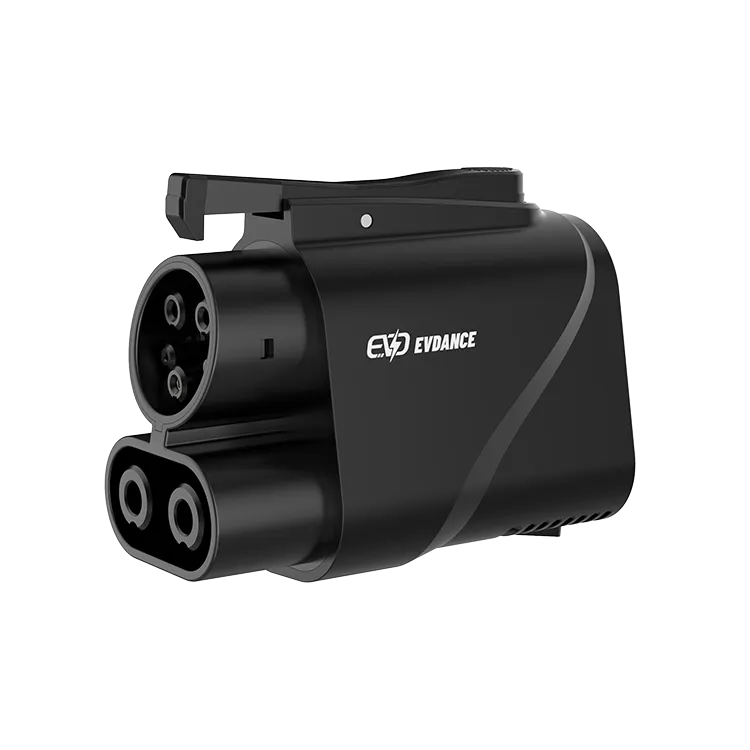
Two EVDANCE products meet CCS cars directly. The JT08 and JT09 are NACS-to-CCS1 DC adapters (up to 500 A, IP66; the JT09 adds a handle): they let a CCS1-inlet car charge at a NACS DC station, including Superchargers open to that car — only where both conditions hold: the vehicle maker approves third-party DC adapters for the exact car, and the station is open to that car. The adapter changes the connector, not the conversation. For the AC half at home, the EV-AC04001U is a 40A J1772 portable charger (9.6 kW, NEMA 14-50P, IP66, 25 ft).
Frequently Asked Questions
Does a CCS charger talk to the car during the whole session?
On DC, yes — the exchange continues throughout: the car keeps stating the current it can accept, and the charger follows. On AC it is reduced to the pilot signal that sets the ceiling.
Why does the car, not the charger, control DC charging speed?
Because only the car’s battery system knows the pack’s state — charge level, temperature and limits at that moment. The charger supplies what it is told, up to its own rating.
Are CCS1 and CCS2 the same system?
They are the two regional forms of one system: CCS1 on the North American Type 1 (J1772) inlet, CCS2 on the European Type 2 inlet. The session logic is the same idea; the connectors are physically different and not interchangeable.
Related Reading
- Does J1772 Work With CCS? CCS Connectors Explained
- How Do DC Fast Chargers Work?
- What Is J1772? The North American EV Plug Explained
- Why Does EV Charging Slow Down After 80%?
Sources & Standards
For buyers: EVDANCE is a DC fast charger manufacturer in Shenzhen — our 22 kW commercial DC charger, with samples before bulk orders.

