
Type 1 and Type 2 are the world’s two AC charging connector families, and they differ in more than shape. Type 1 (SAE J1772) is the single-phase standard of North America and Japan, with a latch on the plug that you release by hand. Type 2 (IEC 62196) is Europe’s standard: it carries single-phase and three-phase power, and the locking is done by the car, not by a latch on the handle. Which one a charger needs is decided by the car’s inlet — the two do not fit each other.
Key Takeaways
- Type 1 is single-phase with a latch on the plug; Type 2 carries single- and three-phase and is locked by the car.
- The two shapes do not fit each other — a charger is ordered for the car’s inlet.
- Type 2’s car-side locking is why socketed posts and bring-your-own-cable charging work in its markets.
- Speed comes from the supply and the car, not the connector name alone.
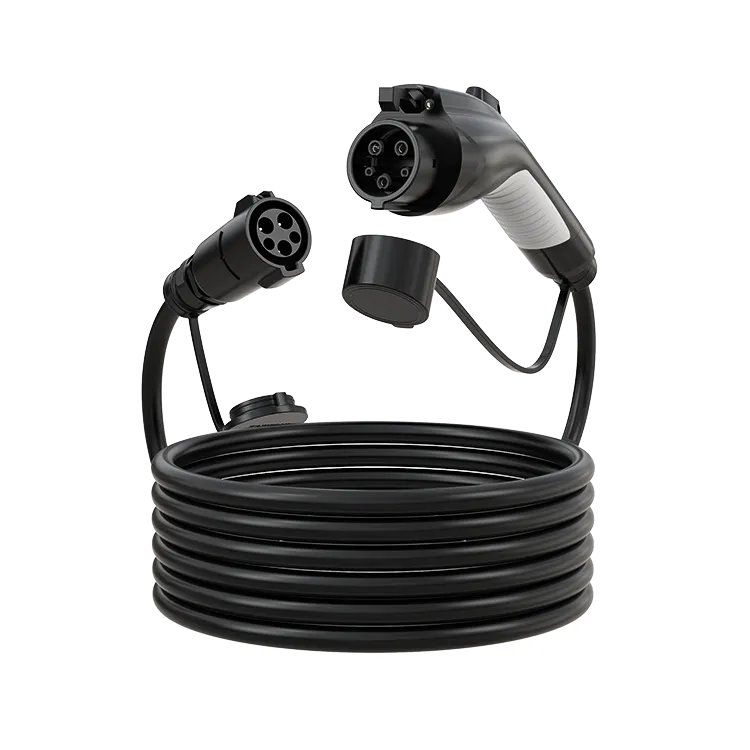
The Two Families, Side by Side
| Dimension | Type 1 (SAE J1772) | Type 2 (IEC 62196) |
|---|---|---|
| Home ground | North America, Japan; older and non-Tesla cars | Europe, the UK, and much of the rest of the world |
| Phases | Single-phase only | Single-phase and three-phase in the same connector |
| How it locks | A latch on the plug itself, released by the driver’s thumb | No latch button on the plug — the car’s inlet locks the connector in place |
| Its DC partner | CCS1: two large DC pins added below the Type 1 head | CCS2: two large DC pins added below the Type 2 head |
| Typical public posts | Usually a tethered cable ending in the plug | Often a socket on the post — drivers bring their own cable |
The Locking Difference You Feel Every Session
The phase difference is the one in the specification tables, but the locking difference is the one drivers notice. With Type 1, the plug carries a spring latch and a release button: you squeeze, and the connector comes away — the decision is in your hand. With Type 2, the plug has no release button. The car’s inlet pins the connector in place, and the car decides when it lets go — commonly when the car is unlocked or the session is properly ended.
That design has practical consequences. A Type 2 cable generally cannot be pulled out of a locked car by a passer-by, which is one reason socketed public posts work in Type 2 markets: the cable stays with the car it is charging. It also means the “stuck cable” moment is a car question, answered by the car’s own unlock routine — not by pulling harder on a handle that has no release.
What the Difference Means When You Buy a Charger
A charger’s connector name describes the car end of the cable — the end that must match your car’s inlet. It says nothing by itself about the wall end, which may be a plug for an existing socket or a hard-wired connection, and nothing about speed on its own: a Type 2 unit on a single-phase supply delivers single-phase power, and three-phase charging needs both the connector and a three-phase supply behind it. Order the connector for the car, then confirm the supply side separately.
In the EVDANCE range the two families sit side by side. The EV-AC04001U is the Type 1 portable charger (40 A J1772, 9.6 kW, NEMA 14-50P, IP66, 25 ft). The Type 2 family is the EV-ACS3210E portable (32 A, single-phase about 7 kW, IP66) and the EV-ACT3204PE wallbox (22 kW three-phase, tethered Type 2 cable, RFID and app, IP66, CE). Same job, two inlets — the car chooses which list you shop from.

Frequently Asked Questions
Can a Type 1 car charge at a Type 2 post?
Not by plugging in directly — the shapes do not meet. The bridge is a cable or adapter with the correct ends, a separate purchase with its own stated ratings; treat any such product’s documents as the authority for whether and how it may be used.
Is Type 2 faster than Type 1?
Type 2 can be, because it can carry three-phase power — 11 kW and 22 kW classes exist behind it. The connector alone guarantees nothing: the supply and the car’s own charger set the real speed, and a Type 2 unit on a single-phase supply charges at single-phase rates.
Which connector does a Tesla use?
It depends on where the car was sold: North American cars use NACS, European cars use Type 2 — a regional split our guide to charging a Tesla in each region works through. Check the inlet on the car in front of you, not the badge.
Related Reading
- Type 2 vs J1772 vs NACS: Which EV Charger Connector Does Your Market Need?
- What Is J1772? The North American EV Plug Explained
- Charging a Tesla: Type 2 in Europe, NACS in North America
- Does J1772 Work With CCS? CCS Connectors Explained
Sources & Standards
For buyers: EVDANCE is a portable EV charger manufacturer in Shenzhen — wholesale, private label and OEM portable chargers, with samples before bulk orders.

