
DC fast charging runs on two different conversation systems. Chargers in the CCS family — and NACS DC charging with them — talk to the car by power-line communication: a data signal carried on the control pilot conductor inside the charging cable. CHAdeMO and GB/T chargers run the same conversation over a CAN bus link instead, on its own communication wiring. Both do the same job — agreeing voltage, current limits and stop conditions, continuously — but they are different languages on different carriers, which is why the families do not interwork and no plug adapter translates between them.
Key Takeaways
- CCS and NACS DC charging converse over power-line communication; CHAdeMO and GB/T converse over CAN.
- Both carry the same negotiation — limits, charge level, stop conditions — in different languages on different carriers.
- Adapters work inside one family only; nothing at the plug translates between the two.
- An imported car’s problem is a language gap, not a plug-shape gap.
The Same Job, in Two Languages
| Dimension | Power-line communication | CAN bus |
|---|---|---|
| Charging families | CCS1, CCS2 and NACS DC | CHAdeMO and GB/T DC |
| The carrier | A data signal riding on the cable’s control pilot conductor, alongside the basic connection signals | A dedicated data link of the kind cars already use between their own control units |
| The conversation | The car states its voltage and limits; the charger follows them; both watch for faults — the message sets of DIN 70121 and ISO 15118 run on this carrier | The same negotiation, defined inside the CHAdeMO and GB/T specifications themselves |
| What an adapter can do | Pass it through, inside the family — the connection is extended, the language unchanged | The same, inside its family — and no further |
Neither column is a quality ranking. Each is simply the communication design its connector family was standardised with, and a session works when car and charger share one — the same matching logic as the connector itself, compared in our guide to how J1772 works with CCS.
Why Two Systems Exist
The split is a design lineage, not an accident. CAN grew up inside the car industry as the network cars use to talk to themselves, so the earliest DC standards — CHAdeMO in Japan and GB/T in China — carried the session conversation on the car’s own kind of bus. CCS took a different route: DC pins below the familiar AC connector, and data over the pilot conductor already in the cable, keeping one connector for AC and DC. NACS DC charging follows the power-line pattern, which is why a NACS-to-CCS1 adapter can bridge those two connectors at all: the plugs differ, the conversation does not.
What This Means When You Buy, Import or Travel
- On a spec sheet, the language follows the plug. Communication lines in a catalogue are read backwards from the connector family: CCS or NACS means the power-line conversation, CHAdeMO or GB/T means CAN. If a line leaves the family unclear, that is a question for the maker, in writing, before an order.
- An imported car carries its language with it. A GB/T car at European CCS infrastructure faces a protocol gap, not a shape gap — the connector could be made to fit while the conversation still cannot start. No adapter route should be assumed; the car maker’s position for the exact model governs.
- Charging speed classes sit on top. The U.S. DOT puts DC fast charging at 50–350 kW whichever family delivers it; the language decides compatibility, not power.
Hardware in the Power-Line Family
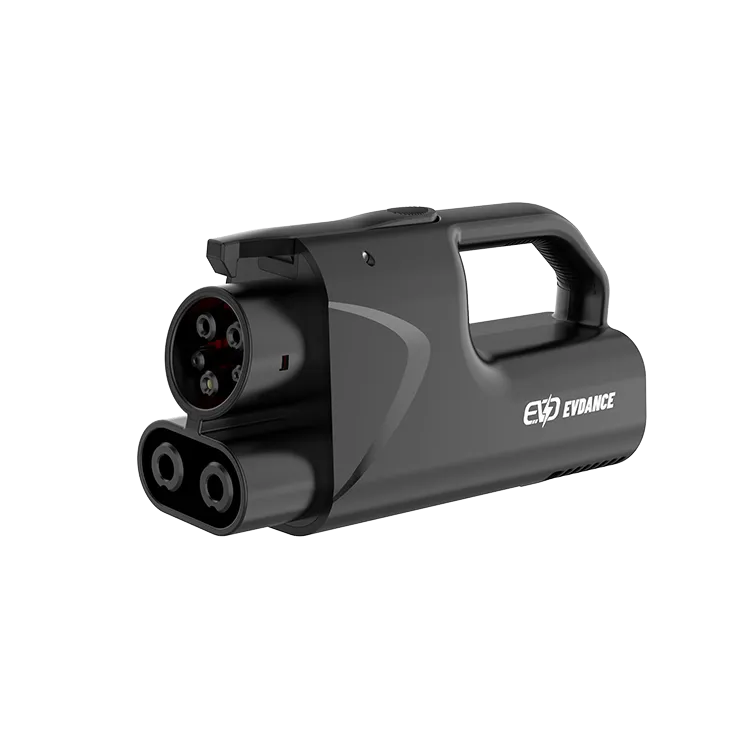
The EVDANCE EV-RHDC30K-L compact DC fast charger (22 kW DC, OCPP 1.6J, IP54) works in the CCS family’s conversation, and the EVDANCE JT09 NACS-to-CCS1 DC adapter (up to 500 A, IP66, with handle) bridges two connectors inside that family — usable only where the vehicle maker approves that adapter for the exact car and the station is open to that car. The boundary to state plainly: EVDANCE sells no CHAdeMO or GB/T charger, and nothing in the range converts between the two languages.

Frequently Asked Questions
Which is better, PLC or CAN?
Neither. Each is its family’s standard design, and both carry the same negotiation. What matters is that your car and the charger share one — a matching question, not a ranking.
Does my home AC charger use either of them?
No. Home AC charging uses the simple pilot signals — the charger announces a current ceiling and the car draws within it, as how home EV chargers work explains. Data conversations belong to DC charging.
Can a software update switch a charger from one language to the other?
No. The communication design is built into the car and the charger at the design level. Updates can fix behaviour inside a family; they do not convert a charger or a car into the other family.
Related Reading
- Does J1772 Work With CCS? CCS Connectors Explained
- What Is J1772? The North American EV Plug Explained
- Are EV Chargers Universal?
- OCPP Explained: What Charge Point Operators Need From EV Charger Hardware

