
There is no honest figure in years. The relay or contactor inside an EV charger — the electrically controlled switch in the power path, as how home EV chargers work shows — lives and dies by how many times it switches, at what current, and in what conditions. The same class of part can wear out within a few years of public-station duty or outlast the wallbox around it in a home garage. That is why manufacturers rate the device inside a design instead of printing a lifespan for the charger, and why the buyer’s useful answers are the warranty and the service terms.
Key Takeaways
- A charger relay’s life is counted in operations under load — there is no honest figure in years.
- Contact erosion, heat and environment wear it out; public duty ages it far faster than home duty.
- The buyer’s real instruments are the design rating (a written question), the 3-year standard warranty, and the service concept.
- Clicking without a start, intermittent starts and a dead unit are report-it symptoms — never open a sealed charger.
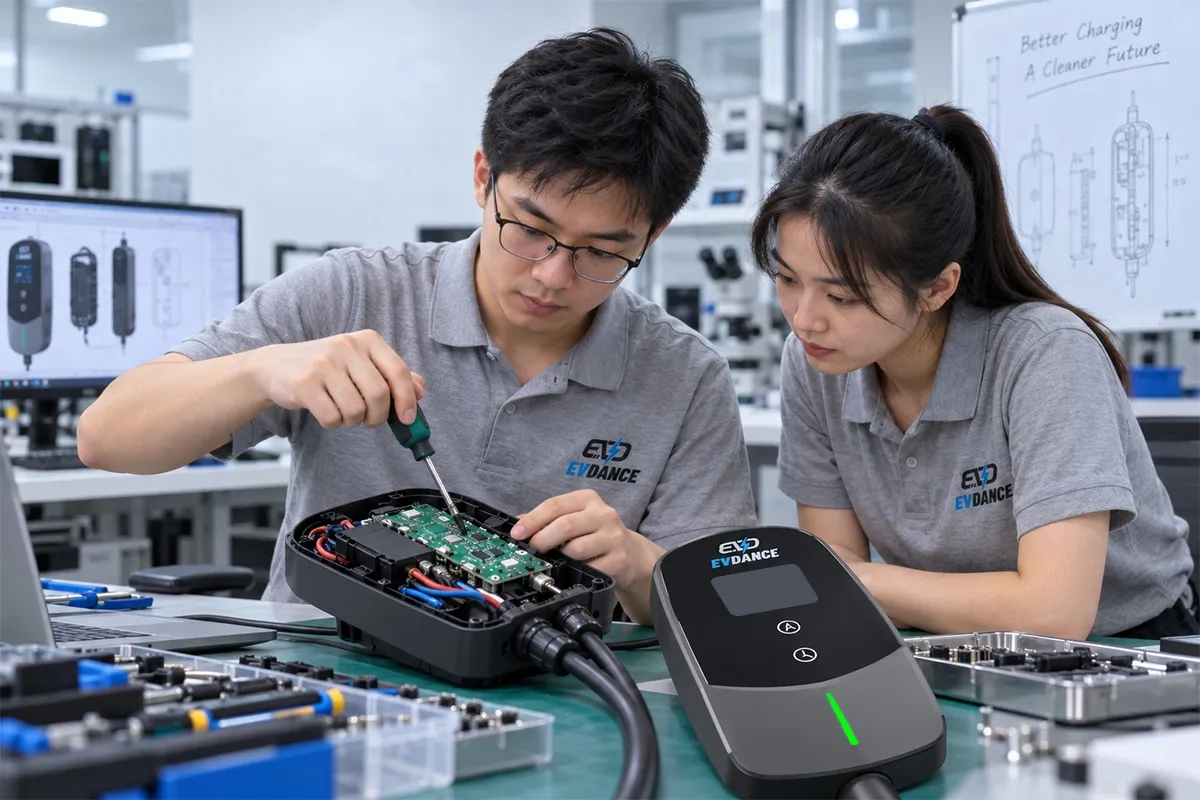
A Life Counted in Operations, Not Years
Every session switches the device at least twice: closed when charging starts, opened when the session ends or a protection acts. Wear accumulates per operation and grows with the current switched. So the calendar is the wrong unit: a home charger switching for one household ages on a different clock from a public unit switching all day, every day.
What Actually Wears Out
| Wear driver | What happens | What it depends on |
|---|---|---|
| Contact erosion | Each make and break draws a small arc; over time the contact faces pit and thin | Operations count and the current switched |
| Heat | A worn contact runs hotter, and heat speeds the erosion that caused it — wear accelerates late in life | Session current, enclosure ventilation and ambient conditions |
| Environment | Dust, moisture and temperature swings age the mechanism and the coil that drives it | Siting and the enclosure’s stated ingress rating |
None of these drivers is visible from outside the cabinet. They explain why lifespan can only be answered for a duty profile, never in the abstract.
The Instruments a Buyer Actually Has
- The design rating. The manufacturer selects the switching device for the charger’s rated duty — a design-file fact. No EVDANCE page names the device inside a model or states an operations rating, so for any brand it is a written question, not a brochure line.
- The warranty. EVDANCE’s standard warranty is 3 years. A device that fails inside it is a warranty conversation with the manufacturer — that stated commitment is the frame a buyer actually holds.
- The service concept. Whether the device is a replaceable service part or part of a larger assembly decides the repair bill later. For a fleet purchase, ask in writing before the order.
Signs the Switching Device May Be Failing
- Repeated clicking with no session starting.
- Intermittent starts — the same car and cable work one day and fail the next.
- A dead charger on a live supply — the breaker and supply check out, but the unit never offers a session.
The response to all three is the same: stop using the unit and report it, with the model and symptoms recorded. A charger is a sealed unit — never open it, and never try to free or bridge a switch. Fault-finding on the supply side belongs to a licensed electrician; the unit itself goes through the manufacturer’s service route.
EVDANCE Chargers and the Switching Question
The EV-ACT5006T wall charger (up to 48 A, NACS, IP65/IP66, ETL/FCC/CE) and the EV-ACS4005T portable charger (9.6 kW, 16/24/32/40 A adjustable, NEMA 14-50P, IP66) are specified on their pages by output, connector and enclosure — not by the switching device inside. If that device matters to your purchase — for a fleet or long-service site — ask us for the model’s service concept in writing via the contact page before you order.
Frequently Asked Questions
Can the relay be replaced on its own?
It depends on the design: on some models it is a service part, on others it belongs to a power assembly that is replaced as a unit. The manufacturer’s service route decides — and the charger is never opened by the user either way.
Is there maintenance that extends relay life?
No user maintenance exists for a sealed switching device. What protects it is correct duty: installation and use within its rating, on a sound circuit.
Does the warranty cover a worn-out relay?
The 3-year standard warranty is the frame for EVDANCE products. Whether a given failure counts as a defect or as wear is decided under the warranty terms, so raise it with the model and symptoms recorded.
Related Reading
- How Do Home EV Chargers Work?
- How Do DC Fast Chargers Work?
- Does an EV Charger Need GFCI Protection?
- EV Charger Certifications Explained: CE, UKCA, UL, ETL, CB and What Buyers Should Ask For

