
In most cases nothing is broken. A 22 kW rating is a three-phase total: the charger carries roughly a third of it on each phase, and a car that charges on a single phase can only take one phase’s share — about 7 kW. The same number shows up when a cable or a setting caps the session instead, so work through the classes below before assuming a fault.
Key Takeaways
- 22 kW is a three-phase total; one phase of it is the roughly 7 kW class.
- A single-phase car, a 7 kW-class car limit, a single-phase cable and a low setting all produce the same number.
- The verdict test is a known three-phase car on the same charger with a three-phase cable.
- A steady fractional rate is a limit doing its job, not a fault signature.

Why the Rating Splits Into Thirds
A three-phase charger does not hold 22 kW on one wire. Its stated current — 32 A class for a 22 kW unit — runs on each of three phases, and the total is the sum of the three. A car whose onboard charger accepts three phases draws on all of them; a single-phase car draws on one, and one phase delivers roughly a third of the total: the 7 kW class. A car that accepts two phases lands in between. Our explainer on single-phase vs three-phase EV charging works through the figures. Note the consistency: a fault gives erratic numbers, while a phase limit gives the same clean fraction every session — information, not a symptom.
The Four Classes That Produce About 7 kW
| Class | What is happening | How it shows itself |
|---|---|---|
| The car charges on one phase | Its onboard charger is single-phase and uses one of the charger’s three phases | The same roughly 7 kW on every three-phase charger |
| The car’s AC limit is in the 7 kW class | Its stated maximum AC rate is about 7 kW by design | The same ceiling everywhere, including on a 32 A single-phase charger |
| A single-phase cable is in the chain | On a socket-version wallbox, the driver’s own cable carries one phase only | Full rate returns with a three-phase cable; the cable’s rating is printed on it |
| The charger is set below its maximum | An adjustable unit was set to a lower current at installation or left there | The set current shows on the unit or in its app, and the session tracks it |
The cable class is the one owners miss: a socket-version wallbox inherits whatever cable each driver brings, and a single-phase cable caps a three-phase car at one phase just as firmly. The CEE plug guide and the portable charger types explainer show how cable ratings are marked.
How to Reach a Verdict
- Read the car’s documents first. Its stated AC maximum and phase count settle the first two classes without touching any hardware.
- Try a car you know accepts three-phase AC on the same charger, with a three-phase cable. Full rate there clears the charger.
- Swap the cable if the wallbox is a socket version and the test car also sits near 7 kW.
- Read the set current on the charger or its app. If it was set low to match the circuit, that pairing is the installer’s design — raise it only with the installer.
Two 22 kW Chargers, the Same Arithmetic
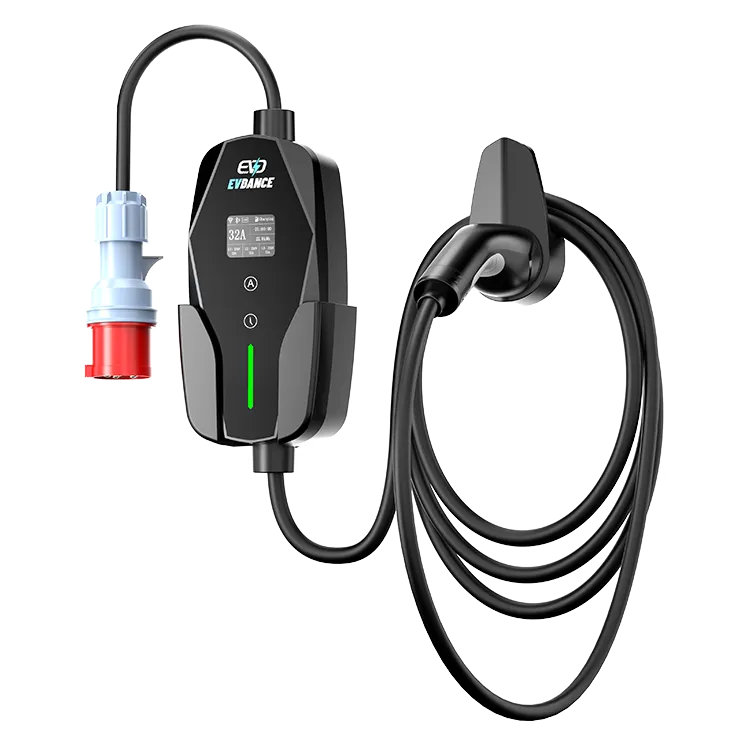
The EV-ACT3204PE is a 22 kW three-phase wallbox with a tethered Type 2 cable, RFID and app control, IP66 and CE. Its socket version is exactly where the cable class appears: the wallbox offers three phases, and the driver’s cable decides how many reach the car. The EV-ACS3205PE is a 22 kW three-phase portable — 32 A three-phase, CEE 32A plug, Type 2, IP66. Neither unit can add phases to a car that does not take them, and neither is faulty when a single-phase car settles at its one-phase share. Session times at each rate are in our 7, 11 and 22 kW charging time explainer.
Frequently Asked Questions
Will a different 22 kW charger charge my single-phase car faster?
No. The phase count belongs to the car: every three-phase charger offers it the same one phase, and the same roughly 7 kW session.
Is a steady 7 kW a fault I should report?
Not by itself. Report it when a car that accepts three-phase power, on a three-phase cable, with the charger set to full current, still sits near 7 kW — and bring those three facts to the maker or your installer.
Can a setting move power from the unused phases to the one my car uses?
No. A setting changes the current offered; it cannot change how many phases the car’s onboard charger connects to.
Related Reading
- Single-Phase vs Three-Phase EV Charging: 7kW, 11kW and 22kW Explained
- How Long Does It Take to Charge an EV at 7 kW, 11 kW and 22 kW?
- Portable EV Charger Types Explained: 10A, 16A, 32A and Three-Phase Models
- Why Is My Electric Car Charging Slowly at Home?

