
Yes — mild warmth spread evenly along a charging cable is normal, because any conductor carrying current for hours warms. What is not ordinary is warmth concentrated at one point: a single hot spot at a kink, under a mat, or at one connector. This page is about reading that pattern. The plain verdicts on hot cables and plugs are in our guide to whether EV charging cables get hot.
Key Takeaways
- Mild warmth spread evenly along the run is ordinary.
- One localised hot spot is never ordinary; it marks a kink, pinch, covered section or hidden damage.
- Judge warmth comparatively: spot against run, end against end, season against season.
- Uncoil fully, route in the open, and treat unexplained change as an inspection trigger.
The Ordinary Pattern: Even, Mild, and Explained
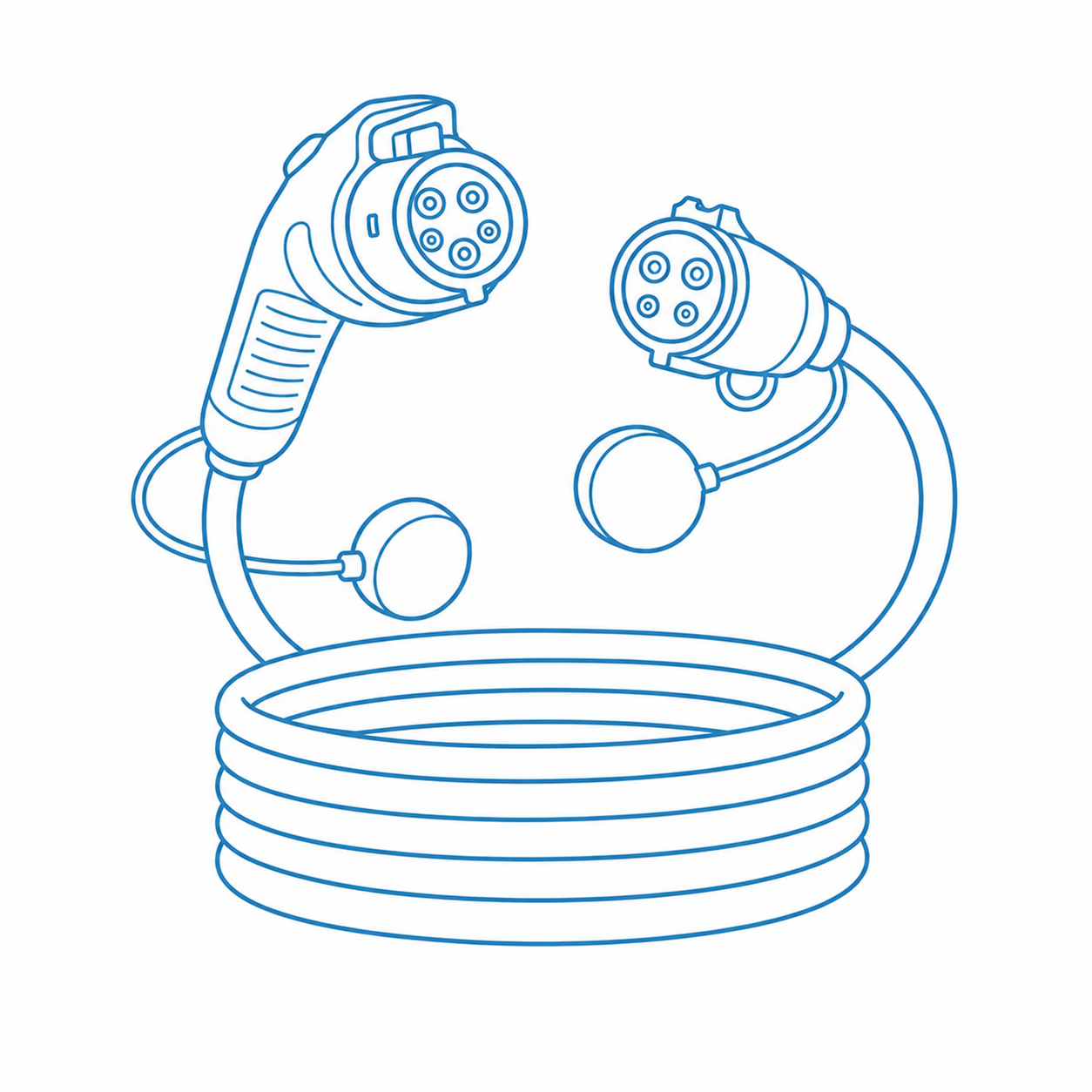
Every conductor resists the current a little. Spread over metres of cable, that resistance shows up as gentle, fairly uniform warmth along the whole run. It grows with the current you ask for and the length of the session. The two ends may feel a touch warmer than the middle, because that is where the contacts live — a small step at each end is part of the ordinary pattern. What it never does is pick one point and heat it far beyond its neighbours.
Patterns and What Each One Points To
| Pattern you find | What it points to | Response |
|---|---|---|
| Mild warmth, roughly the same along the whole run | Ordinary conductor warmth at working current | Nothing to do; note it as your baseline |
| One point mid-run clearly hotter than the rest | A local cause there: a kink, a pinch, a covered section, or damage | Stop charging on that cable; inspect the point |
| Hot only at the car end | The contact story at that joint — connector or inlet | Stop and inspect; the cables-get-hot verdicts apply |
| Hot only at the charger end | The same contact story at the other joint | Stop and inspect that connector and its seat |
| The whole run much warmer when it is coiled | Trapped heat — a coiled run sheds warmth poorly | Uncoil fully before high-current sessions |
The comparisons do the work: spot against run, end against end, coiled against laid out. No number or hand test settles it — the pattern does.
Why One Point Heats When the Rest Does Not
A localised hot spot means something changed at that exact place:
- A kink or tight bend. Repeated sharp bending stresses conductor and insulation at one point, which then resists more than the straight runs either side.
- A covered section. Cable under a mat or stored items cannot shed heat, and is often also pinched — under a door edge or a tyre track.
- Hidden damage. A section driven over or crushed can be injured inside while the outside looks unremarkable; the heat is the injury announcing itself.
- A coiled section. Turns of cable lying on each other warm each other; a mostly coiled run concentrates its warmth in the coil.
Warmth That Changed Is a Signal Too
The most useful comparison is your own history. Same car, same charger, same setting, same route — if the run feels warmer than last season, something changed: a contact is ageing, a section has taken damage, or the routing differs. Treat an unexplained change as a reason to inspect. The reverse confirms a cause too: a cable that runs cooler once uncoiled and moved off a pinch point has told you what was wrong.
Laying the Cable Out Is Part of Using It
The EV-ACS3210T is a 32 A NACS portable charger at about 7.7 kW on a NEMA 14-50P plug, IP66, its current settable in six steps from 10 to 32 A. The EV-ACT5006T is a 48 A Level 2 wall charger with a 25 ft NACS cable, IP65/IP66. On either, cable management is the user’s part: laid out in the open, off pinch points, uncoiled at high current, the run sheds its ordinary warmth as intended.
Frequently Asked Questions
My cable is warm at the car end only. Is that ordinary?
A small step there is expected — the contacts live at the end. A car end clearly hot while the run stays mild is a contact problem, not cable warmth: stop and inspect it.
Can I run the cable under a garage mat to protect it?
That trades one risk for a worse one: a covered section cannot shed heat and is usually pinched as well. Route the cable in the open instead.
Should I join two cables or use an extension to reach the car?
Every added joint is another contact that can heat, and ordinary extension leads are not a workaround for EV charging, as our advisory on extension cord safety explains. The fix for reach is charger placement or one longer cable.
Related Reading
- Do EV Charging Cables Get Hot?
- Can You Extend an EV Charging Cable?
- Portable EV Charger News: Why Extension Cords Are a Code Violation, Not a Workaround

