
None, in the sense the question usually means. Travel adapters and stacking pin-converters are not built or rated for a portable EV charger, which draws its full set current continuously for hours. What works is a portable whose stated plug already matches your sockets — a Schuko or CEE version — or public charging.
Key Takeaways
- No travel or stacking adapter is a safe bridge for a portable charger in Europe: the added joint is unrated and unmonitored.
- Wall end and car end are different problems; Europe’s car end is Type 2 and rarely needs anything.
- Buy the charger in the plug version that matches your sockets — Schuko or CEE — and confirm it before ordering.
- Where your plug does not match, use public charging rather than adapting it.

Why the Adapter Fails This Job
Charging is not an appliance load. A kettle draws hard for three minutes; a portable charger draws at its set current for the whole session, and every connection carries it throughout. An adapter adds one more contact pair where connections are weakest: a blade held by spring pressure, a small contact area, monitored by nothing. Heat builds at joints like that, slowly and out of sight.
Two further problems are structural: a travel adapter’s printed rating describes short appliance loads, not continuous EV duty; and a portable’s plug is part of the unit as tested and listed, so an unlisted part puts an uncertified joint in the certified configuration. Stacking two adapters compounds both. Our checks on whether EV charging adapters are safe set out what a legitimate adapter must prove — a travel adapter proves none of it.
Two Ends of the Charger, Two Different Problems
| End of the charger | The problem in Europe | The working answer |
|---|---|---|
| Wall end (the mains plug) | Socket shapes differ by country: Schuko across most of the continent, CEE on sites and in workshops | Order the charger in the matching plug version — never an adapter in between |
| Car end (the connector) | Almost none: Type 2 is Europe’s AC standard at posts and inlets alike | A Type 2 portable plugs straight in; a socket post takes the car’s own Type 2 lead |
The car end is where confusion starts, because connector adapters genuinely exist there — a separate category with its own checks. The wall end is this question’s subject, and there the answer stays no: the plug your charger ships with is the plug it charges through. See our guide to Type 2 in Europe and NACS in North America and our CEE plugs guide.
What to Buy, or Use, Instead
- A portable in the right plug version. European-market portables are sold with the plug decided at order time — Schuko for domestic sockets, CEE for site and workshop sockets. Confirm the version before ordering.
- A CEE-plug unit where CEE sockets are the pattern. Campsites, farms and workshops provide CEE sockets because they are built for sustained loads.
- The destination’s public charging. Where your plug does not match, Type 2 public posts need no portable at all.
- A proper socket where you charge regularly. A portable used nightly deserves the right socket on the right circuit, fitted by an electrician.
The EVDANCE Route: No Adapter in the Chain
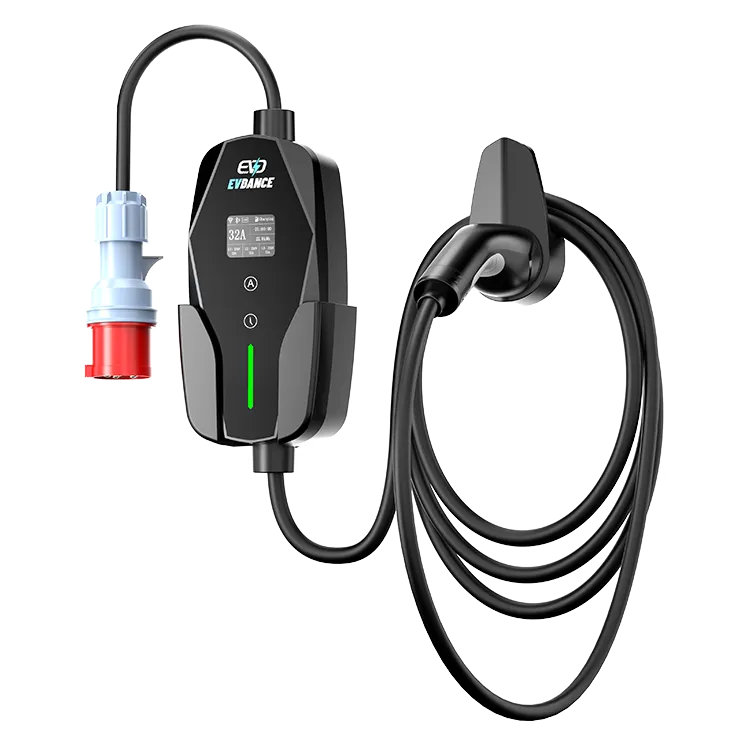
The EV-ACS3210E is a 32 A Type 2 portable charger: single-phase, about 7 kW, adjustable from 10 to 32 A in six steps, with app control and energy monitoring, an IP66 housing and a 7.5 m cable. It is supplied in European plug versions, Schuko and CEE among them; nothing sits between its plug and the wall. Where three-phase CEE sockets are available, the EV-ACS3205PE is a 22 kW three-phase portable with a CEE 32 A plug built in. The full range is on the products page.
Frequently Asked Questions
My travel adapter is rated 16 A. Is that not enough?
The number is not the whole story. That rating describes short appliance loads; the part is not listed for EV charging and its joint is monitored by nothing. For a load held at full draw for hours, a part not stated for EV duty is a no.
What about Type 2 adapter cables sold for imported cars?
Those work on the car end, bridging a European socket post to a different inlet for AC charging — a different category, with its own rating and approval checks. They do nothing for your portable’s plug.
The place I am staying has only Schuko sockets. What do I do?
Ask permission first, then use a charger whose plug is a Schuko version, set at or below what the circuit offers. Our explainer on charging from a normal socket covers that case. With a different plug, public charging is the answer — not an adapter.
Related Reading
- Are EV Charging Adapters Safe?
- CEE Plugs Explained: Choosing 16A or 32A for a Three-Phase Portable EV Charger
- Charging a Tesla: Type 2 in Europe, NACS in North America
- Can I Charge an Electric Car From a Normal Socket?

