
Choose it by measuring the route, not the gap. Walk the path the cable will take — from the charger’s mount or the portable’s socket, along edges, around the end of the car, to the charge port — in both parking directions, with slack at both ends. That number, not the straight-line distance, is the length to buy. Our cable length guide compares the standard lengths on sale; this article is the measuring protocol that decides whether that comparison ends well.
Key Takeaways
- Measure the route the cable will walk — both parking directions, along edges, with slack — never the straight-line gap.
- The route spends cable on the drop, the edges, the car’s own length and the slack; a tape reading at the limit is a shortfall.
- Buy for the worse direction and the second car’s port position: the mount can move later, the cable length cannot.
- Match the measurement to stated factory lengths, and where a listing states none, get the figure in writing.

The Protocol, Step by Step
- Fix the start point first. A tethered cable starts at the wallbox’s mount; a portable’s starts at its socket. If neither exists yet, decide where they will go before measuring — moving the start point later invalidates the measurement.
- Park the car where it will live. Real position, real orientation. If you park nose-in some days and reversed on others, both are real: measure both.
- Walk the route with a tape or string. Down from the start point, along the edge, around the car’s end, up to the port — out of the walking and driving lines, never the diagonal.
- Add slack at both ends. The connector must arrive with a gentle curve and no tension. A route measuring exactly the sold length falls short.
- Round up to a length actually sold. Chargers come in a small set of factory lengths. Between two, the longer one is the order — or the start point moves.
Where the Route Spends Cable
| Route segment | What it consumes | Why it gets undercounted |
|---|---|---|
| The drop from the mount or socket | The vertical run before the cable reaches the ground | Floor plans are measured flat; cables are not |
| The building exit and edge routing | Out of a door or along a wall, then along an edge | Edges are longer than the diagonal the eye measures |
| Alongside the car | Up to a full car length when the port is at the far corner | The port’s corner flips with parking direction |
| Slack at both ends | The curve at the connector and the drop at the charger | A taut cable reads as “reached” on paper and fails in use |
Buy for the Worse Direction
The asymmetry is the argument: a charger’s position can be changed later by an electrician, but a tethered cable’s length is fixed at order time. So measure against the harder cases. A second car may carry its port on the opposite corner; a parking direction used only in winter still counts. If the worse direction exceeds the length you were about to buy, the choices are the longer cable, a start point serving both directions, or one direction that will not charge. Deciding on paper is free; after delivery it is not. Whether the charger is tethered or socketed changes who owns this problem: a socketed unit lets the lead be chosen, and replaced, separately.
The Lengths EVDANCE Actually Sells
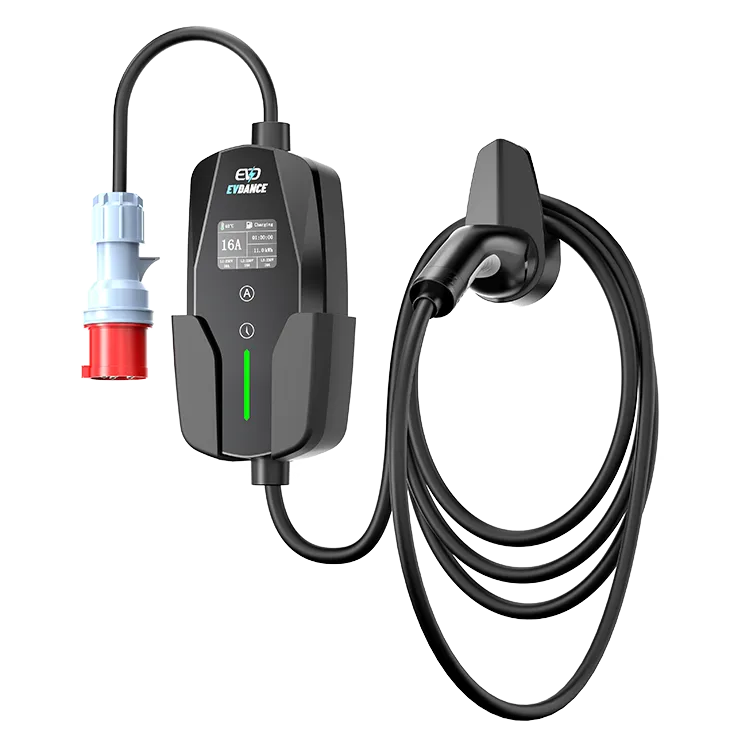
Stated lengths are the menu the measurement is matched against. The EV-ACT5006T wall charger is stated with a 25 ft cable. The EV-ACS3210E portable is stated at 7.5 m, the three-phase ACS1605PE at 7.6 m. The EV-ACS4005T is the range’s genuine order-time choice, at 25 ft or 28 ft. Two cautions: a stated length is the cable itself, connector to connector — your route spends it. And some listings state no length at all; for those, get the figure from the manufacturer in writing before ordering. The full range is on the products page.
Frequently Asked Questions
My tape reads exactly 7.5 m. Is the 7.5 m cable enough?
Treat it as too short. The tape followed the route in a straight pull; the real cable must curve at both ends and hang without tension. A reading at the limit means ordering the next length up, or moving the start point closer.
Can I measure before the charger is installed?
Yes — and you should: the mount position is an input to the decision, not a detail after it. Fix it with your installer, measure from it, and let the result confirm both position and length.
Can I just extend a cable that turns out short?
No. Joining leads and extension cords are not answers for a continuous load — our piece on extending an EV charging cable explains why. The fixes are the longer factory length or a better-placed charger.
Related Reading
- EV Charger Cable Length Guide: 5 m, 7.5 m or Longer?
- Which EV Charging Cable Do I Need?
- Can You Extend an EV Charging Cable?
- Tethered vs Socketed Wallbox Chargers

