
Yes. A charger factory can put your brand on its chargers two ways: private-label an existing certified model, which is where most projects start, or commission deeper work built to an agreed specification. Most guidance is written for people who will resell the chargers. This article covers the other common case — installers, property groups, fleets and employers who brand chargers they install and run themselves — because the branding work is the same, but the duties land differently when the chargers stay yours.
Key Takeaways
- Yes: private-label an existing certified model, or commission deeper work to a written scope.
- You do not need a resale channel — installers, fleets and property groups brand chargers they run themselves.
- The certificate names its holder, not automatically you; confirm the arrangement in writing.
- In your users’ eyes, warranty and support belong to the name on the unit. Plan for that before the first order.
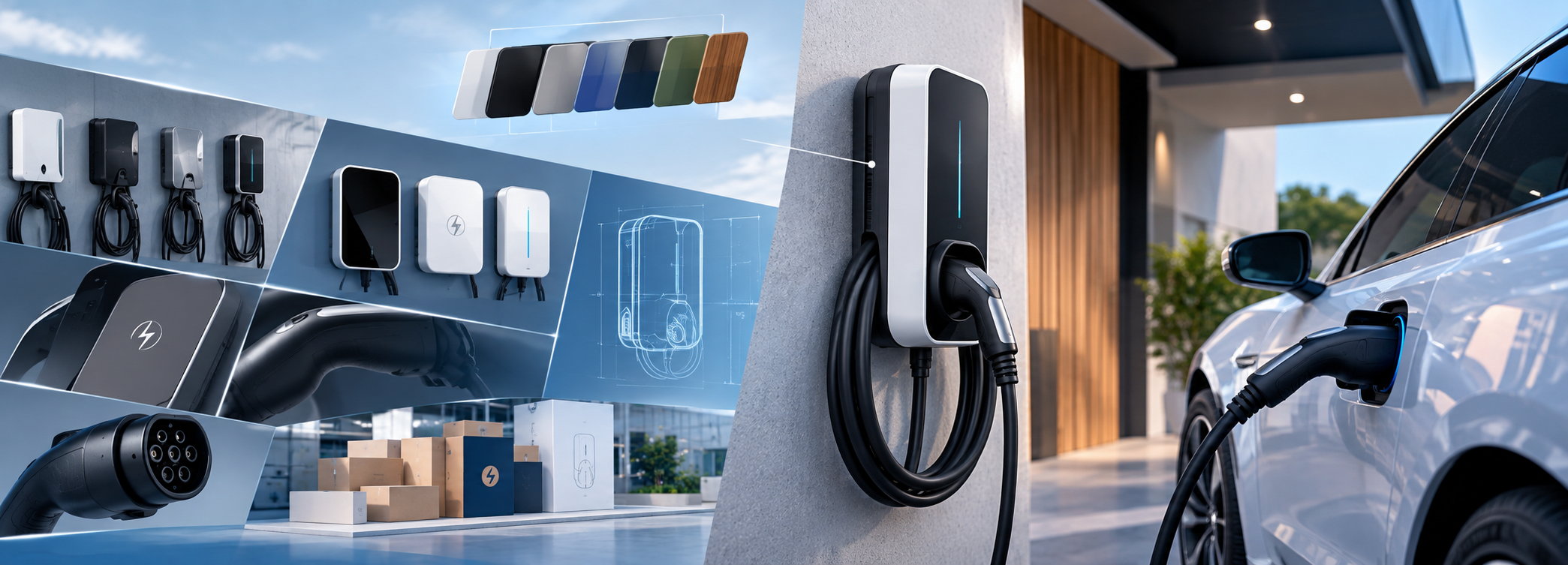
The Two Routes, in Short
| Route | What you get | What decides it |
|---|---|---|
| Private label an existing model | A proven, already certified charger with your logo, colours, packaging and manual | The factory’s stated offer — EVDANCE’s, for example, starts from 100 units |
| Commission deeper customisation | Configuration or design changes beyond the standard offer | The factory’s written scope: what it will change, and what the change does to certification |
Which surfaces can carry a brand — housing, cable, screen, app, packaging — is covered in our guide to logo and branding options for private-label chargers. Before any of it, one asset comes first: a name you are entitled to use — a trademark registered, or at least filed, in your markets; our article on registering your trademark before ordering private-label chargers explains the order of operations.
What Does Not Change When the Chargers Stay Yours
Skipping the retail shelf removes the marketplace checks. It does not remove the duties that follow a name on hardware:
- The certificate still names a holder — not automatically you. The listing behind your branded unit names the model and the company that holds the file. Whether your brand can be added, and on what terms, is a written-confirmation item with the factory, never an assumption; who owns the certificate works through the options.
- Your users come to your name. A driver, tenant or employee with a failed charger contacts the brand on the unit — you. Warranty accountability sits with your brand in the user’s eyes; what you can recover from the factory is whatever your supply agreement says, so that agreement is part of the branding decision.
- The documents carry your details. Manuals, labels and support answers carry your name. Whoever answers your support line needs the factory’s documentation for the exact model, not a brochure.
Questions to Put to Any Factory
- Whose name is on the certificate for the exact model and configuration I am ordering?
- Which branding layers apply to this model, and can I have the list in writing?
- What does the minimum order cover at the depth I want?
- Who fronts warranty to my users, and what does the supply agreement give me behind that?
- If the base model changes or is discontinued, what happens to my branded line?

Branding Your Own Chargers With EVDANCE
EVDANCE is a Shenzhen EV charger manufacturer founded in 2011, with its own factory, exports to more than 30 countries and a 3-year standard warranty. Its private-label route starts from 100 units through the OEM and private-label program — a scale that fits a property portfolio, an installer’s standard offer or a fleet’s depots as readily as a resale range. A wallbox such as the EV-ACT5006T — up to 48 A, hard-wired or NEMA 14-50P, NACS, 25 ft cable, IP65/IP66, ETL/FCC/CE — is the kind of unit an installer brands once and fits repeatedly. Put the questions above to us through the contact page and judge the answers in writing.
Frequently Asked Questions
Do I need to be a reseller to put my brand on a charger?
No. Installer firms, fleets, property groups and employers brand chargers they deploy at their own sites. The factory route is the same private-label arrangement; what differs is that your users, not retail customers, meet the brand.
Will the safety certificate be in my name?
Not automatically. Certificates name a holder, usually the factory for the base model. Whether your brand is added to the file is a specific arrangement to confirm in writing before you order, not a default.
Is a 50-unit start realistic for a small operation?
It is EVDANCE’s stated private-label starting point, and it is deliberately sized so one proven model can be branded first — a single site’s rollout or an installer’s standard unit — before any wider commitment.
Related Reading
- Logo and Branding Options for Private-Label EV Chargers
- Who Owns the Certificate in a Private-Label EV Charger?
- OEM and Private-Label EV Chargers: A Complete Guide for Brands
- Private Label vs Reselling a Branded EV Charger: Pros and Cons
