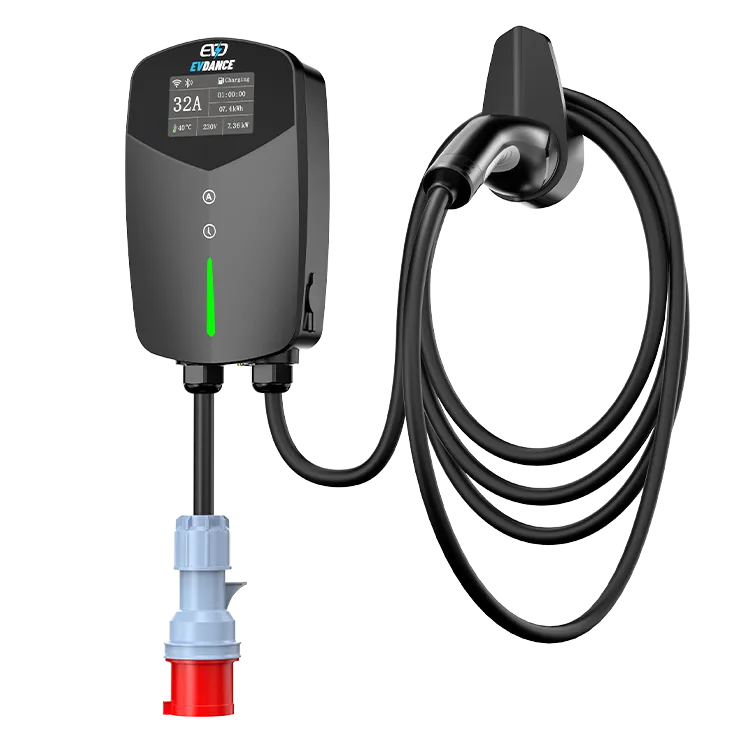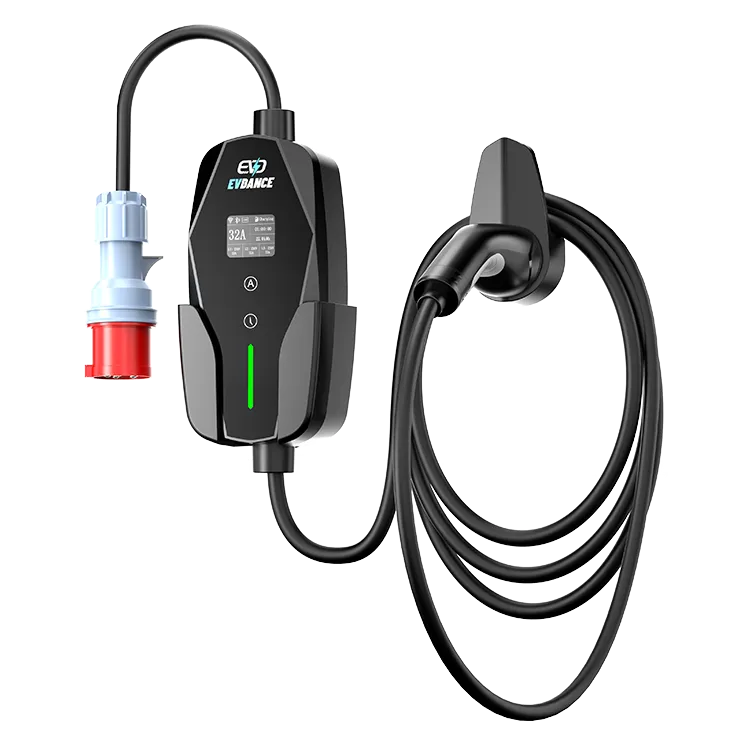
In Germany, Austria, Switzerland, the Netherlands, Scandinavia and much of Central Europe, the red industrial socket in a garage, workshop or barn is often the easiest route to fast AC charging. A three-phase portable EV charger with a CEE plug can turn that socket into an 11 kW or 22 kW charging point without installing a wallbox. Choosing between the 16A and 32A versions depends on the socket, not on the car.
What “CEE” Means
“CEE” plugs are industrial plugs and sockets built to IEC 60309. They are colour-coded by voltage, so the socket type tells you what supply you have before you connect anything.
| Colour | Nominal voltage | Typical use |
|---|---|---|
| Blue | 200–250V | Single-phase outdoor and camping supplies |
| Red | 380–480V | Three-phase industrial and workshop supplies |
| Yellow | 100–130V | Site tools in some markets |
Three-phase portable EV chargers use red 5-pin plugs: three phases, neutral and earth.
16A vs 32A at a Glance
| CEE 16A red | CEE 32A red | |
|---|---|---|
| Charging power (400V) | About 11 kW | About 22 kW |
| Typical socket location | Garages, workshops, farms | Workshops, construction sites, commercial garages |
| Physical size | Smaller plug | Larger plug, not interchangeable with 16A |
| Cars that benefit | Most three-phase EVs (11 kW onboard charger) | EVs with a 22 kW onboard charger |
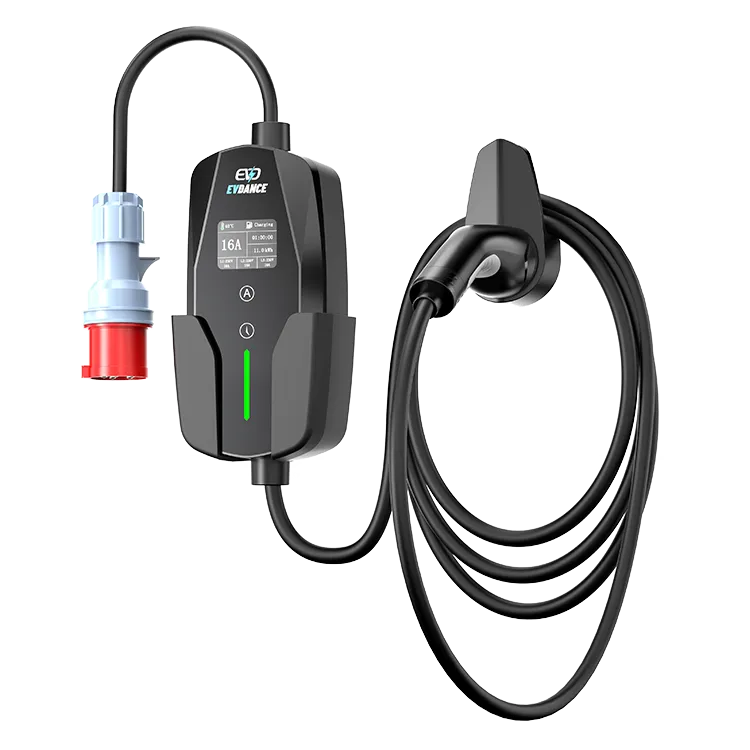
Choose by the Socket, Not the Car
A 16A plug physically cannot fit a 32A socket, and the reverse is also true, which prevents most accidents. The key rule is never to use an adapter that lets a 32A charger draw 32A from a 16A socket. If your customers mostly have 16A red sockets, the 16A version is the right product even if their car could accept 22 kW. Most cars on the road charge at 11 kW on AC anyway.
Safe Use on Sites and Farms
- Check that the socket and its circuit breaker are rated for the charger’s current and in good condition.
- Keep the control box off the ground and away from standing water, even with an IP66 rating.
- Do not coil a long cable tightly while charging at high current.
- For permanent daily use, consider a fixed 11 kW or 22 kW wallbox on a dedicated circuit.
EVDANCE CEE Portable Chargers
EVDANCE builds the ACS1605PE (11 kW, CEE 16A) and the EV-ACS3205PE and EV-ACT3204PE (22 kW, CEE 32A), all with Type 2 connectors and available for private label. See our German and Austrian market pages for local rules.
Related Reading
- Type 2 vs J1772 vs NACS: Which EV Charger Connector Does Your Market Need?
- Charging a Tesla: Type 2 in Europe, NACS in North America
- EV Charging News: T&E Finds EU Charging Has Outpaced EV Sales in All but One Country
Key Takeaways
- Red CEE plugs (IEC 60309) indicate a 400V three-phase supply.
- CEE 16A supports about 11 kW; CEE 32A supports about 22 kW.
- Choose the plug by the socket your customers have, never by the car’s maximum.
- Never use adapters that let a charger draw more current than the socket is rated for.
Sources & Standards
- IEC 60309 — Plugs, socket-outlets and couplers for industrial purposes
- IEC 62196-2 — Type 2 vehicle connector
- IEC 61851-1 — Electric vehicle conductive charging system