
On a single-phase 230 volt supply, a 7 kW charger draws about 30 to 32 amps, which is why 7 kW home chargers are sold as 32 amp units. On a three-phase supply, the same 7 kW is spread across the phases at only about 10 amps each. Amps are watts divided by volts, so the supply type changes the current, not the power.
Key Takeaways
- A 7 kW charger draws about 32 amps single-phase, or about 10 amps per phase on three-phase.
- Amps are power divided by volts; the supply type changes the current, not the kilowatts.
- Most nights need only a few amps; 32 amps is for fast overnight refills.
- U.S. breakers are sized at 125 percent of the charging current.
The arithmetic
Current is power divided by voltage. For three-phase power, each phase carries a third of the load:
- Single-phase: 7,000 W ÷ 230 V ≈ 30.4 A. Chargers are built and set to 32 A.
- Three-phase: 7,000 W ÷ (1.73 × 400 V) ≈ 10 A per phase.
- North America: 7,000 W ÷ 240 V ≈ 29 A, typically a 32 A charger setting.
| Setup | Voltage | Amps for about 7 kW | What installers fit |
|---|---|---|---|
| Single-phase (Europe, UK) | 230 V | About 32 A | 32 A charger on a dedicated circuit |
| Three-phase (Europe) | 400 V | About 10 A per phase | 16 A charger, giving about 11 kW, is the common size |
| Split-phase (North America) | 240 V | About 29 A | 32 A charger on a 40 A breaker |
These are continuous currents. In the U.S., the National Electrical Code treats EV charging as a continuous load, so the breaker is rated at 125 percent of the charger current: a 32 amp charger needs a 40 amp breaker. Our breaker sizing guide lists the standard pairings.
How many amps does an EV actually need?
Far less than the maximum, most nights. Need is set by how much energy you must replace and how long the car is parked:
- Replacing 10 kWh over 10 hours takes only 1 kW — about 4 to 5 amps at 230 V.
- A typical 30 to 40 mile day uses about 8 to 12 kWh. Spread over eight hours, that is roughly 6 amps single-phase.
- The full 32 amps matters on the nights you arrive nearly empty and need a full battery by morning.
This is why adjustable chargers help: the same unit can run at 10 amps on a shared circuit and at 32 amps on a dedicated one. A licensed electrician should confirm what your panel and wiring can supply continuously.

Adjustable-current chargers from EVDANCE
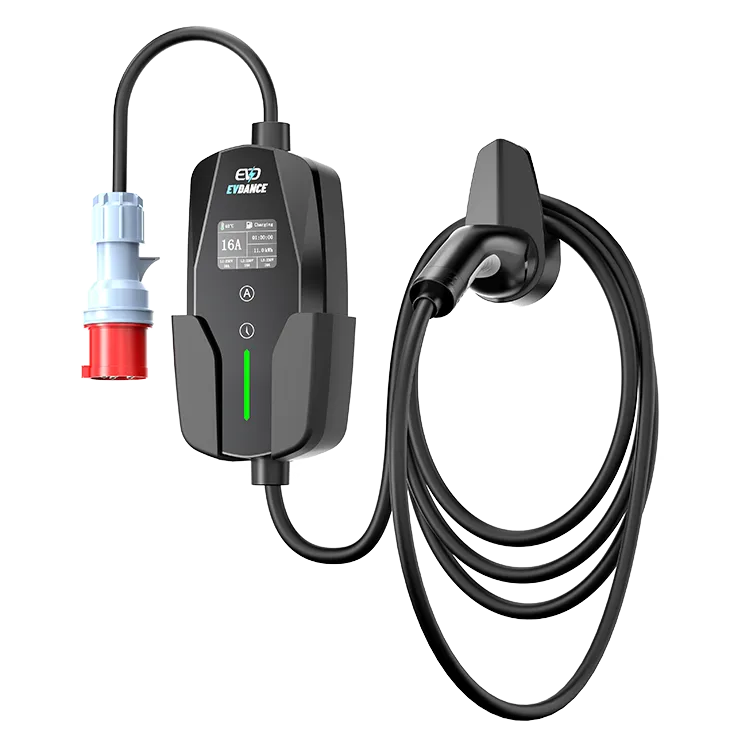
The EV-ACS3210T portable charger adjusts from 10 to 32 amps in six steps, at about 7.7 kW maximum, which lets an installer match the draw to the circuit. For three-phase sites, the ACS1605PE delivers 11 kW at 16 amps per phase through a CEE plug.
Frequently Asked Questions
Does a 7 kW charger need a 32 amp breaker?
In the U.S., a 32 amp continuous charger load needs a 40 amp breaker under the NEC 125 percent rule. Elsewhere, the protective device follows local rules and the charger rating; your installer confirms it.
Can I run a 7 kW charger at lower amps?
Yes, if the charger offers current settings. Lower amps mean proportionally slower charging — 16 amps gives about 3.7 kW single-phase — but the same total energy overnight, if the car stays parked long enough.
How many amps is a 22 kW charger?
On three-phase power, 32 amps per phase. On a single-phase supply the 22 kW rating cannot be reached; the charger falls back to about 7.4 kW at 32 amps.
Related Reading
- How Many Amps Does an EV Charger Need?
- What Size Breaker Do I Need for an EV Charger?
- Single-Phase vs Three-Phase EV Charging: 7kW, 11kW and 22kW Explained
- How Many kW Is a Level 2 Charger?

